Productivity
Weekly Review: A 30-Minute System to Reset Your Life
A 30-minute weekly review helps you close the past week, inspect money, schedule, health, and goals, then choose a realistic plan for the next seven days.
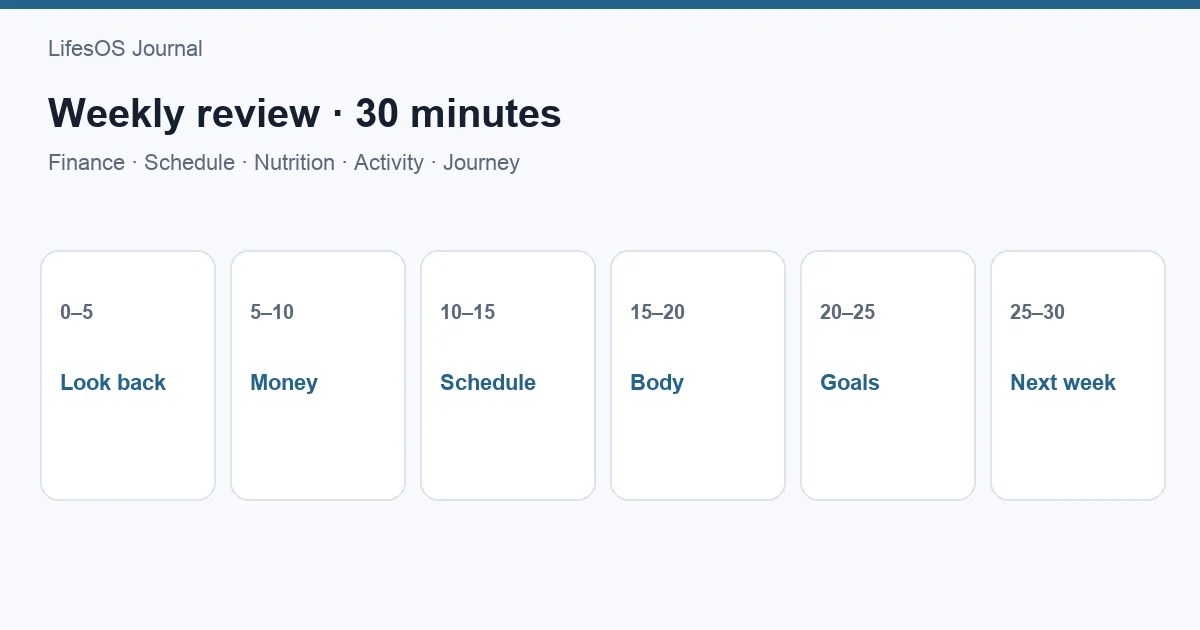
A weekly review is a 30-minute checkpoint that turns the past seven days into a better plan for the next seven. Spend five minutes reviewing what happened, five on finances, five on the coming schedule, five on nutrition and activity, five on goals and personal progress, and five building next week's plan. Finish with no more than three outcomes and place them on the calendar.
The review is not a performance score or a complete life audit. It is a regular place to notice patterns, close small loops, and make tradeoffs before the week gets busy. Use the timed framework below as written for four weeks, then shorten or customize the parts that do not improve decisions.
Why a weekly review works
Daily plans operate too close to the action to reveal many patterns. One rushed lunch may mean little; four rushed lunches may explain low afternoon energy and repeated delivery spending. One postponed workout may be sensible; three may show that the planned time never fits. A weekly view turns scattered events into evidence.
A review also closes the gap between domains. An overloaded calendar affects meals. A late bill affects weekend plans. Poor sleep changes the kind of work that fits Tuesday morning. Looking at each area briefly helps you plan the same finite time, money, and energy once rather than making separate plans that compete.
If you need help choosing the right cadence, compare a daily review vs weekly review. A daily check adjusts execution; this weekly process reassesses direction.
Prepare in two minutes
Choose a consistent time—Friday afternoon, Sunday evening, or Monday morning—and protect a 30-minute calendar block. Gather only the inputs you will use:
- Last week's and next week's calendar
- Active task or project list
- Bank or spending summary
- Meal, nutrition, sleep, or activity notes you already track
- Current goals or journey milestones
- A place to record decisions
Do not create new tracking work solely to feed the review. If a data point is unavailable, use a short observation and continue. Set a timer for each segment; unresolved work becomes a scheduled follow-up, not a reason for the review to consume the morning.
The 30-minute weekly life review
| Time | Domain | Finish with |
|---|---|---|
| 0–5 | Previous week | One win, one lesson, open loops |
| 5–10 | Finance | Bills confirmed and one money decision |
| 10–15 | Schedule | Constraints and available capacity |
| 15–20 | Nutrition and activity | One supportive setup action |
| 20–25 | Goals and journey | Next meaningful milestone |
| 25–30 | Next week | Up to three scheduled outcomes |
0–5 minutes: close the previous week
Scan the calendar from seven days ago to today. Review completed work, notes, and tasks that remain open. Ask:
- What moved forward?
- What was harder or easier than expected?
- What did I promise someone?
- What keeps returning without progress?
- What can be deleted, delegated, or renegotiated?
Record one win and one useful lesson. Keep them specific: “Protected two 60-minute writing blocks” and “Back-to-back afternoon calls left no energy for training.” Then capture open loops. If a task takes less than two minutes, you may close it; otherwise clarify its next action and move on.
Avoid turning this segment into inbox cleanup. The purpose is to understand the week, not process every message. If the backlog needs 45 minutes, schedule a separate block.
5–10 minutes: review finances
Check current balances, transactions that need attention, bills due before the next review, and one or two flexible spending categories. Compare actual spending with the plan, but investigate only meaningful differences. Confirm that enough cash is available on the right dates.
| Check | Question | Possible action |
|---|---|---|
| Balances | Will priority bills clear? | Move money or adjust optional spending |
| Transactions | Any duplicate or unknown charge? | Verify and contact the provider |
| Categories | Where is spending above plan? | Change this week's limit or setup |
| Upcoming costs | What arrives in the next 14 days? | Fund or schedule it |
| Savings | Did the planned transfer happen? | Resume or revise the amount |
Finish with one decision: lower dining spending by $40, transfer money for insurance, cancel an unused subscription, or leave the plan unchanged. A review that confirms the plan is also useful.
10–15 minutes: scan the schedule
Look 7–14 days ahead. Add fixed appointments, deadlines, travel, caregiving, and preparation time. Check for double bookings and transitions. A meeting across town occupies more than its listed 60 minutes; include travel and recovery.
Estimate discretionary capacity only after fixed commitments, sleep, meals, and basic household needs are visible. Identify your strongest open blocks and protect them for meaningful work. Keep buffers around uncertain or demanding days.
This segment is not yet where you fill every gap. It establishes the container. For a fuller method, use how to plan your week. If logistics need attention first, the Sunday reset checklist offers a practical household reset.
15–20 minutes: check nutrition and activity
Review patterns you can act on, not every calorie or workout detail. Consider meal timing, grocery availability, protein or produce consistency, movement, training sessions, sleep timing, and energy. Ask what the week made easy and what it made difficult.
- Which days lacked an available meal?
- When did energy feel strongest and weakest?
- Did planned activity fit the schedule?
- What recovery or sleep constraint needs space?
- What one preparation step would help most?
Finish with one setup action: add two easy lunches to the grocery list, place training on lower-meeting days, prepare a water bottle, schedule a walk with a friend, or protect an earlier bedtime. This is planning support, not medical assessment.
20–25 minutes: review goals and your journey
Read your current goals and ask whether they still deserve capacity. For each active goal, identify evidence of progress, friction, and the next meaningful milestone. A goal such as “improve fitness” is too broad for next week; “complete two planned strength sessions” creates a usable commitment.
Limit active goals. If five projects require their own best hours, the calendar will expose the conflict. Pause, sequence, or reduce scope rather than distributing tiny amounts of attention to everything.
| Goal | Evidence this week | Next milestone | Decision |
|---|---|---|---|
| Complete course | Finished module 3 | Submit module 4 exercise | Schedule Wednesday |
| Build emergency fund | Transfer completed | Reach $1,500 | Continue automatic transfer |
| Run consistently | One of three runs | Two short runs | Reduce target and change timing |
A journey includes more than formal targets. Note one relationship, experience, or personal interest that deserves attention. Progress can mean maintenance, recovery, or deciding not to pursue something.
Open your LifesOS Weekly Report and look for one cross-domain pattern worth carrying into next week's plan.
25–30 minutes: build the next week
Choose no more than three outcomes. An outcome is a result, not a category: “Send the proposal,” “Prepare four weekday lunches,” or “Resolve the insurance renewal.” Give each outcome a concrete next action and calendar space.
- Select the three outcomes.
- Match demanding work to strong open periods.
- Add preparation and travel.
- Place health, household, and personal commitments.
- Keep at least one meaningful buffer.
- Write what you will drop if the week loses capacity.
Finish by checking that the plan can physically fit. A calendar crowded to 100% has no room for delays or normal human variation. Planning 60–75% of truly discretionary time is often more resilient.
WEEKLY LIFE REVIEW CHECKLIST
Previous week
- Scan the last seven days of calendar and tasks.
- Record one win and one lesson.
- Capture promises and unresolved loops.
- Delete, delegate, or renegotiate stale work.
Finance
- Check balances and unusual transactions.
- Confirm bills before the next review.
- Compare key categories with the plan.
- Make one money decision.
Schedule
- Look ahead 7–14 days.
- Add fixed commitments, travel, and preparation.
- Resolve conflicts.
- Identify strong work blocks and buffers.
Nutrition and activity
- Review meal, energy, sleep, and movement patterns.
- Notice the main friction point.
- Choose one setup action.
Goals and journey
- Check progress evidence.
- Pause goals that no longer deserve capacity.
- Define the next milestone.
- Include one relationship or personal priority.
Next week
- Choose up to three outcomes.
- Define and schedule next actions.
- Leave open capacity.
- Write a fallback plan.
Example outputs from one review
Jordan's review finds that lunch purchases rose on meeting-heavy days, a medical bill is due Thursday, and a course project has stalled. The next week does not become a 20-item improvement plan. Jordan chooses three outcomes: pay the bill, submit the course exercise, and prepare lunch for Monday through Wednesday.
The schedule places the exercise Tuesday morning, confirms the bill Tuesday afternoon, and adds a 20-minute Sunday food setup. Thursday evening stays open because the day already contains several meetings. One review coordinates money, health, learning, and recovery without pretending each has separate capacity.
If you only have 10 minutes
Use two minutes for the previous week, one for balances and bills, two for the coming calendar, one for health setup, one for goals, and three for next week's outcomes. Skip detailed analysis, not the final scheduling step. A smaller review done consistently can preserve the core loop.
Common weekly review mistakes
- Reviewing only work. Money, health, and home conditions shape work capacity.
- Collecting data without deciding. End each section with an action or an explicit “no change.”
- Turning the review into cleanup. Schedule large backlogs separately.
- Choosing too many priorities. More than three outcomes usually hides tradeoffs.
- Ignoring the calendar. A priority without time is not yet planned.
- Using the review for self-judgment. Describe the pattern, cause, and next experiment.
- Planning every open minute. Buffers make the plan robust.
See your week as one connected system
Most tools show tasks, spending, meals, activity, or goals in isolation. The value of a life review comes from seeing how those areas affect one another. LifesOS brings these signals into a shared weekly view so a schedule change can inform food preparation, a spending pattern can inform weekend plans, and progress can be reviewed against the same limited capacity.
This does not require tracking everything. Start with the domains that repeatedly change your decisions. Remove metrics that produce no useful action after several reviews. For background on the method, read what personal analytics is.
FAQ
When is the best time for a weekly review?
Choose a consistent point before your next planning cycle. Friday afternoon, Sunday, and Monday morning can all work. The best time is one you can protect with adequate attention.
How long should a weekly review take?
Start with 30 minutes. If it runs long, you may be doing tasks or cleanup inside the review. Capture those items and schedule them separately.
What if I miss a week?
Resume with the current week. Do not reconstruct every missed detail. Check immediate bills and commitments, scan the next seven days, and choose current priorities.
Should partners do a review together?
A short shared review can coordinate calendars, bills, meals, caregiving, and household decisions. Each person may still keep a separate personal or work review.
What should I track?
Track only signals that inform decisions: commitments, cash flow, key health patterns, and active-goal progress. Start small and add a metric when a recurring question requires it.
Run your first review
Put 30 minutes on the calendar, copy the checklist, and follow the timer. Judge the routine after four weeks by whether surprises decrease and decisions improve.
Start your free 7-day LifesOS trial and use one connected weekly view for schedule, money, health, and goals.