LifesOS Guides
What Is Personal Analytics? How to Use Your Own Data to Make Better Decisions
Personal analytics turns your own records into context, patterns, insights, and actions—so tracking changes decisions instead of merely producing dashboards.
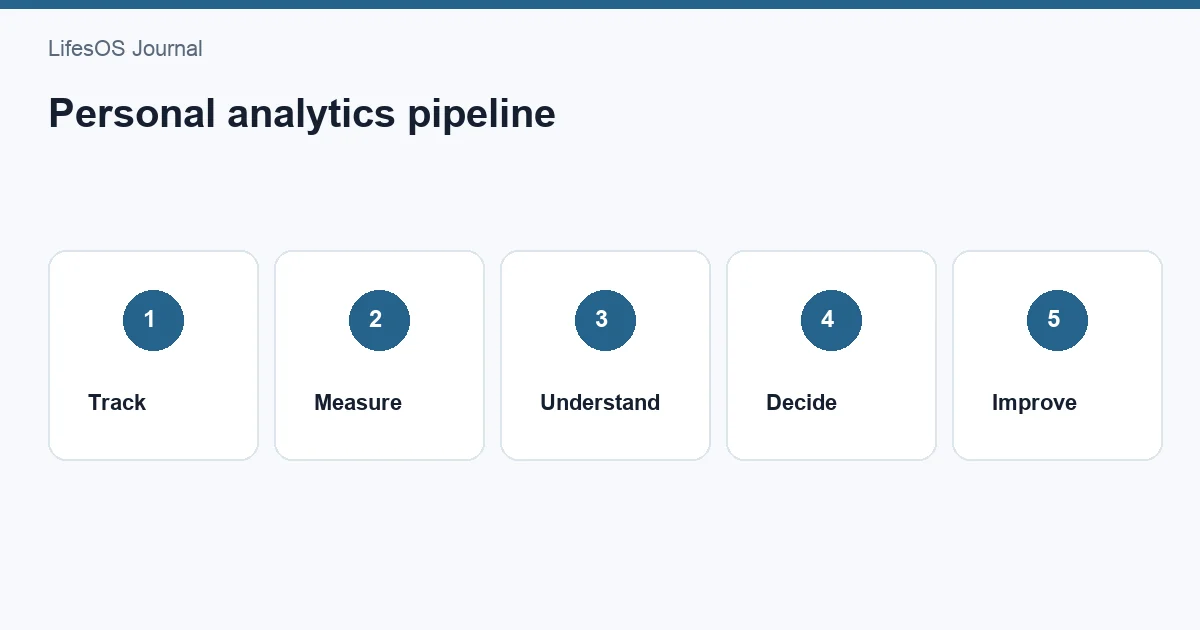
Personal analytics is the practice of using your own data to make better decisions. It moves beyond tracking individual events—expenses, meetings, meals, workouts, or goal updates—and asks what those records mean in context, which patterns repeat, and what action is worth taking. A useful personal analytics process follows five stages: DATA → CONTEXT → PATTERN → INSIGHT → ACTION.
The goal is not to measure your entire life. It is to reduce uncertainty around decisions you already face: how much capacity next week has, why a budget category varies, which routines survive busy periods, or whether a goal receives actual time and money.
What personal analytics includes
Personal analytics combines tracking, measurement, interpretation, and review. These terms are related but not interchangeable.
| Stage | Question | Example |
|---|---|---|
| Tracking | What happened? | Recorded four restaurant transactions |
| Metric | How can it be summarized? | Dining spend totaled $184 this week |
| Pattern | What repeats or changes? | Dining spend is higher during late-meeting weeks |
| Insight | Why might this matter? | Schedule pressure may be increasing convenience purchases |
| Decision | What choice follows? | Plan two easy dinners for meeting-heavy days |
| Behavior | What will change in practice? | Buy ingredients Sunday and block Wednesday meal preparation |
A dashboard showing $184 is a metric, not yet an insight. The insight appears only when the number is compared with a baseline, tied to context, and linked to a choice.
The DATA → CONTEXT → PATTERN → INSIGHT → ACTION framework
1. Data: record the event
Data is the raw evidence: a transaction amount, calendar event, meal entry, activity duration, sleep time, or milestone update. Good data does not need to be exhaustive. It needs enough consistency and meaning to answer a question.
For a spending question, amount, category, and date may be enough. For a time question, event type and duration may matter. Add fields only when they could change interpretation.
2. Context: describe the conditions
Context explains what surrounded the event. A $70 grocery trip means something different before visitors arrive than during an ordinary week. A missed workout means something different during illness than during a recurring scheduling conflict.
Useful context can include weekday, location, travel, deadlines, energy, season, life stage, or whether an event was planned. Context should be purposeful, not indiscriminate. More sensitive data is not automatically more useful.
3. Pattern: find recurrence or contrast
A pattern is a relationship observed across multiple records or periods. It might be a trend, cycle, cluster, outlier, or repeated sequence.
- Discretionary spending rises in travel weeks.
- Focus blocks are completed more often before noon.
- Lunch is skipped on days with meetings from 11:00 to 2:00.
- Walking is consistent when attached to commuting.
- Goal progress slows when no next action is scheduled.
Patterns are observations, not proof of cause. Two things moving together does not establish that one caused the other.
4. Insight: interpret what matters
An insight is a pattern with decision relevance. “Tuesday workouts are completed 80% of the time” becomes useful when it suggests Tuesday is a dependable anchor. “Dining spend rose 20%” needs context before it becomes meaningful.
Strong insights state evidence, uncertainty, and implication. For example: “Across six weeks, takeout purchases occurred mainly on the four evenings with meetings after 6:00. Late meetings may be creating a meal-preparation gap. Keeping two convenient options available could reduce last-minute decisions.”
5. Action: run the smallest useful change
Analytics earns its cost only when it improves a decision. Convert an insight into one bounded experiment: move a focus block, create a sinking fund, prepare two meals, shorten a workout, or reduce a weekly goal.
Set a review date. If the change does not improve the target outcome—or creates a new problem—revise it. Personal analytics is a feedback loop, not a one-time diagnosis.
Five domains for personal analytics
Finance
Finance records can reveal cash flow, category variation, recurring charges, savings progress, and the effect of irregular expenses. The most useful question is often not “Did I stay under budget?” but “Why did actual spending differ from the plan, and was that difference avoidable, intentional, or temporary?”
Budget variance separates the plan from actual results. A higher category may reflect an unrealistic baseline, a one-time event, shifted timing, or behavior worth changing. Each cause suggests a different response.
Time and schedule
Calendar data shows fixed commitments, meeting load, travel, transitions, and protected work. Comparing planned and completed blocks can reveal systematic overcommitment or unreliable times of day.
Time analytics should not reward filling every hour. Useful measures include focus capacity, schedule fragmentation, recovery time, and whether priority work had a realistic place.
Nutrition
Nutrition analytics can be as light as meal timing and preparation patterns or as detailed as nutrient estimates when appropriate. Questions might include which days produce long meal gaps, whether planned meals are used, or how schedule conditions influence convenience choices.
Nutrition data is approximate and can be sensitive. It should support education and appropriate professional care, not self-diagnosis or moral judgment.
Activity
Activity records can compare planned and completed sessions, weekly movement, intensity, and recovery. A completion rate alone may hide the important fact that shorter sessions survive busy weeks better than ambitious ones.
Useful analysis asks what makes movement repeatable and safe. It should not treat more exercise as universally better or infer health status from a small dataset.
Goals and journey
Goals become measurable when connected to milestones, next actions, schedule, and sometimes money. Personal analytics can show whether an outcome receives resources, where progress stalls, and whether the goal still fits current priorities.
A goal with no recent action may need a smaller next step, a scheduled block, a revised deadline, or deliberate retirement. “No progress” is information, not automatically a personal failure.
Why isolated trackers often fail
Most life decisions cross domains, while many trackers remain isolated. A fitness app sees workouts but not the calendar conflict. A budgeting app sees takeout but not the late meetings. A task app sees an overdue goal but not the financial constraint delaying it.
| Isolated signal | Missing context | Possible wrong conclusion |
|---|---|---|
| Three missed workouts | Travel and two late shifts | “Motivation is the problem” |
| Higher restaurant spending | Caregiving week and no meal-prep window | “The budget category is too generous” |
| Low goal progress | No scheduled next action | “The goal does not matter” |
| Few focus hours | Required meetings and onboarding | “Productivity declined” |
| Irregular meal timing | Shift-work schedule | “Planning is inconsistent” |
Fragmentation also creates review friction. If evidence is spread across six apps with different dates and definitions, comparing one week requires manual reconstruction. People then track extensively but review rarely.
The answer is not to centralize every possible datum. It is to align the limited records relevant to recurring decisions around shared time periods and clear definitions.
Start with decisions, not dashboards
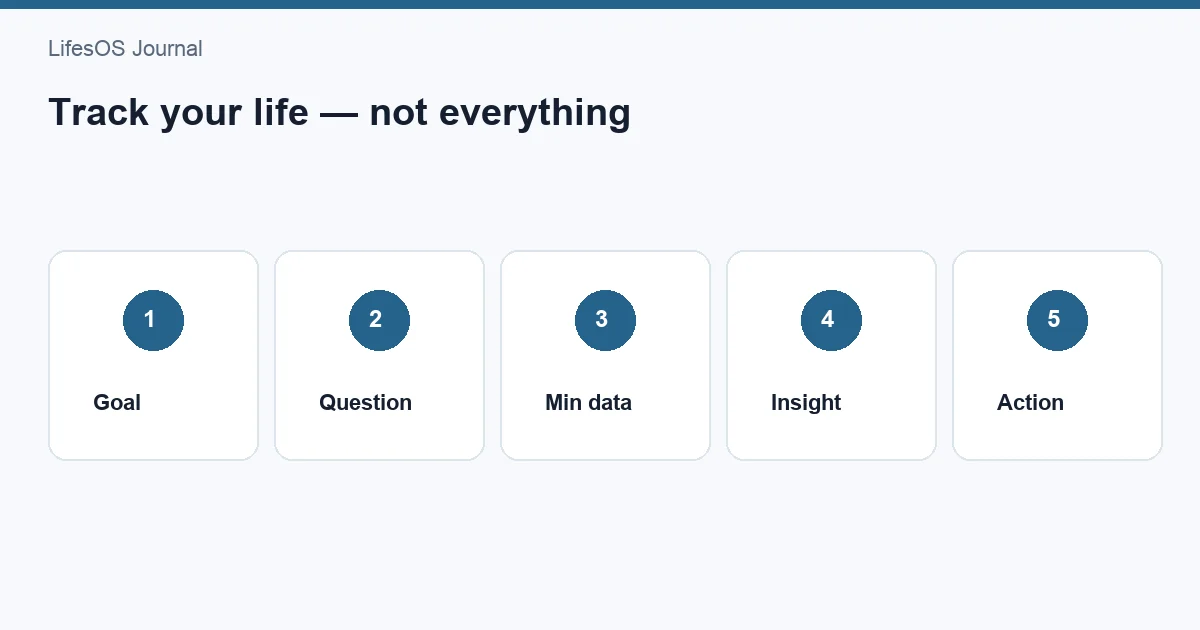
A common mistake is choosing metrics because they are available. Reverse the process:
- Name the decision. “When should I schedule demanding work?”
- State a question. “Which weekday mornings have enough uninterrupted capacity?”
- Choose minimum evidence. Calendar commitments, planned focus blocks, and completion.
- Set a period. Review four to six representative weeks.
- Define an action threshold. If one window succeeds at least three of four times, test it as an anchor.
- Review side effects. Ensure the change does not displace sleep, meals, or critical commitments.
This structure prevents tracking from becoming an end in itself.
Choose metrics that change decisions
A useful metric is understandable, reasonably reliable, and connected to action. It should not invite optimization at the expense of the underlying goal.
| Weak metric alone | More useful interpretation |
|---|---|
| Tasks completed | Priority outcomes advanced within available capacity |
| Money spent | Actual versus plan, with category and context |
| Workouts completed | Planned versus completed, plus recovery and repeatability |
| Meals logged | Pattern relevant to a defined nutrition question |
| Goal percentage | Milestone progress and next scheduled action |
Beware Goodhart's law: when a measure becomes a target, people can improve the number without improving the outcome. Completing more tasks may mean choosing easier work. Maximizing workout minutes may compromise recovery. Optimize the decision, not the counter.
Use a weekly personal analytics loop
A weekly review is often the right cadence: frequent enough to remember context, slow enough for patterns to form.
- Collect: ensure important records are reasonably current.
- Compare: look at plan versus actual across relevant domains.
- Notice: identify one repeated pattern, outlier, or conflict.
- Explain carefully: list plausible context without claiming certainty.
- Decide: choose one action or experiment.
- Schedule: give the action a time, trigger, or owner.
- Record: write a short insight note for later comparison.
The LifesOS Weekly Report can provide a common review window. Keep the output short enough that you will read it.
Example: from scattered data to a better week
Imagine that a person wants to reduce rushed weekday evenings without simply “being more disciplined.”
- Data: calendar events, dinner records, restaurant transactions, and evening activity plans.
- Context: late meetings occurred Tuesday and Thursday for five weeks.
- Pattern: takeout purchases and missed walks clustered on those evenings.
- Insight: the issue may be a predictable transition and meal gap, not separate failures in budgeting, nutrition, and exercise.
- Action: move one walk to lunch, keep two easy dinners available, and set a realistic dining allowance for one late evening.
The cross-domain view produces a smaller and more humane intervention than three isolated apps each demanding better compliance.
Data quality, uncertainty, and causation
Personal datasets are small and messy. Travel, illness, seasons, and changing responsibilities can distort comparisons. Missing records may not be random: people often stop logging during the busiest periods, exactly when context matters most.
- Compare similar periods when possible.
- Label estimates and missing data.
- Look for recurrence before acting on one event.
- Treat correlations as hypotheses, not causes.
- Prefer reversible experiments.
- Use professional advice for medical, legal, or individualized financial decisions.
You do not need statistical significance for every household choice. You do need appropriate humility about what the evidence can support.
Privacy and measurement boundaries
Personal analytics can involve sensitive financial, health-adjacent, schedule, and goal information. Collect less, protect it appropriately, and decide in advance who or what can access it.
Useful boundaries include tracking only fields tied to a decision, setting retention periods, reviewing connected services, exporting or deleting records when needed, and avoiding sensitive notes when a category or yes/no field is enough.
Do not turn analytics into surveillance of yourself or others. The purpose is agency. If measurement increases anxiety, narrows behavior, or creates compulsive checking, simplify or stop.
How LifesOS supports connected context
LifesOS brings Finance, Schedule, Nutrition, Activity, and Journey context into a shared personal system. That structure can make daily and weekly comparisons easier than reconstructing the same period across isolated trackers.
AI-assisted input, insights, and chat can help turn ordinary descriptions into structured records or explain patterns, while the underlying data remains available for review. The role of AI is to reduce friction and support interpretation—not to invent certainty or make consequential decisions for you. See what a personal AI assistant should do and explore LifesOS AI.
This builds on the broader idea of a personal operating system: one review rhythm, connected domains, explicit decisions, and feedback over time. You can begin with one domain and add context only when it improves a real question.
A 30-day personal analytics starter plan
Week 1: define one question
Choose a recurring decision with manageable scope. Avoid “How can I optimize my life?” Prefer “Why does Wednesday feel overloaded?” or “Which expenses make the monthly plan unpredictable?”
Week 2: collect minimum evidence
Record only the fields needed. Keep definitions consistent and capture context that could explain variation.
Week 3: inspect patterns
Compare similar days or weeks. Write observations without judgment. List more than one possible explanation.
Week 4: run one experiment
Change one controllable factor. Schedule the action and define what you will review. Continue only the tracking needed to evaluate that change.
Start a 7-day LifesOS trial during this process and test whether connected context makes the weekly decision easier—not merely whether it produces more data.
Common personal analytics mistakes
- Tracking before defining a question. Availability is not relevance.
- Confusing metrics with insights. A total needs comparison and context.
- Claiming causation from correlation. Treat relationships as hypotheses.
- Optimizing proxies. Better numbers can hide worse outcomes.
- Ignoring cross-domain effects. Time, money, food, activity, and goals compete for shared capacity.
- Collecting sensitive data by default. Minimize fields and access.
- Reviewing without acting. End each review with one decision or consciously choose no change.
- Never stopping. Retire metrics that no longer affect choices.
Related: Avoid overload with how to track your life without tracking everything.
FAQ
What is personal analytics in simple terms?
It is using your own records to identify patterns and make better decisions. The process connects data with context, insight, and action rather than stopping at tracking.
Is personal analytics the same as quantified self?
They overlap. Quantified-self practices often emphasize self-tracking and measurement. Personal analytics emphasizes the full decision loop, including qualitative context, interpretation, and behavior change.
Do I need an app or wearable?
No. A calendar, spreadsheet, notebook, or simple weekly checklist can support personal analytics. Tools help when they reduce capture and comparison effort.
How much data do I need before finding a pattern?
It depends on the question and frequency. Several comparable weeks may reveal a practical routine pattern, while rare or high-stakes questions need more caution and often professional expertise.
Can AI analyze personal data for me?
AI can summarize permitted data, surface possible relationships, and help formulate questions. Its output should be checked against source records, uncertainty, privacy boundaries, and your judgment.
Turn one record into one better decision
Personal analytics is not a project to model every part of yourself. It is a disciplined way to move from tracking to action: data → context → pattern → insight → action. Start with one decision, collect the minimum useful evidence, and run one reversible experiment. The value is not the size of your dashboard. It is the quality of the next choice.