Personal Finance
Budget Variance Explained: Why Your Plan Never Matches Reality
Budget variance is the difference between what you planned and what actually happened. Read it as feedback, find the cause, and improve the next forecast.
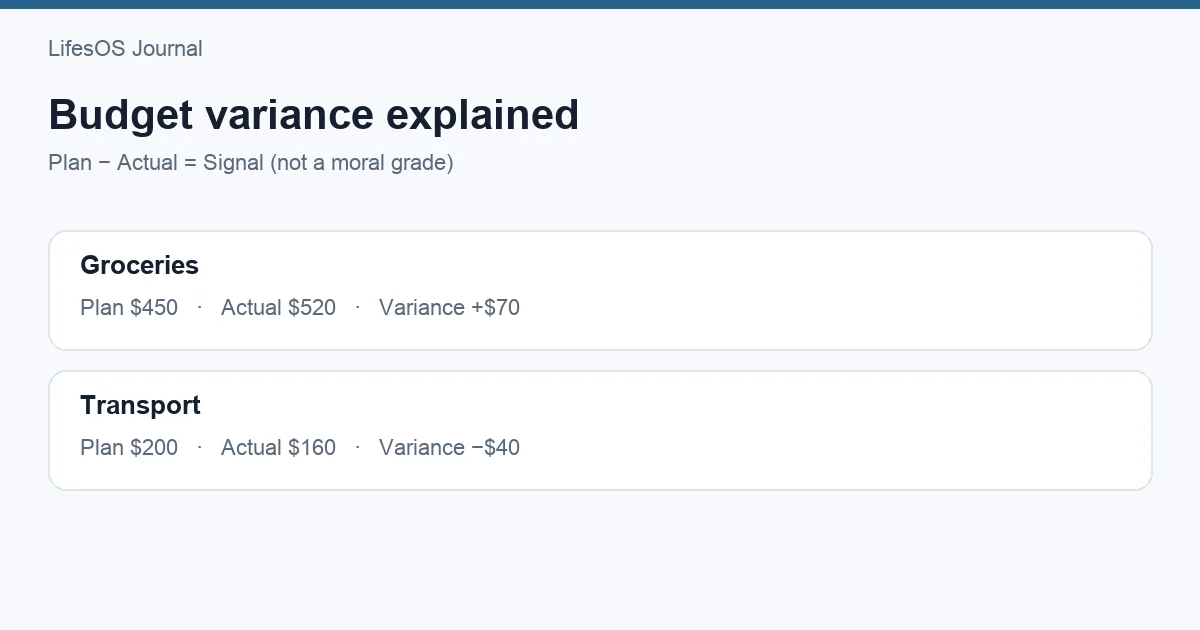
Budget variance is the difference between a planned amount and the actual result. If you budget $500 for groceries and spend $560, the spending variance is $60 over plan. That gap is not proof that budgeting failed. It is information: the estimate, timing, price, or behavior differed from what you expected. A short weekly check helps you respond before one difference affects the rest of the month.
What budget variance means
A budget is a forecast made with incomplete information. Actual spending records what occurred. Variance connects the two:
Spending variance = Budgeted spending − Actual spending
With this convention, a positive result is favorable because you spent less than planned; a negative result is unfavorable because you spent more. Some tools reverse the subtraction and display overspending as a positive number. Always check the tool's labels before interpreting the sign.
| Category | Budget | Actual | Variance | Reading |
|---|---|---|---|---|
| Rent | $1,500 | $1,500 | $0 | On plan |
| Groceries | $500 | $560 | −$60 | Unfavorable |
| Transport | $300 | $245 | +$55 | Favorable |
| Dining | $220 | $310 | −$90 | Unfavorable |
| Utilities | $240 | $215 | +$25 | Favorable |
| Total | $2,760 | $2,830 | −$70 | Over plan |
The category view matters more than the total alone. Transport and utilities partly offset groceries and dining, but they do not explain those overruns. You need both the net outcome and the category causes.
Favorable versus unfavorable is not good versus bad
In accounting language, favorable generally means the result improved the financial position relative to plan. Unfavorable means it weakened it. Those words do not measure whether a choice was wise.
- A favorable medical variance may mean you delayed needed care.
- An unfavorable grocery variance may reflect hosting family while dining spending fell.
- A favorable income variance may come from a bonus, but it may not repeat.
- An unfavorable childcare variance may be necessary to accept paid work.
Variance starts a question; it does not answer it. Ask what changed, whether the change was controllable, whether it will repeat, and what decision follows.
Dollar variance and percentage variance
Dollar differences show the effect on cash. Percentage differences make categories of different sizes easier to compare:
Variance percentage = (Budget − Actual) ÷ Budget × 100
| Category | Dollar variance | Percentage variance | Why both matter |
|---|---|---|---|
| Groceries | −$60 | −12% | Meaningful recurring gap |
| Dining | −$90 | −40.9% | Largest relative miss |
| Transport | +$55 | +18.3% | May offset this month only |
A $100 variance on rent would be small as a percentage but still important because housing is fixed and recurring. A $20 variance on a $30 hobby budget is large in percentage terms but may have little effect on the monthly total. Use judgment, not a single threshold.
Why the plan and reality differ
Estimation variance
You guessed too low or too high. This is common when you create a monthly budget without several months of actual spending. The fix is often to update the baseline, not demand better self-control.
Price variance
The same quantity cost more or less. Utility rates, food prices, insurance renewals, and service fees can move while your behavior stays unchanged.
Quantity or behavior variance
You bought more, traveled more, canceled fewer subscriptions, or ate out more often. The useful question is what condition drove the behavior: workload, convenience, social plans, poor scheduling, or a conscious choice.
Timing variance
A purchase landed this month even though you mentally assigned it to another. Credit-card posting dates, annual renewals, reimbursements, and pay cycles create timing gaps. A sinking fund or cash-flow calendar may solve this without changing the annual total.
Classification variance
The plan and actual transaction used different categories. A warehouse-store purchase might combine groceries, household supplies, and clothing. Before changing the budget, confirm the data is classified consistently.
One-time event variance
A repair, wedding trip, medical bill, or refund altered the month. Record it, but do not automatically bake the whole amount into every future month. Predictable irregular costs belong in monthly set-asides.
The 10-minute weekly variance check
A monthly postmortem is too late to change the month. Use this short check once a week:
- Update actuals for two minutes. Import, enter, or confirm recent transactions. A variance based on missing spending is false comfort. See how to track expenses with less friction.
- Scan large differences for two minutes. Look at dollar impact and percentage, especially categories with much of the budget already used.
- Name causes for three minutes. Label each material gap as estimate, price, behavior, timing, classification, or one-time event.
- Choose responses for two minutes. Reallocate, reduce upcoming spending, accept the difference, or revise the forecast.
- Write one learning note for one minute. Save a sentence to use when building next month's plan.
| Observation | Cause | This-month response | Next-month learning |
|---|---|---|---|
| Groceries $60 over | Prices plus guests | Use pantry plan this week | Add $25 baseline, use guest buffer |
| Transport $55 under | Worked from home | Move $40 to groceries | Do not lower yet; schedule varies |
| Dining $90 over | Late workdays | Plan two quick dinners | Budget convenience meals during deadlines |
This turns variance into a decision. Without the response and learning columns, a report can become a colorful record of something you already know.
Try LifesOS free for 7 days to compare budget and actual spending in Finance and carry one useful note into your next plan.
Use variance as a learning loop
A useful budget follows a repeating cycle:
- Plan: set a category amount from recent evidence and upcoming events.
- Observe: record actual spending consistently.
- Explain: identify the reason for meaningful differences.
- Respond: adjust the remaining month while choices are still available.
- Revise: update the next budget only when the evidence is likely to repeat.
Suppose groceries run $50 over plan for three ordinary months. Repeated variance suggests the budget is unrealistic. Raising the grocery target by $50 and reducing another category is more honest than copying the old number and feeling surprised again. By contrast, one expensive month caused by houseguests does not establish a new baseline.
Decide which variances deserve attention
Reviewing every $2 difference wastes attention. Set a materiality rule appropriate to your budget. For example, investigate when a category is more than $25 and 10% off plan, or whenever a difference threatens a bill, savings transfer, or end-of-month cash balance. The two-part rule avoids chasing tiny percentage changes in small categories and missing large dollar changes in big ones.
Also watch pace. Spending $250 of a $500 grocery budget by the middle of the month may be fine. Spending $450 by day ten deserves attention even though the final variance does not exist yet. A weekly check should include amount remaining and days remaining.
Variance with irregular income
If income changes month to month, compare actual income with a conservative baseline and keep spending decisions separate from optimistic revenue. You can create a minimum budget for essential obligations, then allocate income above that floor according to preset priorities such as taxes, reserves, debt, and flexible spending.
| Income result | Response |
|---|---|
| Below baseline | Use the minimum budget and defined reserve rules |
| Near baseline | Fund the standard plan |
| Above baseline | Allocate the surplus by preset percentages or priorities |
This avoids treating every high-income month as permanent and every low-income month as a budgeting failure.
Close the month without rewriting history
At month-end, keep the original budget visible. If you silently edit targets to match actual spending, variance disappears and so does the lesson. Record any approved transfers between categories as adjustments, preserve the initial plan, and write three lines:
- What was the largest useful surprise?
- Which difference is likely to repeat?
- What one change belongs in next month's budget?
Pair this close with a weekly money review. A short weekly rhythm makes month-end less about cleanup and more about choosing better estimates.
Common budget-variance mistakes
- Calling every overage irresponsible. Some reflect prices, timing, or deliberate priorities.
- Celebrating every underspend. It may show a delayed bill or unmet need.
- Looking only at the total. Offsetting category errors can hide unstable patterns.
- Changing next month after one unusual event. Separate recurring signals from exceptions.
- Ignoring income variance. A spending plan cannot be read apart from the cash available.
- Checking only after month-end. Review weekly while you can still respond.
- Expecting zero variance. Exact agreement can mean the plan was edited after the fact, not that forecasting was perfect.
FAQ
What is a budget variance in simple terms?
It is the difference between what you planned and what actually happened. It can apply to expenses, income, savings, or any other budgeted amount.
Is an unfavorable variance always bad?
No. It means the result was financially worse than the plan under the chosen formula, but the underlying choice may have been necessary or worthwhile. Investigate the cause before judging it.
How often should I check budget variance?
Weekly is frequent enough for most households to adjust during the month without turning money management into a daily chore. A brief month-end close captures lessons for the next plan.
Should I change my budget when I overspend?
Change the current forecast if needed, but preserve the original plan. Change future budgets when evidence suggests the difference will repeat, not simply to erase an uncomfortable number.
What variance percentage is acceptable?
There is no universal percentage. Fixed bills may warrant tight thresholds, while variable categories naturally move more. Choose thresholds based on dollar impact, category size, predictability, and whether the difference threatens priorities.
Turn one difference into one decision
Open your latest budget, select the largest unexplained category variance, and write its likely cause. Then choose one response for this month and one possible lesson for next month. That single loop is more useful than trying to force every category to land exactly on its forecast.
Start your 7-day LifesOS trial and make budget-versus-actual review part of a calm weekly routine.
This article provides general educational information, not personalized financial, investment, tax, or legal advice. Consider your circumstances and consult a qualified professional when needed.