Personal Finance
50/30/20 Budget Rule: Does It Actually Work?
The 50/30/20 rule is a useful diagnostic, not a universal law. Learn the categories, test your numbers, and adjust the percentages to fit your constraints.
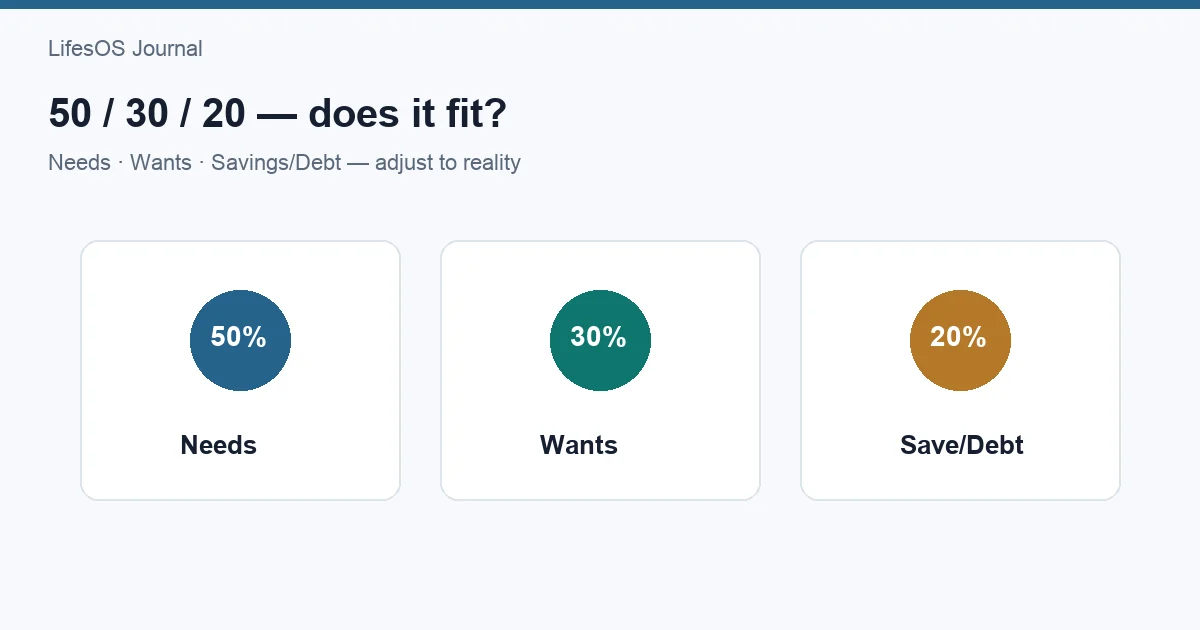
The 50/30/20 budget rule can work as a quick starting point: allocate about 50% of after-tax income to needs, 30% to wants, and 20% to savings and extra debt repayment. It is most useful as a diagnostic, not a law. If rent and basic costs already consume 65% of your income, forcing “needs” down to 50% next month may be impossible. If you want early retirement, 20% savings may be too low. Use the rule to see where your money goes, identify tradeoffs, and create percentages that fit your actual costs and goals.
How the 50/30/20 budget rule works
Start with monthly take-home pay: the amount deposited after taxes and payroll deductions. Divide it into three broad buckets.
- 50% for needs: expenses required for basic living, earning income, and meeting obligations.
- 30% for wants: optional spending that improves comfort, convenience, or enjoyment.
- 20% for savings and extra debt payments: emergency savings, investing, goal contributions, and principal paid above required minimums.
Someone taking home $4,000 per month would use guideposts of $2,000 for needs, $1,200 for wants, and $800 for saving and extra debt repayment. These are planning references. A real month might be 57/23/20 or 48/27/25.
| Bucket | Percentage | On $4,000 take-home | Common examples |
|---|---|---|---|
| Needs | 50% | $2,000 | Housing, groceries, utilities, insurance, required transport |
| Wants | 30% | $1,200 | Dining out, entertainment, upgrades, hobbies, optional travel |
| Savings and extra debt | 20% | $800 | Emergency fund, retirement, investments, extra principal |
What belongs in each category?
Needs: required, but not always fixed
Needs usually include rent or a basic mortgage payment, essential utilities, staple groceries, basic clothing, medication, insurance, minimum loan payments, childcare required for work, and necessary transportation. The amount you currently spend is not automatically a need. A reliable basic internet plan may be necessary for work; the premium entertainment bundle attached to it is not.
Wants: optional does not mean bad
Wants include restaurant meals, streaming, leisure travel, hobbies, convenience purchases, premium brands, and optional upgrades. Labeling them “wants” is not criticism. A budget exists partly to fund enjoyment deliberately. The distinction matters because wants can often change faster when cash flow tightens.
Savings and debt: future capacity
This bucket includes emergency-fund contributions, retirement and investment deposits, home or education goals, and payments above debt minimums. Minimum debt payments belong under needs because missing them has immediate consequences. Extra repayment belongs here because it increases future financial room.
If retirement contributions leave your paycheck before take-home pay reaches your account, account for them consistently. Either add those contributions back when calculating the base or count them toward the 20% separately. Do not accidentally ignore them or count them twice.
A complete 50/30/20 budget example
| Expense | Amount | Bucket |
|---|---|---|
| Rent and renter insurance | $1,400 | Need |
| Utilities, phone, internet | $260 | Need |
| Groceries | $420 | Need |
| Transport and health costs | $320 | Need |
| Minimum student loan | $100 | Need |
| Dining, subscriptions, hobbies | $700 | Want |
| Travel sinking fund | $300 | Want |
| Emergency savings | $300 | Savings/debt |
| Retirement investing | $300 | Savings/debt |
| Extra loan payment | $200 | Savings/debt |
| Total | $4,300 |
This person takes home $4,300. Their split is about 58% needs, 23% wants, and 19% savings/debt. The rule reveals high fixed costs, but it does not prove the budget is irresponsible. If housing cannot change soon, a temporary 58/22/20 plan may be more honest than pretending 50/30/20 has been achieved.
Does 50/30/20 fit your situation?
| Situation | Does 50/30/20 fit? | Adjustment |
|---|---|---|
| Stable income and moderate housing costs | Often | Use it as a baseline, then refine categories |
| High-cost city | Often not exactly | Try 60/20/20 while planning longer-term housing or income changes |
| Low income near essential-cost floor | Usually not yet | Prioritize essentials, a small buffer, and available assistance |
| Irregular income | Useful annually, weak monthly | Base essentials on a conservative income floor and use percentages on each payment |
| High-interest debt | Needs modification | Reduce wants and direct more than 20% to buffer plus repayment where feasible |
| Aggressive savings goal | Too permissive | Try 50/20/30 or a custom savings-first plan |
| Temporarily unemployed | No | Use a bare-bones cash-flow budget |
When the rule fails
Housing dominates the budget
In a high-cost area, rent alone may approach 50% of take-home pay. Calling the plan a failure does not lower rent. Focus first on cash-flow safety, then evaluate changes available at lease renewal: a roommate, different location, negotiation, or increased income. Some constraints take months to change.
Income does not cover basic needs
At low income, there may be no 30% wants bucket to cut. The useful question becomes how to keep priority bills current, access eligible support, avoid expensive fees, and create a small margin. Percentage templates cannot solve an insufficient income-to-essentials ratio by themselves.
Income changes every month
A freelancer earning $7,000 one month and $2,500 the next should not build recurring spending around the high month. Use a conservative baseline for essential commitments, hold an income buffer, and apply target percentages to quarterly or annual averages. A monthly budget can still work if it distinguishes money received from money available to spend.
Debt requires faster action
Someone carrying high-interest revolving debt may choose a starter emergency fund, essential costs, and accelerated repayment before allowing a full 30% wants category. This is a risk decision, not a moral rule. Compare rates, fees, cash reserves, and stability, and seek qualified advice when needed.
Your savings goal is more ambitious
A 20% savings rate is strong for some goals and insufficient for others. A sabbatical, house deposit, career transition, or early-retirement plan may require 30%, 40%, or more. The 50/30/20 model is not a ceiling.
How to test the rule with your own spending
- Calculate dependable take-home income. Use the last three months or a conservative baseline if income varies.
- Track actual spending. Review transactions using expense tracking; estimates often miss irregular costs.
- Classify each transaction. Split mixed bills when practical.
- Calculate the percentages. Divide each bucket total by take-home income.
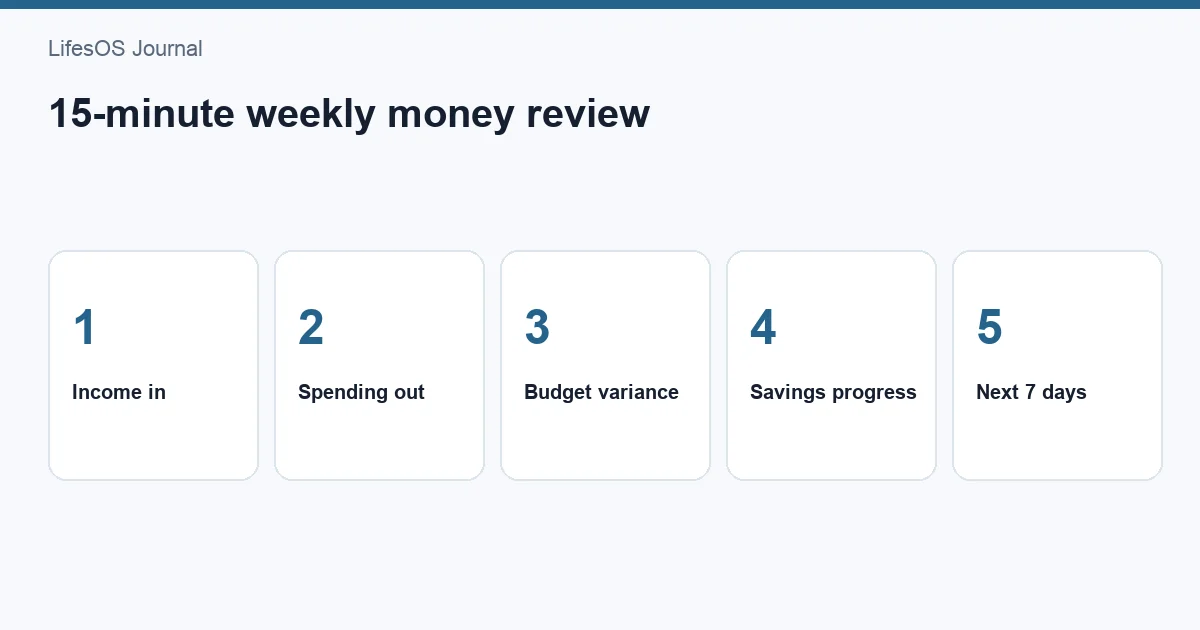
- Inspect the gap. A budget variance shows where the plan and actual spending differ.
- Choose one adjustment. Change the category with the clearest realistic opportunity, then review after a month.
Compare your real spending with a percentage plan in LifesOS Finance. Use the result to make one decision, not to grade every purchase.
Alternatives to 50/30/20
A zero-based budget assigns every available dollar a role and works well when close control matters. A pay-yourself-first budget automates savings, covers bills, and leaves the remainder flexible. The six jars method uses more categories for education, play, giving, and long-term freedom. A bare-bones budget is designed for temporary survival during income loss.
You can also keep the three-bucket idea and customize the split. The best percentages are the ones that acknowledge fixed constraints, protect priority goals, and remain usable for more than one unusually motivated month.
How to improve the plan over time
Review the split monthly for the first quarter, then quarterly. If needs remain above target, separate structural costs from temporary spikes. If wants repeatedly exceed the plan, inspect specific categories instead of cutting all enjoyment. If savings falls short, automate the contribution and check whether the goal conflicts with required cash flow.
- Use three-month averages for volatile categories.
- Create sinking funds for annual bills so they appear in monthly costs.
- Count all saving consistently, including payroll deductions.
- Recalculate after income, housing, or household changes.
- Keep the model only while it improves decisions.
Related: Categorize spending with needs vs wants.
FAQ
Is the 50/30/20 budget based on gross or net income?
It is generally applied to after-tax or take-home income. Handle payroll retirement and insurance deductions consistently so contributions and needs are not missed or double-counted.
Is rent always a need?
Housing is a need, but every feature or price level is not automatically required. Classify the current payment as a need for cash-flow planning, then evaluate alternatives separately.
Do minimum debt payments count in the 20%?
Minimum required payments generally count as needs. Payments above the minimum count toward savings and extra debt repayment.
What if my needs are 70%?
Use 70% as an honest baseline. Protect essentials, choose a feasible savings amount, and look for structural changes over time. Do not force numbers that make the budget fictional.
Is 50/30/20 better than zero-based budgeting?
Neither is universally better. The percentage rule is simpler and flexible; zero-based budgeting offers more control. Choose based on how much detail changes your decisions.
The verdict
The 50/30/20 budget rule works when you need a clear first draft and your essential costs leave room for choice. It fails when treated as proof that every household should fit the same proportions. Measure your split, understand why it differs, and adopt a custom version that protects current needs and future capacity.
Start a free 7-day LifesOS trial to organize spending, goals, and monthly reviews in one place.
This article provides general educational information, not personalized financial, investment, tax, or legal advice. Consider your circumstances and consult a qualified professional when needed.