Personal Finance
The Six Jars Method: A Simple System for Where Every Dollar Goes
A twenty-year-old idea, one famous book, and six percentages that make budgeting close to automatic — plus a concrete way to run it inside LifesOS.
Most budgeting advice says "spend less" or "track everything." True, but not actionable — it doesn't tell you what to do the moment money lands in your account. The Six Jars method does. Popularized by T. Harv Eker in his 2005 book Secrets of the Millionaire Mind, it replaces vague intentions with six named jars and a fixed percentage for each. Every time income arrives, it gets split six ways — before you decide anything else.
How it works
Instead of one bank balance, you hold six — literally in jars, or as six categories in an app. The moment money comes in, you divide it immediately across all six, in the same proportions, every time. The division happens first. Spending decisions happen after, and only within whichever jar the money already belongs to.
The six jars
Each jar gets a fixed share of every dollar earned:
| Jar | Code | % | Purpose |
|---|---|---|---|
| Necessities | NEC | 55% | Rent, groceries, bills, transport — everything required to live and work today. |
| Play | Play | 10% | Spent on pure enjoyment, every month, with zero guilt — the jar that keeps the whole system sustainable. |
| Education | EDU | 10% | Books, courses, coaching — reinvested in your own earning ability, not spent on things. |
| Financial Freedom Account | FFA | 10% | Never spent, only invested. The seed of long-term wealth — untouchable by design. |
| Long-Term Savings for Spending | LTSS | 10% | Saved deliberately for a big future purchase — a car, a trip, a deposit. |
| Give | GIVE | 5% | Charity or generosity — keeps money's purpose bigger than your own spending. |
Why the percentages matter less than the habit
Eker's own point is that the exact ratios matter less than the act of always dividing. If 55% doesn't cover necessities where you live, or you're paying down debt, the common adjustment is to raise NEC and drop FFA and GIVE to a symbolic 1% each — just enough to keep the habit alive — then grow them back as necessities shrink relative to income. What compounds over years isn't the starting ratio. It's never skipping the split.
The order of operations is the whole mechanism: divide first, decide second. A budget that asks you to decide first and divide what's left rarely survives contact with a bad week.
The part most people get wrong
Two mistakes show up constantly. First, cutting Play to "focus on saving." Eker argues the opposite: a budget with no guilt-free spending feels like punishment, and punishment doesn't last. Second, quietly raiding FFA for a one-off expense. The rule that makes Financial Freedom actually work is that it's invested, never spent — the instant it becomes a backup emergency fund, it stops compounding the way it's supposed to.
Applying the six jars in LifesOS
The jars are a mental model. LifesOS's Finance area is where the model becomes a running total you can actually see. Here's a concrete way to set it up using what's already in the app — no separate spreadsheet required.
1. Create six budget categories
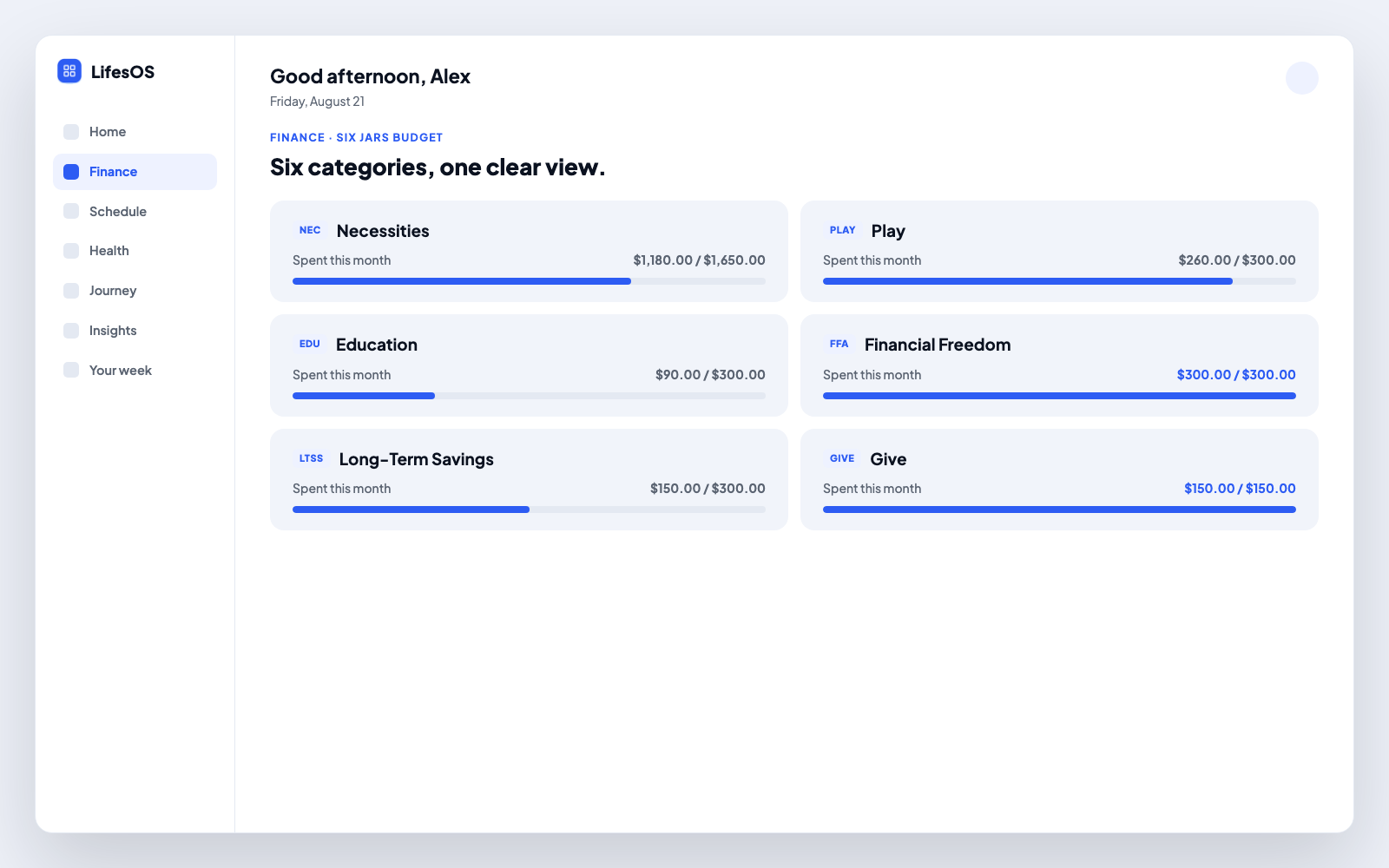
In Finance, set up NEC, Play, Education, FFA, LTSS, and Give as separate categories, with each month's target amount based on your income and the percentages above.
2. Log income the way you already talk
Tell LifesOS what happened — "Salary received, $3,000" — then log the split as it lands: "$1,650 to Necessities," "$300 to Play," and so on. It reads the intent and files each one under the right category.
3. Spend from the matching jar
Tag every expense to its category as you log it, so each budget's remaining balance always reflects what's actually left in that jar this month — not a number you have to reconstruct later.
4. Check the drift in Weekly Report
Your Weekly Report becomes a live check on the system: is NEC creeping past 55%? Is Play sitting unused, which usually means it'll get raided later? Catching drift weekly is easier than fixing it in December.
5. Treat FFA as a one-way door
Watch the Financial Freedom category the same way you'd watch a Current Balance — the goal is a number that only ever goes up.
Six budget categories in LifesOS Finance, one for each jar — set up exactly as described above.
Start your first jar this week
Set up Finance categories for NEC, Play, and FFA today — the other three can wait until payday.
The Six Jars method is a budgeting framework created by T. Harv Eker, not financial advice — adjust every percentage to your own income, debt, and cost of living. LifesOS's Insights and Weekly Report are informational and are not financial advice.