LifesOS Guides
How to Track Your Life Without Tracking Everything
Track only the minimum data needed to answer a current question, review it on a useful cadence, and stop when it no longer changes a decision.
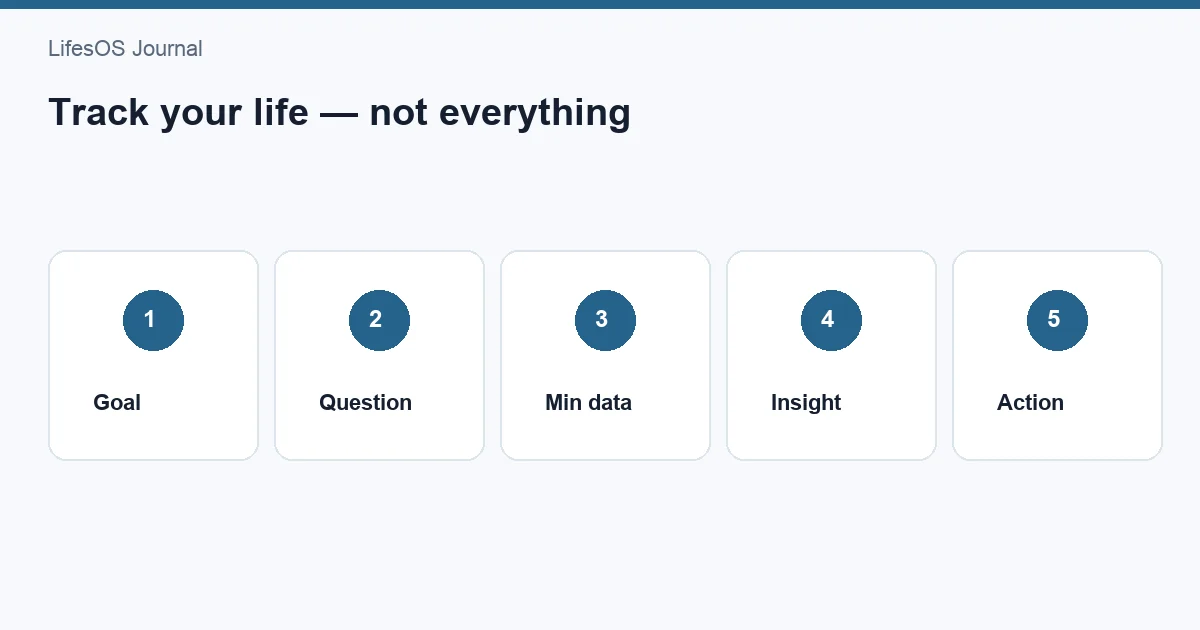
You do not need to track everything to understand your life. Start with one goal, turn it into a specific question, collect the minimum data required to answer it, review that data for an insight, and take one action. The framework is: GOAL → QUESTION → MINIMUM DATA → INSIGHT → ACTION. If a field cannot plausibly change a decision, do not collect it.
More data does not automatically produce better decisions. It can create maintenance work, false precision, privacy exposure, and dashboards too crowded to interpret. Useful tracking is selective. It reduces uncertainty around a real choice and ends—or changes—when the choice is made.
Why tracking everything usually fails
Life creates nearly unlimited measurable events: spending, steps, meals, sleep, screen time, meetings, moods, habits, tasks, reading, and goals. Each metric looks defensible alone. Together, they demand constant capture and review.
The cost is not only time. Every field creates decisions about definition, accuracy, storage, privacy, interpretation, and retention. Missing entries can produce guilt. Automated streams create volume without context. Eventually, tracking becomes a second job detached from the problem it was supposed to solve.
This is tracking fatigue: the effort of collecting and maintaining data begins to exceed the benefit of the decisions it supports. The remedy is not better discipline. It is a smaller measurement system.
More data is not the same as more evidence
Evidence is data relevant to a question. Suppose your goal is to protect focused work. Tracking every application opened, keystroke, task, mood, and minute may produce detail, but the decision could require only three fields: planned focus block, completed focus block, and interruption category.
| Available data | Possible value | Likely noise |
|---|---|---|
| Every task completed | Useful for workload questions | Weak proxy for meaningful progress |
| Every food amount | May support a defined nutrition purpose | Unnecessary for basic meal-planning questions |
| Every purchase | Useful for category and cash-flow review | Extra notes that never affect classification |
| Every calendar event | Useful schedule context | Minute-by-minute reconstruction of unplanned time |
| Every mood change | May support an appropriate defined question | Frequent subjective entries without an action plan |
The test is not “Could this be interesting?” Almost anything could. Ask, “What would I do differently if this value were high, low, or missing?” If the answer is nothing, the field is probably noise for the current purpose.
The GOAL → QUESTION → MINIMUM DATA → INSIGHT → ACTION framework
1. Goal: name the outcome
Begin with a direction, not a metric. “Reduce rushed weekday evenings,” “make monthly spending predictable,” “walk more consistently,” or “move a project forward” are outcomes. “Track steps” and “log meals” are activities.
A goal gives measurement a stopping rule. Once you can make the decision or establish a stable routine, you can reduce, pause, or replace the tracking.
2. Question: identify the uncertainty
A good question is narrow enough to answer and connected to a choice. Replace “Why am I unproductive?” with “Which two weekday mornings have enough uninterrupted time for a 60-minute project block?” Replace “Am I eating well?” with “Which workdays repeatedly create a lunch gap?”
- What causes the largest monthly budget variance?
- Which scheduled walking cue survives busy days?
- How often does a late meeting change the dinner plan?
- Which goal has no scheduled next action?
- Where does the week routinely exceed available capacity?
3. Minimum data: collect only what can answer the question
Choose the smallest set of fields, a clear definition, and a limited period. For the focus-block question, collect weekday, planned start, completion, and one interruption category for four representative weeks. You probably do not need every browser tab or message.
Minimum does not mean careless. Consistent definitions matter more than maximum detail. Record estimates as estimates, distinguish planned from completed, and preserve context that could reverse an interpretation.
4. Insight: state what the evidence suggests
An insight is not a total. “I completed six focus blocks” is a summary. “Five of six completed blocks began before 10:00, while afternoon blocks were displaced by meetings” is a pattern with possible decision value.
Use cautious language. Personal datasets are small and affected by travel, illness, deadlines, and season. A pattern suggests a hypothesis; it rarely proves a cause.
5. Action: make one bounded change
Reserve Tuesday morning, move a walking cue, prepare lunch before a meeting-heavy day, revise a category budget, or reduce a weekly goal. Give the action a date and review point.
If the insight produces no action, consciously decide whether to keep observing. Do not collect indefinitely because the dashboard already exists.
Separate signal from noise
Signal is information that changes your understanding of the question. Noise is irrelevant detail, random variation, duplicate measures, or precision too weak to support a different action.
| Question | Signal | Noise |
|---|---|---|
| Why is dining spending variable? | Amount, category, week, late-meeting context | Weather unless you have a reason to test it |
| Which walk cue works? | Cue, completion, schedule conflict | Exact GPS route for every walk |
| Are project goals receiving time? | Scheduled and completed project blocks | Total number of unrelated tasks |
| Does meal planning reduce rush? | Plan, schedule constraint, fallback used | Detailed nutrient values unrelated to the question |
Signal can change as the question changes. Data that was useful during a four-week experiment may become noise once a routine is stable.
What to track in different areas of life
Finance
For most budget questions, transactions need amount, date, and category. Add merchant, account, or planned-versus-unplanned status only when it improves a decision. Monthly totals can hide weekly timing, while hyper-detailed purchase notes can add work without changing the budget.
Schedule
Track commitments and the few planned blocks related to your question. If you are testing capacity, planned versus completed and a short conflict category may be enough. Filling every unscheduled minute can make a calendar less truthful, not more.
Nutrition
A meal name, time, and contextual note may answer a planning question. Precise calorie or nutrient estimates are not required for every purpose and can be inappropriate for some people. Health conditions and clinical decisions belong with qualified professionals.
Activity
Activity type, duration, and approximate effort often support routine review. Distance, pace, heart rate, and detailed route data should earn their place through a specific question.
Goals and journey
Record milestones, current next action, and the time or money allocated. A percentage without evidence of the next move may look precise while providing little direction.
This selective approach is compatible with personal analytics. The purpose of analytics is to connect data with context, patterns, insights, and decisions—not to maximize record count.
Prefer weekly aggregation over constant checking
Many life patterns become clearer at a weekly cadence. A single late dinner or missed walk may be random. Repetition across several comparable weeks is more informative. Weekly aggregation also reduces reactive decisions based on daily variation.
A useful weekly review can take 15 minutes:
- Update only the records relevant to active questions.
- Compare the plan with actual results.
- Look for one repeated pattern, exception, or conflict.
- Write one sentence explaining what the evidence suggests.
- Choose one action and put it into the next week.
- Retire one metric that no longer changes a decision.
The LifesOS Weekly Report can provide a shared period across domains. Keep the report short enough to read and act on.
Design against tracking fatigue
- Limit active questions. One to three is usually more workable than measuring every goal.
- Use defaults. Keep categories and definitions stable.
- Batch review. Avoid checking dashboards throughout the day unless the decision is time-sensitive.
- Automate cautiously. Automatic collection can reduce entry but increase irrelevant volume.
- Allow missing data. Label gaps rather than reconstructing every detail.
- Set an end date. Four or six weeks is often enough for a routine experiment.
- Notice wellbeing. Simplify or stop if tracking creates anxiety, compulsion, or harmful restriction.
Friction is information. If a field is repeatedly skipped, ask whether it is truly necessary before trying to force compliance.
Collect less for privacy as well as focus
Personal data can reveal finances, locations, routines, health-adjacent information, relationships, and future plans. Data minimization limits both cognitive load and exposure.
Choose purpose-specific fields, restrict access, review connected services, set retention periods, and use export and deletion controls. Avoid recording sensitive free-text details when a broad category answers the question. Do not track other people without appropriate knowledge and consent.
AI can help summarize or structure permitted information, but it does not make unnecessary collection necessary. Better AI advice depends on relevant personal data, clear boundaries, and source checking—not indiscriminate access.
Build a small personal operating system
A personal operating system is most useful when it creates a common rhythm for decisions. You need a capture method, a schedule, a few active goals, and a review. You do not need a digital replica of your life.
Keep facts in inspectable structures and insights as short notes linked to the evidence. A strong system can answer: What am I trying to change? What question am I testing? What did the week show? What will I do next?
In LifesOS AI, AI-assisted input can help structure ordinary descriptions across Finance, Schedule, Nutrition, Activity, and Journey. Use connected context only where it improves an active question, and confirm generated interpretations against your records.
Example: reduce rushed evenings without tracking the whole day
Goal: make weekday evenings less rushed.
Question: Which recurring conditions cause dinner and planned activity to collide?
Minimum data: late meeting yes/no, dinner plan used/fallback, activity completed/moved, and weekday. Collect for four weeks.
Insight: On six evenings with meetings ending after 6:00, the original dinner plan was used once and activity was missed four times. Other evenings did not show the same cluster.
Action: Keep two easy dinners available and move activity to lunch on known late-meeting days. Review after three more weeks.
No minute-by-minute diary, mood score, GPS history, or complete food log was needed. The smaller dataset produced a testable change.
Know when to stop tracking
Stop or reduce a metric when the decision is made, the behavior is stable, the question is no longer important, the data is unreliable, or the cost exceeds the benefit. Archive a brief conclusion so you do not need to repeat the experiment without reason.
You can restart later if circumstances change. Measurement should be available when useful, not permanent by default.
Common minimal-tracking mistakes
- Starting with a dashboard. Start with a goal and question.
- Choosing available metrics. Availability does not establish relevance.
- Tracking outcomes without context. Include the condition most likely to change interpretation.
- Claiming causation. Treat small-data patterns as hypotheses.
- Reviewing every day. Match cadence to the decision.
- Keeping metrics forever. Use end dates and retirement rules.
- Confusing missing data with failure. Simplify the system and label gaps.
- Ignoring privacy. Collect the least sensitive useful evidence.
FAQ
What should I track in life?
Track the minimum information needed to answer one current question. Common examples include planned versus completed schedule blocks, broad spending categories, meal timing, activity duration, or the next action for a goal.
How many metrics should I track?
There is no universal number. Use as few as can answer your active questions. A small experiment may need two to four fields rather than dozens of metrics.
How often should I review personal data?
Weekly review works well for many routines because it preserves context without encouraging constant checking. Monthly review may suit budgets and slower goals; time-sensitive questions may need a shorter cadence.
Is automatic tracking better?
It can reduce entry friction, but it may collect more noise and sensitive information. Automate only data tied to a purpose and review its accuracy, access, and retention.
What if tracking makes me anxious?
Simplify, pause, or stop. Tracking is optional and should support agency. Seek appropriate professional support if measurement contributes to distress, compulsive behavior, or harmful restriction.
Run one minimum-data experiment
Write one goal and one question. Choose no more than four fields, define them clearly, and set a four-week review date. At each weekly review, write one observation and take at most one action.
Start a 7-day LifesOS trial to test a focused question across the life areas you choose. The goal is not a complete record. It is enough signal to make the next decision with less uncertainty.