AI & Life
How AI Can Use Your Personal Data to Give Better Advice
Personal AI can give more relevant advice when it uses selected, permissioned context—but only with clear consent, minimal data, user control, and secure memory.
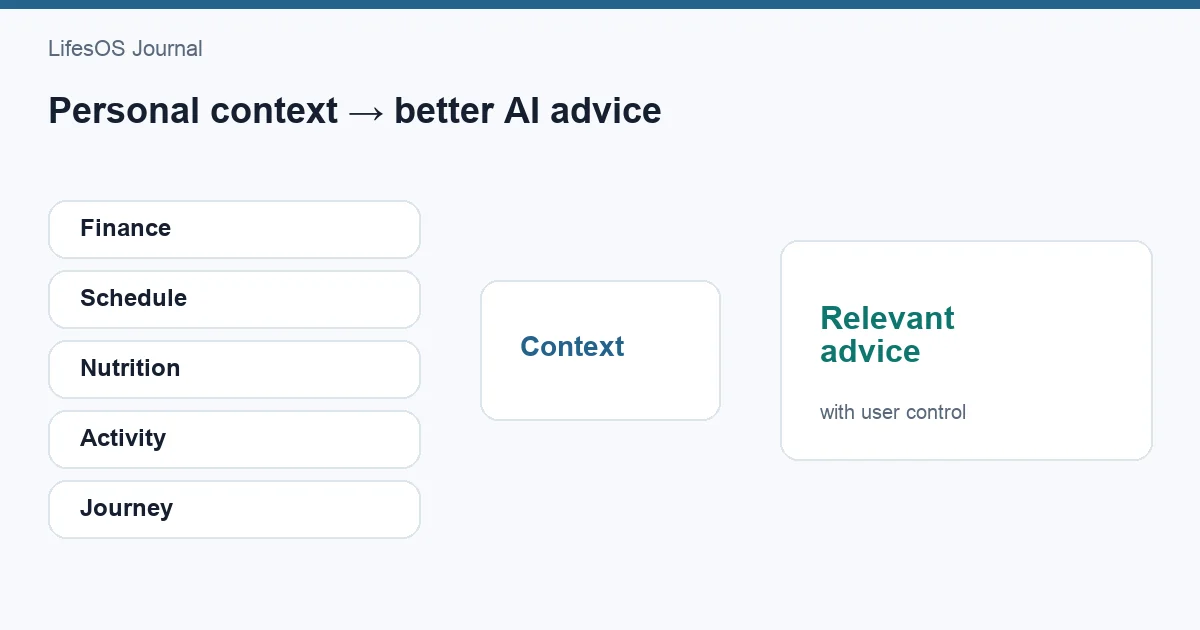
AI can give better advice when it uses relevant personal context you have deliberately allowed: your schedule constraints, budget structure, meal patterns, activity history, goals, and preferences. The improvement comes from replacing generic assumptions with current evidence. But more data is not automatically better. Useful personal AI requires explicit consent, data minimization, user control, security, and memory that can be inspected, corrected, and deleted.
A generic model can explain how to plan a week. A context-aware system can recognize that Tuesday is meeting-heavy, Thursday includes caregiving, and your selected goal needs two focused hours. It can then offer options that fit. The underlying principle is simple: advice becomes more relevant when the constraints are real.
Generic AI vs context-aware personal AI
| Question | Generic AI response | Context-aware response |
|---|---|---|
| When should I exercise? | Choose a consistent morning or evening time | Offer open periods that avoid existing commitments and reflect your recent routine |
| Can I afford a trip? | Create a budget and compare income with expenses | Show the trip's effect on the budget and selected savings goals using current recorded figures |
| How should I plan meals? | Prepare balanced meals in advance | Identify the days your schedule repeatedly creates meal gaps and suggest planning around them |
| Why is my goal stalled? | Break it into smaller steps | Notice whether the goal has no current milestone, scheduled action, or allocated resources |
| How was my week? | Reflect on wins and challenges | Summarize selected finance, schedule, nutrition, activity, and journey records from the same week |
The context-aware answer should not pretend to know more than the records support. It should show what information it used, label estimates, and separate observations from suggestions.
What “personal context” actually means
Personal context is not one giant profile. It is a set of scoped facts, preferences, records, and constraints that may be relevant to a particular request.
- Current state: today's schedule, recent transactions, this week's activity, or an active milestone.
- Stable preferences: working hours, preferred units, dietary preferences, or notification boundaries.
- Historical patterns: recurring schedule conflicts or category trends observed across a defined period.
- Explicit goals: a savings target, event, training routine, or journey milestone the user chose to record.
- Permissions: which domains the assistant can read, summarize, or use for a specific purpose.
Context should be assembled for the task. A request to locate an open calendar block usually does not require transaction history. A spending question usually does not require nutrition records. Relevance is a privacy and quality feature.
How personal data improves an AI response
A responsible context-aware workflow can be described in six steps.
- Interpret the request. Identify the decision, ambiguity, and risk.
- Select permitted context. Retrieve the minimum relevant records.
- Check quality. Note missing, stale, estimated, or conflicting data.
- Analyze relationships. Compare constraints, totals, patterns, and goals.
- Generate options. Explain tradeoffs instead of presenting one inevitable answer.
- Confirm action. Let the user review before anything consequential is saved or changed.
This resembles the personal analytics loop: data gains context, patterns become possible insights, and insights support action. AI can reduce the effort of querying and explaining that loop, but it does not remove the need for evidence.
Example: finance advice with actual context
Ask a generic system, “Can I spend $900 on a trip?” and it must answer with broad rules or request more information. A context-aware assistant could use approved finance records to show:
- the amount currently assigned to travel;
- upcoming recurring obligations;
- the effect on a selected savings goal;
- whether recent transactions are still pending;
- several funding timelines rather than a yes-or-no verdict.
A useful answer might say: “Based on recorded figures, funding $900 over six months would require $150 per month. Your current plan has $80 per month available after selected recurring categories, leaving a $70 gap. Options are extending the date, reducing the trip budget, or revising another category.”
That is decision support, not a guarantee of affordability and not individualized financial advice. Income stability, debt, taxes, unrecorded obligations, and personal risk tolerance may be missing.
Example: schedule advice that respects constraints
Generic productivity advice often recommends morning focus or strict daily routines. Personal schedule data can reveal whether those suggestions are possible.
A context-aware assistant might compare open time, fixed events, travel, work boundaries, and the estimated duration of a task. It could offer two viable blocks and explain their tradeoffs: Wednesday morning is uninterrupted but close to a deadline; Friday afternoon has more time but historically contains frequent changes.
Blank time should not automatically be treated as free. Meals, sleep, preparation, caregiving, and transitions are real constraints even when they are not represented as meetings.
Example: nutrition and activity without overreach
Suppose a person asks why planned workouts and meal preparation repeatedly disappear. Selected schedule, nutrition, and activity records may show that both were placed on late-meeting evenings.
The assistant can surface that coincidence and offer options: move one activity session to lunch, prepare food on a less constrained day, or reduce the plan during deadline weeks. It should not diagnose fatigue, prescribe treatment, or claim a causal relationship from a few records.
Nutrition estimates should be labeled as estimates. Activity suggestions must not pressure someone to train through pain or ignore professional restrictions. Health-adjacent context demands conservative language and clear boundaries.
Example: goals connected to resources
Goals often fail because they remain separate from time and money. A journey goal may have inspiring language but no next milestone, scheduled action, or resource allocation.
With approved journey, schedule, and finance context, AI can ask more useful questions:
- Does the goal have a current milestone?
- Is the next action small and specific?
- Where does it fit in the next two weeks?
- Does it require a budget or recurring expense?
- Which existing commitment would need to move?
The assistant can draft a plan, but the user should choose the tradeoff. This is one reason a personal operating system is valuable: goals, time, and resources share a review rhythm rather than living as isolated intentions.
Four levels of personal AI assistance
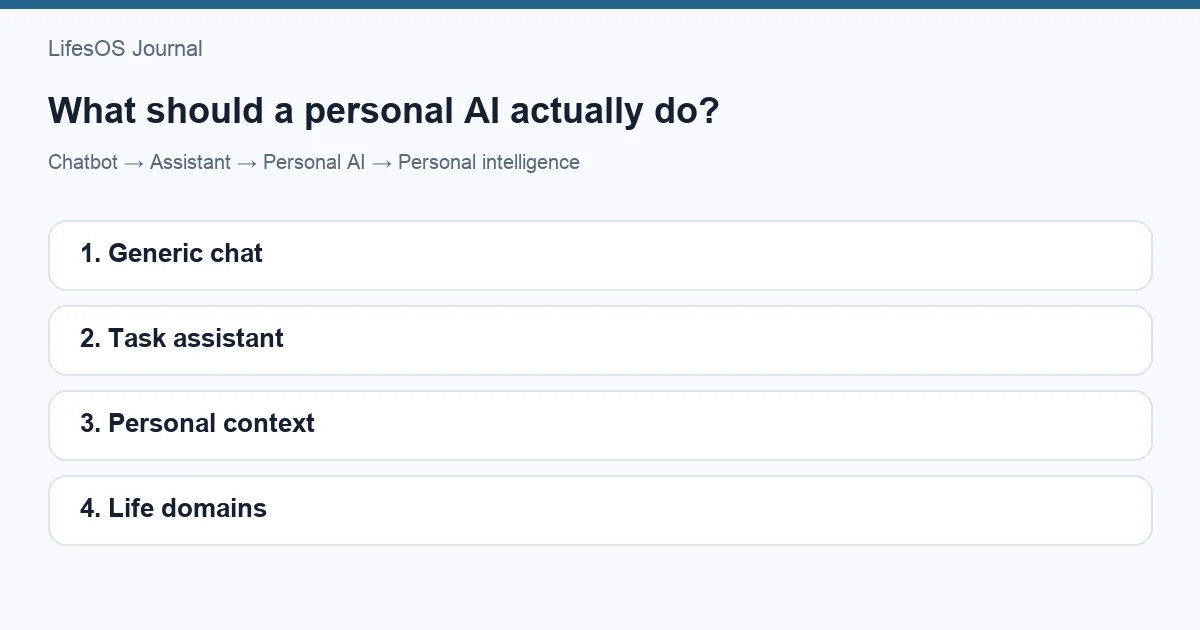
| Level | What AI does | Example | Control needed |
|---|---|---|---|
| Explain | Provides general information | Explains time blocking | Check sources and applicability |
| Personalize | Uses selected context in an answer | Suggests blocks around current commitments | Show context and uncertainty |
| Draft | Creates a structured proposed record or plan | Drafts a transaction, meal, activity, or milestone | Editable preview and confirmation |
| Act | Changes or sends something | Reschedules an event or saves a record | Scoped permission, confirmation, audit, and undo |
Risk increases across the levels. Smooth automation should not erase review where mistakes carry consequences.
Privacy, consent, and control are core product behavior
Personal AI may handle some of the most sensitive information a person has. Privacy cannot be reduced to a policy link. It must shape which data is collected, when it is used, how long it remains, and whether the user can understand and reverse the process.
Consent: permission must be meaningful
Consent should be specific enough that the user understands the domain and purpose. Agreeing to use schedule data for availability should not silently grant indefinite use for unrelated profiling. Permissions should be revocable, and important changes should be communicated clearly.
Good consent is not a one-time blanket acceptance. It is supported by visible controls and context at the moment data is used.
Data minimization: use the least needed
More data can reduce answer quality by adding irrelevant or stale context. It also increases exposure. For each request, retrieve only the fields and time range required.
| Request | Likely relevant | Usually unnecessary |
|---|---|---|
| Find a workout window | Schedule, duration preference, selected activity plan | Detailed finance history |
| Explain budget variance | Budget, categorized transactions, period | Meal descriptions or private goal notes |
| Summarize goal progress | Milestones, actions, related schedule or budget | Unrelated full account history |
User control: inspect, correct, export, delete
Users need to see what is stored and which source informed an answer. They should be able to correct a category, preference, or assumption; disconnect a domain; export records; and delete data where applicable.
Correction matters because personal data compounds. One wrong preference can distort many future suggestions if it is treated as permanent truth.
Security: protect data across its lifecycle
Security should include appropriate access controls, encryption in transit and at rest where applicable, secure authentication, limited internal access, logging, tested recovery, and incident response. No system is risk-free, so users should also consider the sensitivity of what they choose to connect.
Read the product's privacy information, examine available controls, and avoid sharing data that is unnecessary for your purpose.
Memory management: remembering must include forgetting
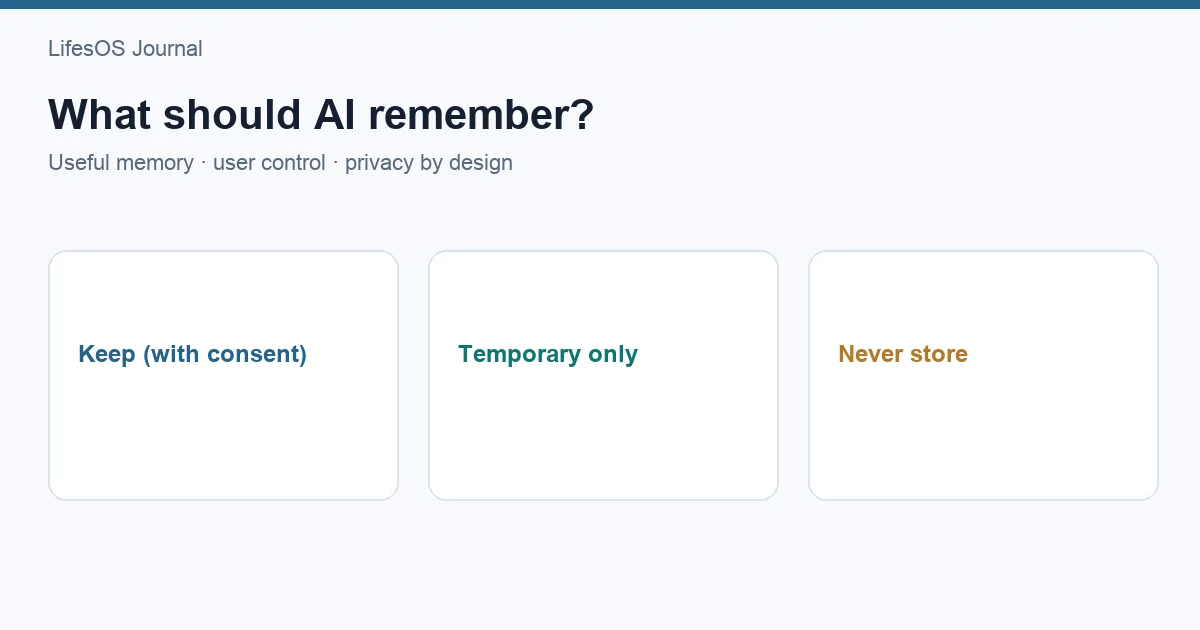
AI memory is useful only when it is bounded. Systems should distinguish among the current conversation, temporary task context, structured records, and longer-term preferences.
- Visibility: show what durable memory exists.
- Purpose: explain why a fact is retained.
- Expiration: allow temporary details to age out.
- Correction: update stale or wrong assumptions.
- Deletion: provide a way to forget information.
- Conflict handling: ask when current instructions differ from stored preferences.
An assistant that remembers everything indiscriminately is not necessarily more personal. It may be less accurate, less private, and harder to control.
What can go wrong even with permission
Stale context
Old working hours, completed goals, former dietary preferences, or outdated budgets can produce confident but irrelevant guidance. Time-sensitive context needs dates and review.
Incomplete records
If cash expenses, private calendars, meals, or offline activity are missing, the assistant sees only part of reality. It should identify likely gaps instead of treating absence as zero.
False causation
An AI may notice that late meetings and takeout occur together. That is a useful hypothesis, not proof that one caused the other. Alternatives include travel, household needs, or unrecorded events.
Automation bias
People may accept a polished suggestion without checking assumptions. Important outputs should expose source records and make alternatives easy to compare.
Cross-domain overreach
Connected data makes new comparisons possible, but not every comparison is appropriate. Health, employment, relationships, and finances require careful purpose limits and often professional expertise.
How to evaluate a personal AI system
- Can you choose which domains are connected?
- Does the system show what context supported an answer?
- Are facts, estimates, patterns, and suggestions clearly separated?
- Can you correct or delete remembered information?
- Does it use the minimum relevant data?
- Are consequential actions previewed and reversible?
- Does it remain useful when only one domain is connected?
- Can you export or remove your data?
- Does it acknowledge missing and stale records?
- Does it avoid medical, legal, or financial certainty beyond the evidence?
A helpful system should reduce repetitive work and improve clarity after the novelty fades. Conversation quality alone is not enough.
Where LifesOS fits
LifesOS is positioned around connected personal context across Finance, Schedule, Nutrition, Activity, and Journey. AI-assisted input can help turn ordinary language into structured drafts; AI insights and chat can help users examine the context they have chosen to maintain.
The intended advantage is continuity across a shared day or week. A schedule constraint can be viewed beside an activity plan. A financial goal can remain connected to budget decisions. Journey context can make the next action visible. LifesOS does not need to replace user judgment for that context to be valuable.
Start with one low-risk workflow, such as drafting a record or summarizing a week. Review the output against the underlying data before adding more context. Explore LifesOS AI or read what a personal AI assistant should actually do.
A safe way to start with personal AI
- Choose one repeated question. For example, “Where can this task fit?”
- Connect or provide one relevant domain. Start with schedule, not every available source.
- Ask the AI to cite context. Check dates, records, and assumptions.
- Use draft mode. Review before saving or changing anything.
- Correct errors immediately. Do not let wrong preferences become durable context.
- Review access. Remove data or permissions that no longer create value.
- Expand only with a clear benefit. Add another domain when it answers a real cross-domain question.
Try LifesOS free for 7 days with one selected workflow. Judge it by whether the resulting advice is more relevant, transparent, and actionable—not by how much data it can absorb.
Related: See what an AI personal assistant should remember.
FAQ
Does AI need all my personal data to be useful?
No. It usually needs a small amount of relevant, current context. Data minimization can improve both privacy and answer quality.
What makes context-aware AI different from a chatbot?
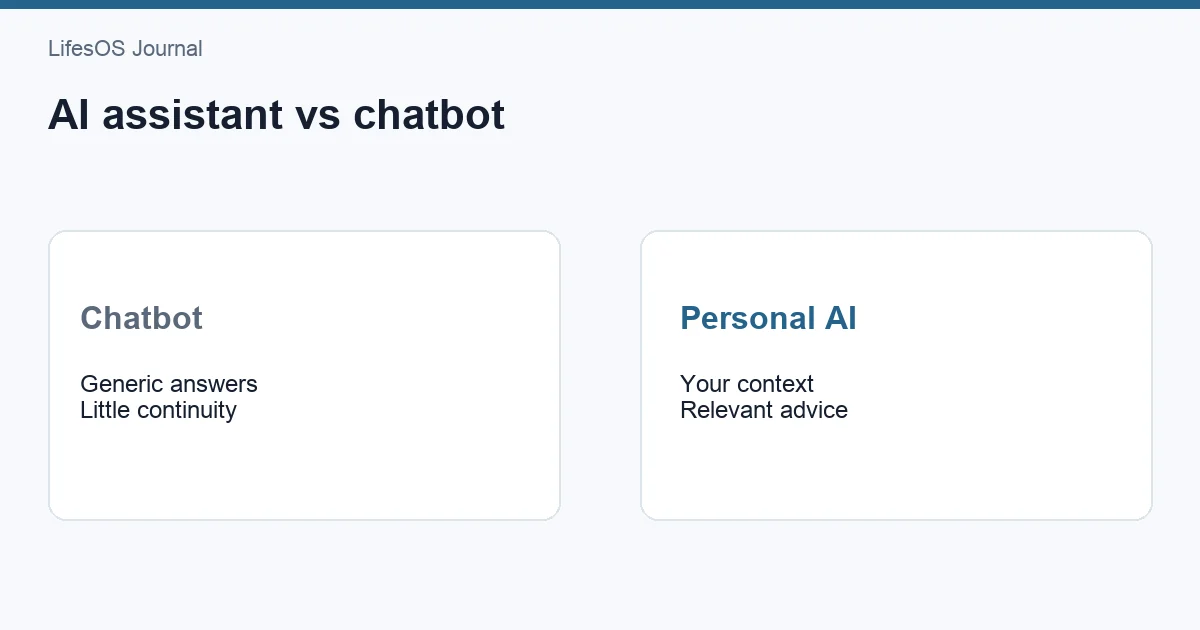
A chatbot can respond to the current prompt. Context-aware AI can use permitted records and preferences to adapt the response to real constraints, while showing what informed it.
Can personal AI make decisions for me?
It can organize evidence, compare options, and draft actions. Consequential health, legal, financial, or life decisions should remain with you and qualified professionals where appropriate.
Should an AI remember everything I tell it?
No. Memory should have a purpose, retention boundary, and controls for inspection, correction, expiration, and deletion.
How do I know whether advice is reliable?
Check the source data, date, assumptions, missing context, and uncertainty. Prefer answers that expose evidence and options over answers that rely on unexplained confidence.
Better context, bounded carefully
Personal AI with your data can replace generic tips with options grounded in your actual schedule, finances, nutrition, activity, and goals. The same context also raises the stakes. Better advice depends on using the right data—not the most data—with consent, minimization, security, user control, and managed memory built into every step.