AI & Life
AI Personal Assistant vs AI Chatbot: What's the Difference?
A chatbot primarily produces conversational responses; an AI assistant helps complete tasks using relevant context, tools, permissions, and reviewable actions.
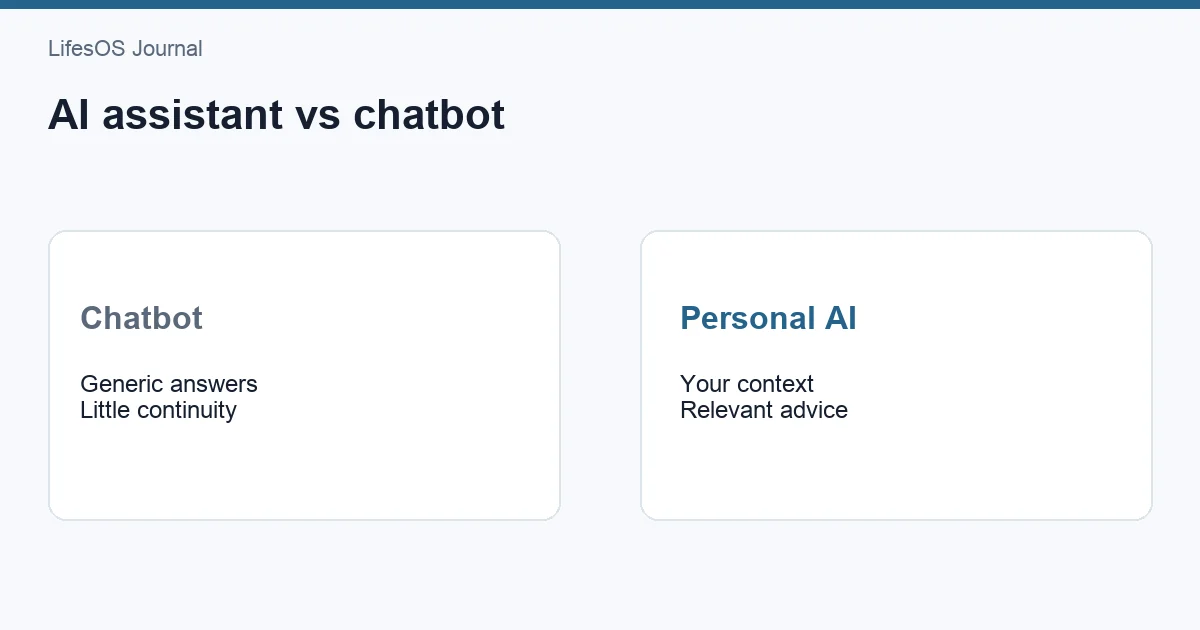
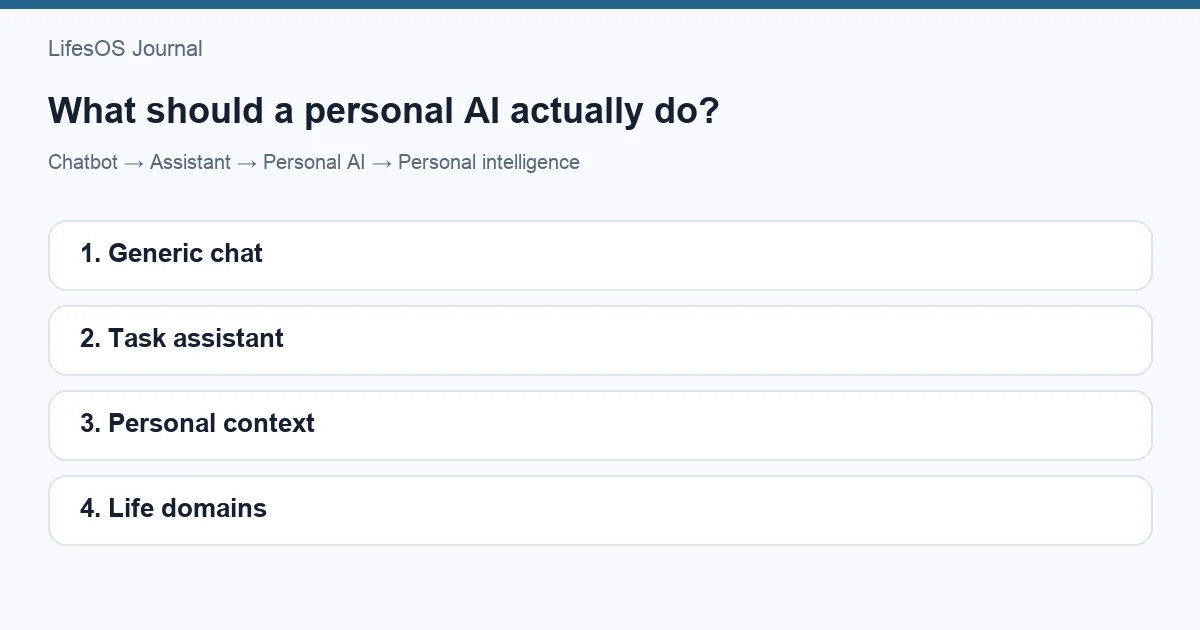
The difference between an AI assistant and a chatbot is what happens beyond the conversation. A chatbot primarily responds to messages. An AI assistant helps complete a task by using relevant context, producing a structured result, or working with permitted tools. A personal AI assistant adapts that help to an individual, while a personal intelligence system connects structured context across multiple life areas and time periods.
These terms are not regulated product categories, and real systems often overlap. The practical way to compare them is to ignore the label and test six capabilities: context, memory, personal data, actions, recommendations, and continuity.
Four useful definitions
Generic chatbot
A generic chatbot conducts a conversation. It interprets a prompt and returns text, images, code, or another conversational output. It may use the current thread and sometimes previous conversations, depending on the product and settings. Its core unit of work is the response.
A chatbot can explain how to create a budget, suggest meal ideas, or draft a weekly plan. That can be valuable. But unless the output becomes a reviewable record or action, the user still has to transfer it into the system where life is managed.
AI assistant
An AI assistant is oriented toward completing a task. It may search approved sources, create a draft calendar event, categorize an expense, summarize a document, or prepare a shopping list. Its core unit is a result that advances work, not merely an answer.
Task execution introduces requirements that conversation alone does not: tool permissions, confirmation, error handling, visible sources, and reversibility.
Personal AI assistant
A personal AI assistant uses information deliberately associated with an individual: preferences, working hours, selected history, goals, or connected records. Personalization should be scoped to the task. A calendar request rarely needs unrestricted financial or journal data.
The term is explored in depth in what a personal AI assistant should actually do. The essential test is whether approved context improves a repeatable task while preserving user control.
Personal intelligence system
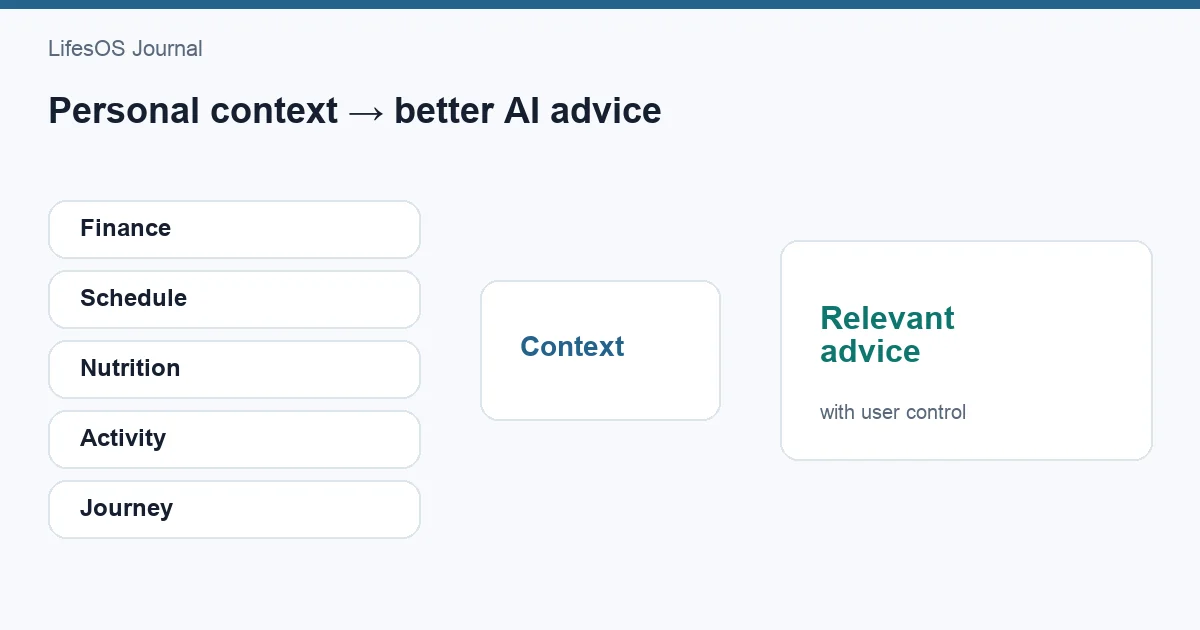
A personal intelligence system connects structured signals across domains and time. It can support questions whose answer depends on more than one app: whether late meetings affect meal plans and spending, whether a goal has realistic calendar capacity, or how a busy week changes activity.
The underlying records remain inspectable. AI helps capture, retrieve, compare, and explain; it should not become the only place where facts live.
Detailed comparison
| Capability | Generic chatbot | AI assistant | Personal AI assistant | Personal intelligence system |
|---|---|---|---|---|
| Primary role | Answer and converse | Help complete a task | Complete tasks with approved individual context | Connect personal signals into decisions and reviews |
| Context | Prompt and current conversation | Task instructions and relevant tool output | Task plus selected preferences and history | Structured cross-domain context over shared periods |
| Memory | Often session or product-dependent history | Task state and sometimes saved settings | Purposeful, user-controlled personal context | Durable records plus governed assumptions and summaries |
| Personal data | Only what the user enters or connects | Data needed for the assigned task | Selected individual data under permission | Multiple structured domains with explicit boundaries |
| Actions | Usually returns a response | Can draft or perform tool-supported actions | Can tailor drafts and actions to the individual | Can support connected workflows across domains |
| Recommendations | General, based on prompt | Task-specific | Adapted to approved context | Cross-domain, evidence-linked, and review-oriented |
| Continuity | Conversation-dependent | May persist task outputs | Can maintain selected preferences and task history | Uses structured records and recurring review periods |
| User control | Prompt and chat controls | Permissions and action confirmation | Context, correction, forgetting, and scope controls | Domain permissions, source visibility, export, deletion, and review |
The table describes capability levels, not claims about every product using a particular label. A product can offer an assistant for one workflow and a chatbot for another.
Context: what does the system know for this task?
A chatbot receives what appears in the prompt or conversation. An assistant may also inspect a file, calendar, database, or tool result when authorized. Personal assistance adds selected information about the user, while a personal intelligence system can align different records by date, goal, or category.
More context is not inherently better. Irrelevant context can distract the system, expose sensitive data, or create misleading associations. Good assistance uses the least information needed and shows which sources informed a consequential answer.
For example, finding two open meeting times requires schedule availability and constraints. It does not usually require meal history or bank transactions. Evaluating whether a travel goal is feasible may require schedule and finance context, but still not every private note.
Memory: conversation history is not the whole story
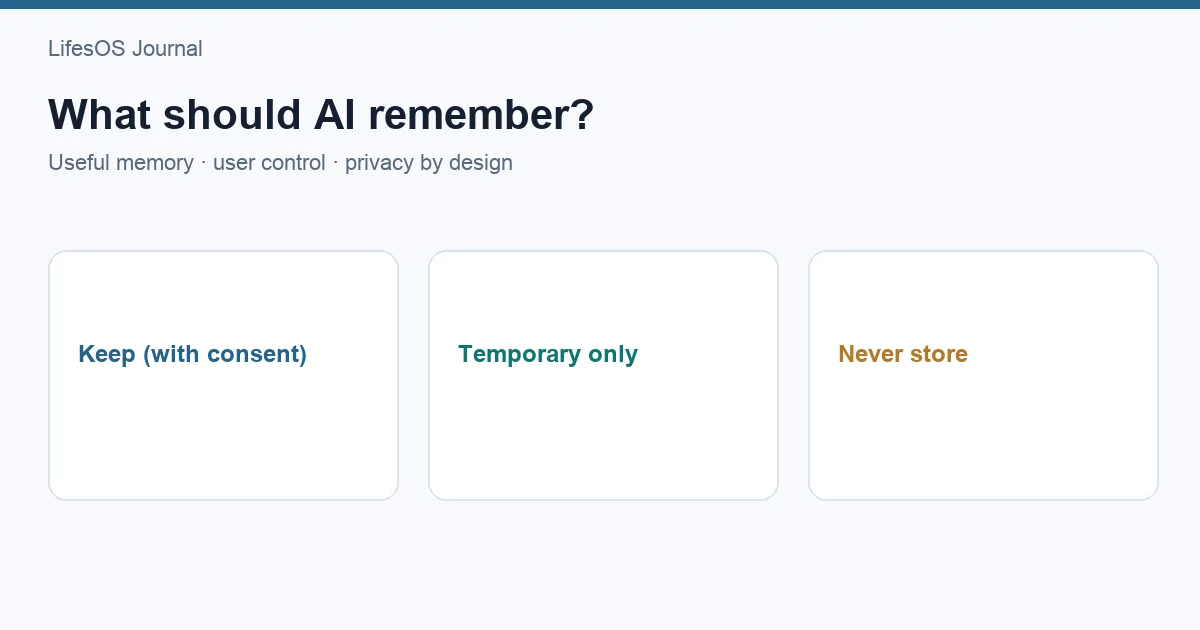
“Memory” can refer to several different things: text still visible in a conversation, saved preferences, previous task outputs, structured records, or inferred summaries. Treating them as one feature obscures important control questions.
- What is stored, and for how long?
- Was it explicitly provided or inferred?
- Can the user view and correct it?
- Can it be limited to one task or domain?
- Can it be deleted or forgotten?
- Does the answer distinguish current facts from old assumptions?
An assistant does not need to remember everything. It needs the right current context with clear boundaries. Durable structured data and generated memory should remain distinguishable.
Actions: the point where reliability matters more
Generating “Your meeting is scheduled” is different from actually creating an event. Once a system can change external state, users need a preview, permission, confirmation proportionate to risk, and an undo path.
| Task | Useful assistant behavior | Control needed |
|---|---|---|
| Schedule an event | Draft time, duration, participants, and conflicts | Confirm before saving or inviting |
| Log a transaction | Extract amount, merchant, date, and category | Show uncertain fields for correction |
| Plan meals | Use schedule constraints and stated preferences | Avoid unsupported health assumptions |
| Record activity | Create an editable entry | Do not diagnose or prescribe |
| Update a goal | Draft milestone and next action | Keep the user responsible for priorities |
The higher the consequence, the stronger the review requirement. An AI-produced suggestion is not proof that an action occurred.
Recommendations: general advice versus evidence-linked options
A generic chatbot can offer broad ideas based on the prompt. An assistant can tailor options to task constraints. A personal assistant can use approved preferences and history. A personal intelligence system can compare related evidence across domains.
Consider “How can I make evenings less rushed?”
- A chatbot may suggest meal preparation and fewer commitments.
- An assistant may inspect the supplied calendar and identify open preparation windows.
- A personal assistant may use stated working hours and preferred meals.
- A personal intelligence system may show that late meetings, takeout, and missed walks cluster on the same two weekdays.
The last observation is still not proof of causation. A trustworthy system presents records, period, uncertainty, and options rather than declaring why a person behaves a certain way. AI can give better advice with relevant personal data, but the data must be appropriate, current, and interpreted carefully.
Continuity: can useful work survive the chat?
A response has limited continuity if the user must copy it elsewhere and explain the same constraints next time. Assistance becomes more durable when an approved result is stored as an event, transaction, meal, activity, goal update, or decision note that can be edited and reviewed.
This is why a personal operating system matters. It provides stable structures for finance, schedule, nutrition, activity, and goals. AI can help operate the system without replacing it.
Continuity should not mean preserving every conversation forever. It means retaining purposeful records and preferences under user control while allowing temporary context to expire.
How personal analytics changes the comparison
Personal analytics connects data with context, patterns, insights, and actions. A chatbot can explain the method. An assistant can help prepare a review. A personal intelligence system can align permitted records across a shared week and surface candidate patterns.
The quality standard is not the number of correlations produced. It is whether the system can show evidence, acknowledge uncertainty, and support a smaller decision. Patterns should remain hypotheses until tested.
How to evaluate a product without relying on labels
- Test an ordinary task. Use a real low-risk workflow rather than a staged question.
- Inspect context. Can you tell which information was used?
- Check the output. Is it a response, a draft, or a completed action?
- Create ambiguity. Does the system ask, expose uncertainty, or guess silently?
- Correct a detail. Can you edit the record and any saved assumption?
- Limit access. Can permissions be scoped by domain and purpose?
- Reverse an action. Is there confirmation, history, or undo?
- Return next week. Does useful continuity exist without excessive retention?
- Export and delete. Can you control the personal data involved?
Do not infer capabilities from polished conversation. Ask what durable result exists and what control surrounds it.
Choose the simplest tool that fits the job
A chatbot may be sufficient for brainstorming, explaining a concept, rewriting text, or generating options with no need for personal context. An assistant fits bounded tasks such as summarizing approved documents or drafting an event. Personal assistance becomes useful when repeated tasks depend on stable preferences. A personal intelligence system matters when decisions regularly cross life domains.
Greater capability also creates greater responsibility. Tool access, personal data, durable context, and actions require stronger permissions, transparency, security, and deletion controls. “More personal” is not always the right choice.
Where LifesOS fits
LifesOS organizes personal context across Finance, Schedule, Nutrition, Activity, and Journey, with AI-assisted input and review-oriented workflows. That structure is intended to help users move from conversation to inspectable records and connected context.
For example, an ordinary-language description can become a draft entry, while schedule and activity can be viewed within the same week. AI-generated interpretations should still be checked against source data, and consequential decisions remain with the user.
Explore LifesOS AI to understand the available AI-assisted workflows. The meaningful question is not whether a chat box sounds personal; it is whether the system helps create a useful, reviewable result with appropriate control.
Common comparison mistakes
- Assuming every chatbot is only generic. Products can combine capability levels.
- Equating memory with intelligence. Old context can be wrong or irrelevant.
- Treating more access as better personalization. Use purpose-limited data.
- Confusing a statement with an action. Verify external state.
- Ignoring correction and deletion. Control is part of usefulness.
- Believing recommendations prove causation. Inspect evidence and alternatives.
- Comparing marketing claims instead of workflows. Test ordinary tasks.
FAQ
Is an AI assistant the same as a chatbot?
No, though one product can be both. A chatbot primarily exchanges messages; an assistant helps complete tasks using relevant context, tools, drafts, or actions.
What makes an AI assistant personal?
It uses approved information specific to an individual—such as preferences, goals, or selected records—to improve a task. That context should be visible, limited, correctable, and deletable.
Does an AI assistant need long-term memory?
Not for every task. It needs relevant current context. Purposeful preferences or records may persist, while temporary details should be allowed to expire or be forgotten.
What is a personal intelligence system?
It is a system that organizes structured personal data across domains and time so AI and analytics can support connected decisions, reviews, and actions.
Which is better, an AI assistant or chatbot?
It depends on the job. A chatbot can be ideal for explanation and brainstorming. An assistant is more suitable when a task needs tools, structured outputs, personal context, or continuity.
Compare outcomes, not names
The AI assistant vs chatbot distinction becomes clear when you inspect behavior. Ask what context is used, what persists, which personal data is necessary, whether actions are real and reversible, how recommendations cite evidence, and whether useful work survives the conversation.
Start a 7-day LifesOS trial and test one ordinary workflow. Judge it by the result you can inspect and control—not by how confidently the interface describes itself.