Productivity
Daily Review vs Weekly Review: Which Do You Need?
A daily review keeps today aligned; a weekly review reveals patterns and resets priorities. Most people benefit from a brief daily check plus a deeper weekly review.
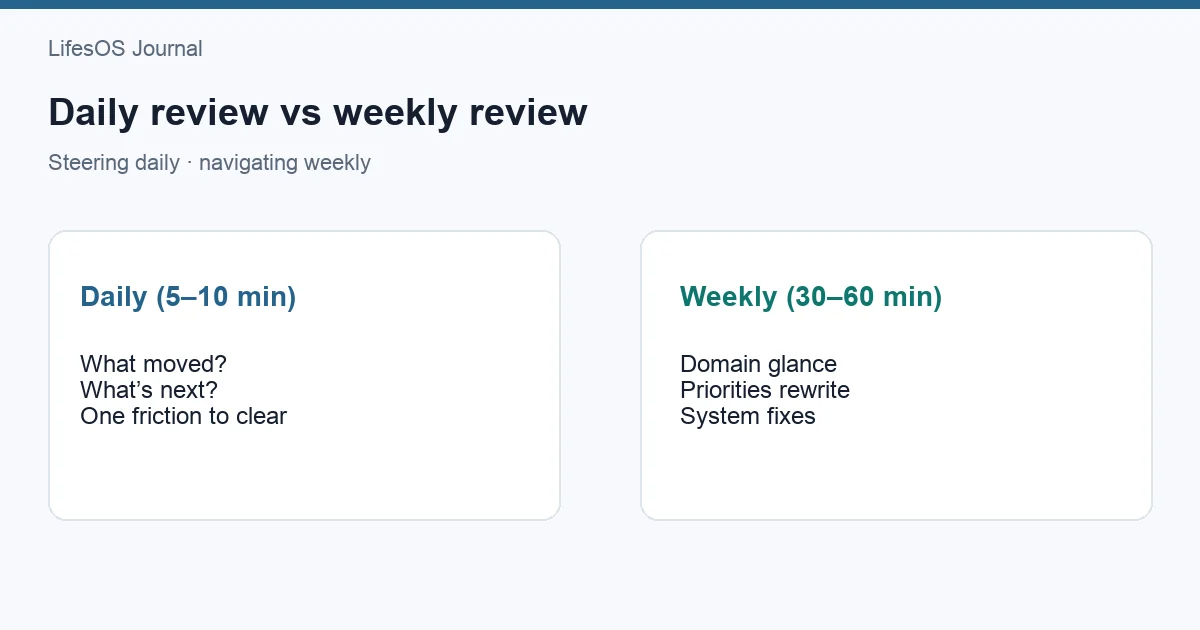
A daily review keeps the next 24 hours realistic; a weekly review helps you see patterns and choose direction. Use a daily review when schedules shift, tasks pile up, or tomorrow needs preparation. Use a weekly review to close loops, inspect projects, and plan across work and life. Most people need both: a five-minute daily check and a 20-to-45-minute weekly reset.
Daily review vs weekly review at a glance
| Dimension | Daily review | Weekly review |
|---|---|---|
| Main purpose | Adjust execution | Reassess direction |
| Time horizon | Today and tomorrow | Last week and next 1–2 weeks |
| Typical length | 3–10 minutes | 20–45 minutes |
| Best questions | What changed? What is next? | What mattered? What needs attention? |
| Inputs | Calendar, active tasks, new notes | Projects, calendar, task inbox, life-domain data |
| Outputs | Tomorrow's first action and adjusted plan | Weekly priorities, closed loops, scheduled outcomes |
| Main risk | Micromanaging every day | Producing a large list without follow-through |
Neither review is inherently better. They operate at different zoom levels. A daily check cannot reveal a month-long workload pattern, while a weekly plan cannot account for the meeting that moved this afternoon.
What is a daily review?
A daily review is a brief transition between doing and deciding. It updates the plan using today's reality and prepares the next work period. You might do it at the end of the workday, after dinner, or first thing in the morning.
A useful daily review answers five questions:
- What did I finish?
- What changed or arrived?
- What must happen tomorrow?
- What can move, shrink, or disappear?
- What is the first action when I begin?
Its scope should remain narrow. Capture loose notes, update a few active tasks, check tomorrow's calendar, and choose the next start. Do not inspect every project or redesign your system each evening.
A five-minute daily checklist
| Minute | Action |
|---|---|
| 0–1 | Mark completed work and capture loose notes |
| 1–2 | Check tomorrow's calendar and preparation |
| 2–3 | Choose one must-do and up to two supporting tasks |
| 3–4 | Move or remove tasks that no longer fit |
| 4–5 | Prepare the first document, space, or item |
The final minute is valuable because it bridges intention and action. Opening the proposal document, setting out training clothes, or placing a form by the door reduces the startup cost tomorrow.
What is a weekly review?
A weekly review is a broader checkpoint for reflection, cleanup, and planning. It reviews the past week, checks ongoing commitments, and chooses what deserves capacity in the next one. The review can cover projects, money, schedule, health, relationships, and personal goals rather than only today's tasks.
A useful weekly review answers:
- What progress, friction, or surprise appeared last week?
- Which commitments are open or unclear?
- What deadlines and constraints are approaching?
- Which two or three outcomes matter most next week?
- What should I stop, defer, delegate, or renegotiate?
The weekly review creates enough distance to see recurrence. One late bedtime may be noise; four may explain poor focus. One overspent lunch may not matter; repeated convenience spending may reveal that Wednesday meals need preparation. That pattern view is difficult to get from daily checks alone.
A 30-minute weekly checklist
| Minutes | Action |
|---|---|
| 0–5 | Collect notes and clear key inboxes |
| 5–10 | Look back at calendar, tasks, and meaningful results |
| 10–17 | Review active projects and unresolved commitments |
| 17–22 | Look ahead at two weeks of calendar constraints |
| 22–27 | Choose up to three outcomes and their next actions |
| 27–30 | Schedule priorities and record one learning note |
If you prefer a more practical preparation ritual, use the 45-minute Sunday reset checklist. It adds a money glance, environmental setup, and explicit recovery planning.
When a daily review matters most
A daily review earns its place when execution conditions change faster than a weekly plan can absorb.
- Your calendar changes often. Meetings move, client requests arrive, or caregiving needs shift.
- You lose track of new inputs. Notes and requests stay in messages instead of reaching a trusted list.
- You overestimate daily capacity. A brief check forces tomorrow's list to fit tomorrow's calendar.
- You struggle to start. Choosing the first action reduces morning indecision.
- You carry work into rest. A clear shutdown can mark that today's work is complete.
During a stable season with repetitive work, you may need only a two-minute calendar and task check. During travel, deadlines, or family disruption, a ten-minute daily review can prevent small changes from becoming missed commitments.
When a weekly review matters most
A weekly review is more valuable when the problem is not today's action but the shape of your commitments.
- You are busy but key projects do not move. The review compares activity with outcomes.
- You manage several roles. Work, family, health, money, and personal goals compete for the same time.
- Tasks go stale. Weekly inspection lets you clarify, delete, delegate, or renegotiate them.
- You repeat the same planning error. A longer horizon reveals overload and recurring friction.
- Deadlines surprise you. Looking ahead two weeks creates preparation time.
Weekly reviews are especially useful for people with multiple projects or autonomy over their time. When priorities are externally assigned and work is highly routine, the review can be shorter but still helps coordinate the rest of life.
Try LifesOS free for 7 days and use the Weekly Report to see patterns before choosing next week's priorities.
The hybrid: a small daily loop inside a weekly loop
The most practical system gives each review one job:
- Weekly: choose direction, inspect commitments, and allocate capacity.
- Daily: adapt the weekly plan to new information.
On Sunday, you might choose three outcomes: send a proposal, complete two training sessions, and renew insurance. On Monday evening, an urgent Tuesday meeting appears. The daily review does not replace the weekly outcomes. It moves the proposal block to Wednesday, confirms that one training session still fits Tuesday evening, and leaves insurance on Thursday.
| Layer | Decision | Example |
|---|---|---|
| Weekly direction | What deserves progress? | Send proposal |
| Weekly capacity | When can it fit? | Tuesday 9:00–10:30 |
| Daily adjustment | What changed? | Urgent meeting took Tuesday block |
| Daily response | What is the smallest responsible revision? | Move draft to Wednesday; send timing note |
This arrangement avoids two extremes: rigidly following a stale weekly plan or rebuilding the entire week every evening.
How to set up your review rhythm
Step 1: choose fixed cues
Attach the daily review to the end of work, dinner cleanup, or the moment you plug in your phone. Attach the weekly review to a recurring block that usually has enough energy and privacy. Consistent cues reduce reliance on remembering.
Step 2: use one source for commitments
A review cannot work if tasks remain scattered across email, chat, paper, and memory. Capture them wherever convenient, but process them into one trusted task view. Keep time-specific commitments on the calendar.
Step 3: define visible outputs
The daily review ends with tomorrow's first action, one must-do, and an updated calendar. The weekly review ends with up to three outcomes, their next actions, and protected time. These outputs make “done” clear.
Step 4: set time limits
Start with five minutes daily and 30 minutes weekly. If the review repeatedly runs long, it may be absorbing actual task work. Capture that work and schedule it instead.
Step 5: review the reviews
After four weeks, ask whether each ritual changes decisions. If the daily review only repeats the task list, shorten it. If the weekly review creates plans that never reach the calendar, add scheduling before it ends. A review is useful when it changes attention or action.
Three situations and the right review mix
Student with fixed class times
A five-minute evening review checks tomorrow's classes, materials, and one study target. A 30-minute weekend review maps assignments and exams across two weeks. The weekly review carries direction; the daily check catches changing workload.
Manager with a meeting-heavy calendar
A ten-minute shutdown captures follow-ups and protects tomorrow's first focus block. A weekly review checks team commitments, decision bottlenecks, and whether meetings leave capacity for priority work. Without the weekly level, urgent requests can occupy every day.
Parent with variable caregiving
A short evening check coordinates transport, meals, school needs, and the next morning. A shared weekly review compares family calendars, bills, and recovery needs. The plan should include fallback priorities because some capacity will remain uncertain.
What to review beyond tasks
Review only data that can inform a decision. Daily inputs might include energy, sleep timing, active schedule, or spending that requires immediate action. Weekly inputs might include completed focus blocks, money variance, training sessions, meal consistency, or time with important people.
| Signal | Daily use | Weekly use |
|---|---|---|
| Calendar | Prepare tomorrow | Check load and conflicts |
| Tasks | Select next actions | Review projects and stale work |
| Money | Notice urgent charge or bill | See category patterns and upcoming costs |
| Energy | Adjust task difficulty | Place demanding work on stronger days |
| Habits | Simple cue or completion | Look for consistency and causes |
Do not turn the routine into personal surveillance. If tracking a signal does not change a choice after several weeks, remove it.
Common review mistakes
- Using both reviews for the same task. Daily adjusts execution; weekly reassesses direction.
- Reviewing without deleting. A task system needs removal and renegotiation, not only additions.
- Ignoring the calendar. Priorities without time remain wishes.
- Writing ten weekly priorities. Limit outcomes so tradeoffs become visible.
- Turning reflection into self-judgment. Describe evidence, cause, and the next experiment.
- Doing work inside the review. If an item takes more than two minutes, schedule or capture it.
- Skipping recovery and personal commitments. Capacity includes the whole person, not only work hours.
- Keeping the routine when it changes nothing. Shorten, revise, or remove steps that do not affect decisions.
If you can only choose one
Choose the review that addresses your current failure point. If each day starts confused and unexpected changes cause missed commitments, begin with a five-minute daily review. If your days are active but important areas receive no sustained attention, begin with a weekly review.
For many people, the weekly review has greater leverage because it selects direction and checks the full system. Add the daily review once there is a weekly plan worth adapting. If your schedule is unusually volatile, reverse that order.
Related: Run the full ritual with a 30-minute weekly review system.
FAQ
Do I need both a daily and weekly review?
Not always, but they solve different problems. A brief daily check handles changing execution; a weekly review handles priorities and patterns. Use both when you need both levels of control.
How long should a daily review take?
Three to ten minutes is enough for most people. If it regularly takes longer, you may be doing tasks, processing a large backlog, or reconsidering projects that belong in the weekly review.
When is the best time for a weekly review?
Use a consistent block before the next planning cycle. Friday afternoon, Sunday, or Monday morning can all work. Choose a time with enough attention and few interruptions.
Is a daily review the same as journaling?
No. They can overlap, but a daily review updates commitments and prepares action. Journaling may explore feelings, experiences, or ideas without producing a plan.
What if my weekly plan becomes outdated by Tuesday?
Use daily reviews to revise timing while preserving the week's most important outcomes. If the underlying priorities changed, take ten minutes for a midweek reset rather than pretending the old plan still fits.
How do I start without building a complicated system?
For one week, end each day by checking tomorrow's calendar and choosing the first action. At week's end, spend 20 minutes looking back, looking ahead, and choosing three outcomes. Add tools only when a clear need appears.
Choose your review cadence
Put a five-minute daily review on tomorrow's calendar and one 30-minute weekly review within the next seven days. Keep the checklists short, follow them for four weeks, and judge them by the decisions they improve—not by how organized they look.
For a connected planning flow, see how to plan your week. Then start your 7-day LifesOS trial and bring your daily adjustments and weekly patterns into one system.