Personal Finance
How to Create a Monthly Financial Review
A monthly financial review closes the books on the past month, explains meaningful differences between plan and reality, and turns those findings into a better plan for next month.
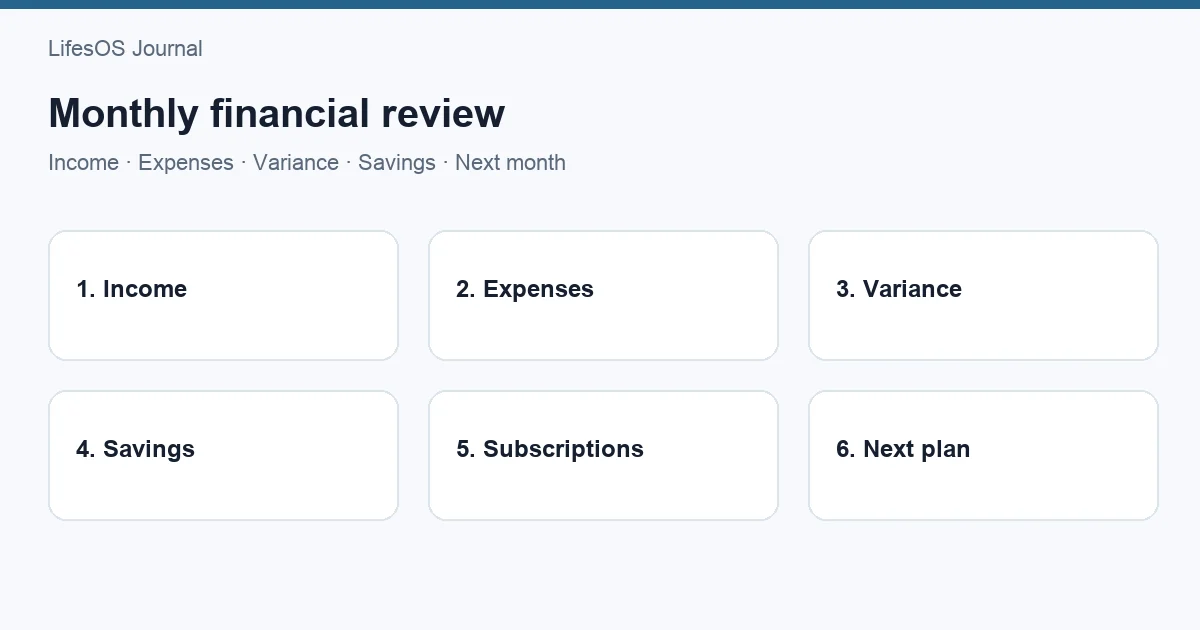
A monthly financial review is a 45- to 60-minute check of what came in, what went out, what changed, and what you will adjust next month. Reconcile your transactions, compare actual results with your budget, review savings and subscriptions, identify unusual expenses, and make a short list of next-month changes. The goal is not to judge every purchase. It is to turn a month of activity into useful decisions.
This review is broader than a weekly money review. A weekly check catches immediate problems, such as a category running hot or a bill due soon. The monthly review looks for patterns, closes incomplete records, and resets the plan. Both can help: weekly reviews steer; monthly reviews learn and reforecast.
Monthly money review checklist
- Confirm all income received and note any missing or delayed income.
- Reconcile accounts and finish tracking expenses.
- Compare total and category expenses with the monthly plan.
- Explain important budget variances without overanalyzing tiny differences.
- Check savings contributions, debt payments, and your savings rate.
- Review subscriptions and recurring charges.
- Separate unusual expenses from repeatable changes.
- Check upcoming bills, annual costs, and next month's known events.
- Choose two or three specific adjustments for next month.
1. Prepare accurate numbers
Start with the same date range across every account, typically the first through the last day of the month. Bring together checking, savings, credit cards, cash records, and any payment apps used for spending. Mark transfers so they are not counted as income or expenses. A transfer from checking to savings changes where money sits; it does not create new money.
Reconcile means checking that your records match account activity. Add missing transactions, fix duplicates, and classify refunds consistently. Pending card charges may settle in the next month, so choose a rule and use it every time. Cash-basis reviews usually count a transaction when it posts. Precision matters, but perfection does not: an unexplained difference of a few dollars should not consume the entire review.
The Consumer Financial Protection Bureau offers practical budgeting and money-management resources, including tools for tracking income, bills, and spending. These can be useful if you are setting up your first review process.
2. Review income received
Compare expected income with deposits that actually arrived. Include salary, freelance payments, benefits, interest, and other real inflows, but keep reimbursements and account transfers separate. If income was higher or lower than planned, write down why. Was there overtime, an unpaid invoice, a bonus, fewer shifts, or a timing difference?
| Income source | Planned | Actual | Difference | Reason |
|---|---|---|---|---|
| Primary pay | $4,000 | $4,000 | $0 | As expected |
| Freelance work | $600 | $350 | -$250 | One invoice delayed |
| Interest | $10 | $14 | +$4 | Higher balance |
Do not automatically build next month's lifestyle around one-time income. If a higher amount is likely to repeat, update the forecast. If it was exceptional, decide deliberately whether it goes toward a reserve, debt, a planned purchase, or another priority.
3. Review expenses by category
First compare total spending with total planned spending. Then examine categories that are large, flexible, or materially different from plan. Housing may be exactly on target while groceries, transportation, or dining account for most of the movement. Focus attention where a decision could change the outcome.
Use both dollars and percentages. Being $50 over on a $100 category is a 50% variance, but being $50 over on a $2,000 category is only 2.5%. The dollar amount affects cash flow; the percentage may reveal a weak estimate. For a fuller explanation, see budget variance explained.
| Category | Budget | Actual | Variance | Action |
|---|---|---|---|---|
| Groceries | $500 | $575 | $75 over | Raise plan $25; use list |
| Transport | $240 | $195 | $45 under | Keep current target |
| Dining | $180 | $310 | $130 over | Set weekly limit |
| Utilities | $210 | $224 | $14 over | No change |
4. Explain variance before changing targets
A variance is information, not proof that you succeeded or failed. Ask whether the difference came from timing, price, quantity, omission, or behavior. A six-month insurance premium is a timing issue. Higher grocery prices are partly a price issue. Extra takeout during a demanding week is a behavior and capacity issue. Each cause suggests a different response.
Do not raise every category that went over. That can turn the budget into a record of spending rather than a plan. Likewise, do not cut every category that came in under; the result may be random. Look for repeated evidence across two or three months. When overspending reflects stress, convenience, or unclear limits, use the practical steps in how to stop overspending.
5. Check savings, debt, and cash reserves
Compare planned contributions with completed transfers and payments. Check emergency savings, sinking funds, retirement contributions, and extra debt payments separately because they serve different purposes. If you planned to save $600 but saved $450, identify whether the missing $150 was redirected intentionally or absorbed without a decision.
Your savings rate can provide a useful trend, but a single month can be distorted by bonuses or annual bills. Compare several months and use the same formula consistently. Also check liquid cash: a strong savings percentage does not help next week's bills if all available money is inaccessible. The review should connect long-term progress with near-term cash flow.
6. Audit subscriptions and recurring charges
Scan the full transaction list for monthly and annual recurring charges. Ask whether you used each service, would buy it again today, and can replace it with something already paid for. A subscription is not automatically wasteful; unused or duplicated subscriptions are the problem.
Canceling a $12 service matters only if the cancellation is completed. Record the confirmation and check next month for a final charge. Also inspect price increases, free trials converting to paid plans, insurance renewals, software, memberships, storage plans, and charitable contributions. Keep valuable recurring expenses in the budget so they stop appearing as surprises.
7. Separate unusual expenses from new normal
Label large unexpected costs, but do not dismiss every inconvenient expense as one-time. A medical copay may be unusual. Car maintenance is irregular but predictable over time. Several months of higher utility bills may represent a new baseline. Ask: could this happen again within a year, and should it have a sinking fund?
Create a short unusual-expense log with the amount, cause, and future response. If the event is likely to repeat, divide an annual estimate by twelve and add that amount to next month's plan. If it was truly exceptional, explain how it was funded. This prevents the same category from being called a surprise repeatedly.
8. Make next-month adjustments
Finish by changing the future, not merely documenting the past. Open your monthly budget and account for known events: travel, birthdays, school fees, seasonal utility changes, annual renewals, or fewer working days. Update income conservatively and revise category targets where evidence supports it.
- Protect obligations: fund housing, utilities, food, transport, insurance, and minimum payments.
- Plan irregular costs: contribute to relevant sinking funds.
- Preserve priorities: schedule savings or extra debt payments.
- Adjust flexible spending: set realistic limits and one concrete behavior.
- Keep a buffer: leave room for estimation error.
A good review ends with no more than three actions, such as cancel one subscription, increase the car-maintenance fund by $40, and set a $60 weekly dining limit. Too many changes are difficult to remember and evaluate.
Use LifesOS Finance to organize categories, compare planned and actual spending, and keep your next review in one place. Download LifesOS and build a repeatable monthly money routine.
A simple 60-minute review agenda
| Minutes | Task | Output |
|---|---|---|
| 0–15 | Reconcile accounts | Complete transaction record |
| 15–25 | Review income and total spending | Headline result |
| 25–40 | Inspect category variance | Reasons for major differences |
| 40–50 | Check savings and subscriptions | Progress and cancellations |
| 50–60 | Adjust next month | Updated budget and three actions |
If your records are current, the process may take less time. If reconciliation regularly takes most of the hour, shorten the gap between transaction updates. A five-minute weekly cleanup makes month-end analysis far easier.
Common review mistakes
- Reviewing too early: wait until most transactions have posted.
- Counting transfers twice: distinguish movement between accounts from income and spending.
- Chasing every small variance: investigate material or repeated differences.
- Ignoring cash flow: category totals do not replace checking upcoming due dates.
- Using guilt as analysis: describe what happened and choose a response.
- Skipping the next-month plan: a review without adjustments is only a report.
FAQ
When should I do a monthly financial review?
Do it after the month ends and most card transactions have posted, often during the first three to five days of the new month. Use the same recurring time so the habit is easier to maintain.
How is a monthly financial review different from a weekly money review?
A weekly review checks current balances, recent spending, and near-term bills so you can steer during the month. A monthly review reconciles the full period, analyzes patterns and variance, reviews subscriptions and savings, and resets the next month's budget.
What if I do not have a budget yet?
Review actual income and spending anyway. Categorize the month, identify obligations and irregular costs, then use those numbers as the starting evidence for your first budget rather than guessing from scratch.
Should couples review money together?
Shared finances benefit from a shared monthly decision point. Agree beforehand on which accounts and goals are joint, what privacy each person keeps, and which differences require discussion. Keep the meeting focused on facts and future choices.
What should I do if I overspent?
Identify the cause, check current cash flow, and choose the smallest useful correction. That might mean reducing one flexible category, adjusting an unrealistic target, funding an irregular cost, or making a specific behavior easier next month.
Close the month with a clear record and a realistic plan. Try LifesOS to review your finances and carry the lessons into next month.
This article provides general educational information and is not personalized financial, investment, tax, or legal advice. Consider your circumstances and consult a qualified professional when appropriate.