Personal Finance
How to Stop Overspending: 10 Practical Strategies That Work
Stop overspending by finding the situations that cause it, adding friction before purchases, setting usable category limits, and reviewing money weekly.
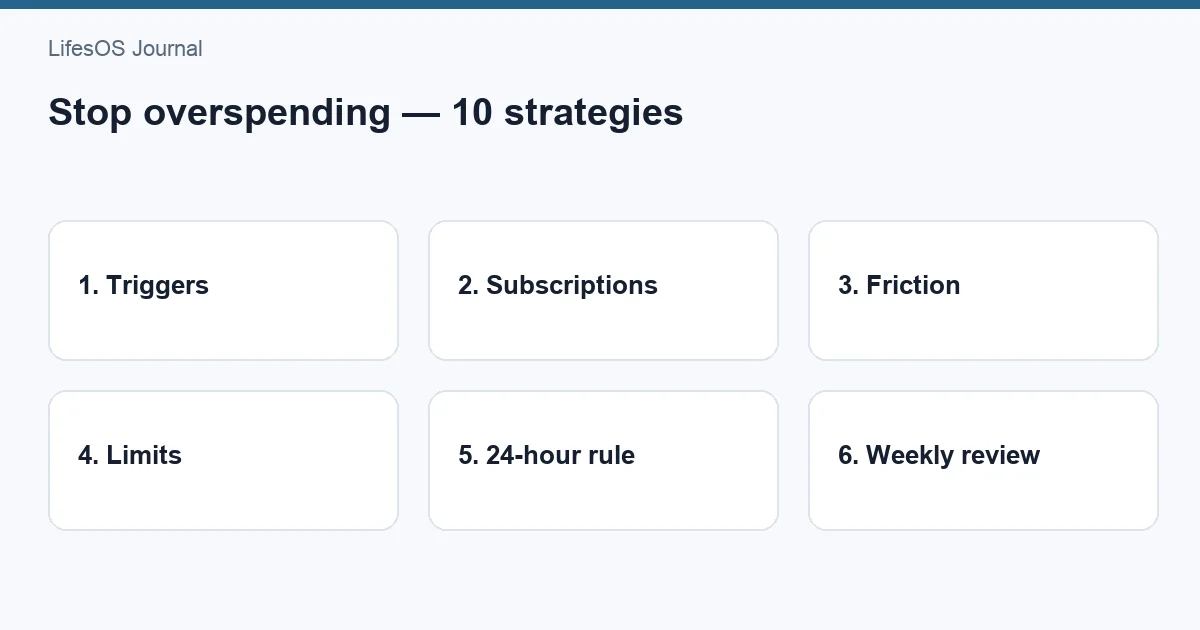
To stop overspending, identify the categories and situations where spending exceeds your plan, then change the environment around those moments. Review the last 30 days, choose one or two high-impact categories, set realistic limits, remove saved payment details, and use a 24-hour pause for unplanned purchases. Automate bills and savings so discretionary spending cannot consume money needed later. A short weekly review keeps the plan current before a small drift becomes a month-end surprise.
Overspending is usually not a character flaw. It often comes from unclear cash flow, convenience, stress, social pressure, forgotten subscriptions, or a plan that never allowed enough for real life. The ten strategies below address those causes without requiring constant self-denial.
What counts as overspending?
Overspending means spending more than your available resources or more than you deliberately planned, especially when it interferes with bills, debt payments, savings, or other priorities. A large purchase is not automatically overspending if it was planned and funded. A series of small convenience purchases can be overspending if it creates a shortfall.
There are three common forms:
- Cash-flow overspending: money leaves before upcoming bills are protected.
- Category overspending: one area repeatedly exceeds its limit.
- Lifestyle overspending: recurring commitments are too high for dependable income.
Each needs a different response. A 24-hour rule may help impulse purchases, but it cannot fix rent and loan payments that consume nearly all take-home income.
Start with a no-blame spending audit
Use bank and card records to track expenses for the last 30 days. Group transactions into housing, bills, groceries, dining, transport, shopping, subscriptions, health, debt, saving, and other categories. Then mark which purchases were planned, unplanned but useful, or regretted.
| Question | What it reveals | Possible response |
|---|---|---|
| Which category exceeded the plan most? | Largest financial opportunity | Set a category limit |
| When did unplanned purchases happen? | Timing trigger | Add a pause or alternate routine |
| Which merchant appears repeatedly? | Convenience loop | Remove app or saved card |
| Which costs were forgotten? | Planning gap | Add bill calendar or sinking fund |
| What did the spending solve? | Underlying need | Find a less costly substitute |
Look for patterns, not a list of mistakes. “I overspent $180 on food delivery on late meeting days” is actionable. “I am bad with money” is not.
10 practical strategies to stop overspending
1. Identify the trigger before changing the purchase
For one week, note the context of unplanned spending: time, place, emotion, people, and what happened immediately before. Common triggers include fatigue, boredom, stress, hunger, social comparison, sales alerts, and a desire for convenience after an overloaded day.
Match the response to the trigger. If late work causes delivery orders, keep two easy meals available. If browsing happens during a commute, remove retail apps and prepare another activity. If social spending is the issue, suggest a lower-cost plan before the group defaults to an expensive one.
2. Give every payday a cash-flow plan
A monthly total can look affordable even when bills arrive before the next paycheck. List each pay date, bill due date, automatic transfer, and expected variable expense. Protect housing, utilities, food, transport, minimum payments, and savings first. Only then calculate what is available for flexible spending.
Use a monthly budget for the overall plan and a payday view for timing. If due dates cause recurring shortages, ask providers whether a change is available.
3. Use realistic category limits
A limit should be lower than current spending but high enough to survive an ordinary month. If dining averages $450, setting $50 without changing work hours, food preparation, or social plans will probably fail. Try $325, decide where the reduction comes from, and reassess after four weeks.
Break a monthly limit into weekly guidance. A $320 flexible-food budget becomes roughly $74 per week, leaving a little margin for a longer month. Stop or adjust when the category reaches its boundary rather than discovering the overage later.
4. Add friction to common impulse paths
- Delete saved cards from retail sites.
- Unsubscribe from sale emails and push alerts.
- Remove shopping apps from your phone.
- Require a separate login or physical card.
- Keep wish-list items outside the checkout cart.
- Do not use one-click purchasing.
Friction creates enough time for the original urge to weaken. The goal is not to make needed purchases difficult; apply it to the channels where unplanned spending usually begins.
5. Use a 24-hour rule
For a nonessential purchase above a chosen threshold—perhaps $30 or $100—wait 24 hours before buying. For larger items, use 72 hours or seven days. Record the item, total cost including fees, where the money would come from, and what goal would be delayed.
The rule is not a ban. If the item still fits after the pause, buy it without turning the decision into a moral debate. Exclude genuine emergencies and routine essentials.
Use LifesOS Finance to set one category limit and review it weekly. Start with the spending pattern that affects your plan most.
6. Audit recurring subscriptions and renewals
Search three months of statements for repeated charges. List the price, renewal date, frequency of use, and cancellation process. Cancel services you do not use, rotate entertainment subscriptions rather than stacking them, and set reminders before annual renewals.
Do not spend an hour chasing a $2 saving while ignoring a rarely used $80 membership. Rank recurring costs by annual amount. Also inspect app stores, cloud storage, warranties, delivery memberships, and software billed through payment processors.
7. Shop with a list and a total
Before groceries, household shopping, or online orders, write a specific list and estimate the total. Eat before grocery shopping when possible, compare unit prices, and choose substitutions in advance. For online purchases, search for the item directly instead of browsing a personalized feed.
A list reduces exposure to decisions; a total connects the trip to available cash. Leave a small planned amount for discovery if rigid lists make the system unpleasant. The point is intention, not perfection.
8. Separate spending money from bill money
Keep money needed for upcoming bills and goals distinct from everyday flexible spending. Some people use separate checking accounts; others use bank subaccounts or digital categories. After payday, move savings automatically and reserve bill amounts. Transfer a weekly allowance for groceries, dining, and personal spending.
Cash can help with one problem category because the remaining amount is visible, but it is not required. A dedicated debit balance can provide similar boundaries. Avoid systems that create fees or make bill payment fragile.
9. Replace the reward, not only the expense
Spending often provides novelty, relief, connection, or a sense of progress. Removing the purchase without replacing its function leaves the trigger intact. Make a short menu of alternatives: call a friend, walk with a podcast, borrow a book, cook a favorite easy meal, repair something owned, or move an item from a wish list to a future plan.
Budget some enjoyable spending on purpose. A plan with no room for preference can produce rebound purchases and be difficult to maintain.
10. Hold a 15-minute weekly money review
A weekly money review catches problems while choices remain. Check account balances, upcoming bills, category totals, unusual transactions, and one decision for the next seven days. Compare planned and actual spending using budget variance.
| Minutes | Review action |
|---|---|
| 0–3 | Check balances and unexpected transactions |
| 3–6 | Confirm bills before the next payday |
| 6–10 | Compare key categories with their limits |
| 10–13 | Review recent unplanned purchases and triggers |
| 13–15 | Choose one adjustment for the next week |
Example: reducing convenience spending
Maya notices that dining and delivery reached $620 against a $350 plan. Her audit shows most orders happen Tuesday through Thursday after late work. She does not set the category to zero. Instead, she:
- Raises the honest starting limit to $450 for the first month.
- Schedules a grocery order with three fast meals each Sunday.
- Keeps one planned restaurant night.
- Deletes the delivery app but keeps access through a browser.
- Moves $42 per week to a dining subaccount.
- Reviews the balance Thursday afternoon.
The first month ends at $430. The plan saves $190 compared with the prior month and remains livable. She can now decide whether $400 is realistic. Progress comes from changing the late-work environment, not from promising to try harder.
What to do after an overspending week
First, protect upcoming essentials. Then calculate the exact shortfall. Avoid punishing cuts that create another rebound. Reduce optional spending for the remainder of the pay period, move a planned purchase, or use an existing discretionary buffer. Do not raid emergency savings for a non-emergency unless the alternative threatens an essential obligation; if you do, make a concrete rebuilding plan.
Ask what needs redesigning. Was the limit unrealistic? Did a known annual expense lack a sinking fund? Did fatigue make convenience worth paying for? Update the system using evidence from the week.
When the problem is structural
If essential bills exceed dependable income, small impulse controls cannot close the gap. Prioritize housing, food, utilities, required transport, insurance, and minimum obligations. Contact service providers or creditors early about hardship options, review eligible assistance, and consider reputable nonprofit credit counseling. Longer-term changes may involve housing, transport, debt structure, or income.
If spending feels uncontrollable, causes secrecy or serious distress, or is linked to a mental-health condition, support from a qualified therapist or financial counselor may help. A budget can show the pattern but may not address its underlying cause.
Overspending reset checklist
- Review 30 days of transactions.
- Choose one or two high-impact categories.
- Write the trigger and likely function of the spending.
- Set a realistic monthly and weekly limit.
- Remove saved cards and marketing alerts.
- Apply a 24-hour rule above a threshold.
- Audit recurring charges.
- Protect bills and savings after payday.
- Use shopping lists with expected totals.
- Schedule a 15-minute weekly review.
FAQ
Why do I keep overspending even with a budget?
The budget may be unrealistic, disconnected from pay timing, or missing triggers and irregular bills. Compare actual spending with the plan and redesign the environment around repeated gaps.
Does using cash stop overspending?
Cash can make a category boundary visible, but it is not a complete solution. Use it for a specific problem area if it is safe and convenient, while keeping bills and savings protected.
How long should I wait before an impulse purchase?
Try 24 hours for moderate nonessential purchases and longer for expensive items. Choose a threshold that catches meaningful decisions without delaying routine necessities.
Should I cancel every subscription?
No. Cancel services that deliver little value relative to their cost. Keep subscriptions you use and can afford, and review them before renewal.
What is the fastest strategy to start?
Review your last 30 days, select the largest flexible overage, and remove the easiest purchase path today. Then set a limit and check it in seven days.
Make one change this week
Choose the strategy tied to your clearest pattern. A system that reduces one recurring $50 decision is more useful than ten rules you cannot remember.
Try LifesOS free for 7 days to connect your budget, transaction patterns, and weekly review in one place.
This article provides general educational information, not personalized financial, investment, tax, or legal advice. Consider your circumstances and consult a qualified professional when needed.