Personal Finance
How Much Should You Keep in an Emergency Fund?
Your emergency fund target should reflect essential monthly costs, income stability, insurance, dependents, and access to backup support—not a single universal number.
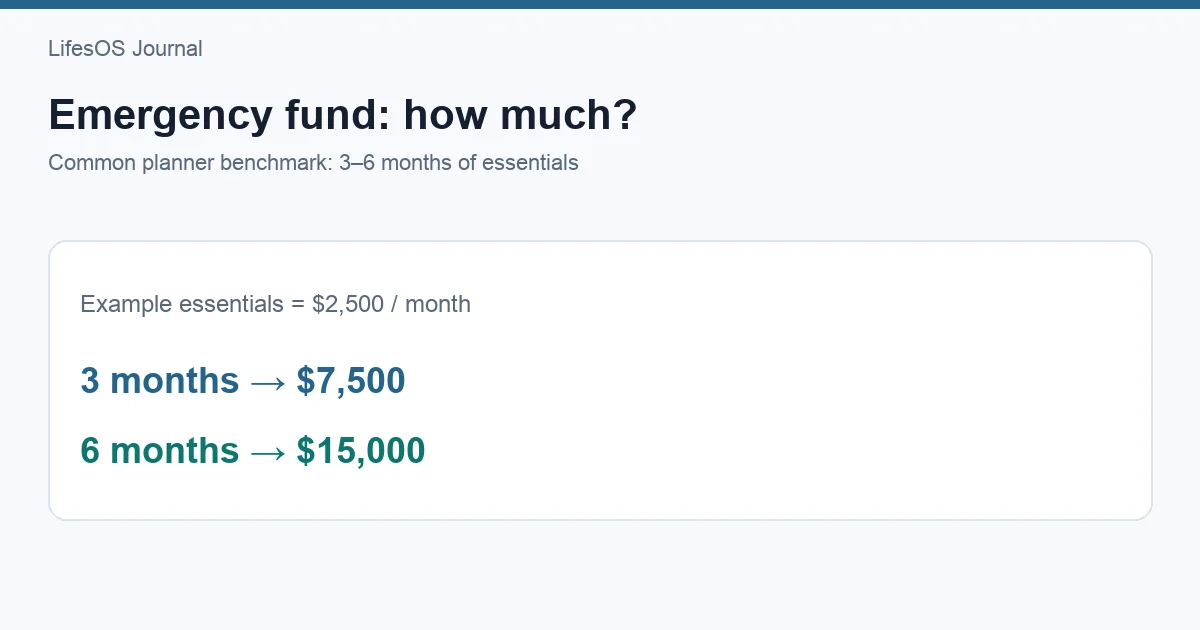
How much emergency fund should you keep? A useful target is enough to cover the essential bills your household would still owe during an income interruption. Many financial planners use three to six months of essential expenses as a rule of thumb, but the right amount depends on your job stability, dependents, insurance, debt, and other support. If that target feels distant, start with a smaller cash buffer and build in stages.
The short answer: use a range, not a magic number
The Consumer Financial Protection Bureau says the amount you need depends on your situation and that even a small amount can provide some financial security. It does not prescribe a universal three- or six-month target. The familiar three-to-six-month benchmark comes from common financial-planning practice, and it should be treated as a planning range rather than a mandate.
A practical sequence looks like this:
- Starter buffer: save enough to absorb a common small shock without using a credit card. Many educators use $1,000 as a motivating first milestone, though your first target could be one insurance deductible or one week of essential costs.
- One month of essentials: create room for a late paycheck or an urgent repair.
- Three to six months: build toward the planner benchmark, choosing your place in the range based on risk.
- Beyond six months: consider more cash if income is highly variable, replacement work may take a long time, or your household has unusually high exposure.
The point is not to wait until the full target is available before calling your savings useful. A $750 buffer can prevent a $750 problem from becoming expensive debt.
How to calculate your emergency fund
Step 1: total essential monthly expenses
Start with a realistic monthly budget. Count expenses you must keep paying during an emergency, not every dollar you spend in a normal month. Include housing, basic utilities, groceries, required transport, insurance, minimum debt payments, medication, childcare needed for work, and essential pet care. Usually you can pause travel, entertainment, extra debt payments, restaurant meals, and some subscriptions.
| Expense | Normal month | Emergency month |
|---|---|---|
| Rent | $1,500 | $1,500 |
| Utilities and phone | $260 | $220 |
| Groceries | $600 | $475 |
| Transport | $420 | $250 |
| Insurance | $280 | $280 |
| Minimum debt payments | $300 | $300 |
| Child and health essentials | $390 | $390 |
| Dining, entertainment, travel | $550 | $0 |
| Total | $4,300 | $3,415 |
In this example, using total normal spending would overstate the baseline by $885 per month. That does not make the larger target wrong; it simply answers a different question. Emergency planning starts with the minimum sustainable household, then adds a margin for uncertainty.
Step 2: multiply by a coverage period
| Coverage | Calculation | Target |
|---|---|---|
| Starter milestone | Chosen first buffer | $1,000 |
| 1 month | $3,415 × 1 | $3,415 |
| 3 months | $3,415 × 3 | $10,245 |
| 6 months | $3,415 × 6 | $20,490 |
| 9 months | $3,415 × 9 | $30,735 |
A dual-income household with stable jobs and flexible expenses might choose the lower end. A sole earner supporting children, a contractor with uneven income, or someone in a specialized field with long hiring cycles may prefer the upper end or more.
Step 3: adjust for your real risks
Add reasons to hold more cash and reasons a smaller target may be workable. Do not turn the exercise into false precision; its purpose is to choose a defensible range.
| Factor | May support a lower target | May support a higher target |
|---|---|---|
| Income | Two stable, independent incomes | One income, commissions, seasonal work |
| Employability | Broad demand and short hiring cycle | Specialized role or uncertain industry |
| Household | No dependents, flexible costs | Children, caregiving, essential childcare |
| Health and insurance | Low deductibles and strong coverage | High deductibles or recurring care |
| Home and transport | Renting, reliable transit access | Older home or car required for work |
| Backup support | Reliable family or partner support | No practical fallback |
What counts as an emergency?
An emergency fund is for urgent, necessary, and unplanned costs or lost income. Examples include a job loss, emergency dental treatment, a necessary car repair, urgent travel for family care, or an insurance deductible after property damage. It is not meant for expenses that are irregular but predictable.
Annual insurance premiums, holiday gifts, routine car maintenance, memberships, and planned home repairs belong in sinking funds for irregular expenses. Separating the two protects emergency cash from being drained by bills you knew would arrive.
Where should you keep emergency savings?
Emergency money should be safe, accessible, and separate enough that you do not spend it casually. A federally insured savings account or similar cash account is often appropriate. Compare fees, withdrawal access, insurance coverage, interest, transfer time, and account rules. Avoid placing your core emergency reserve in volatile investments: a market decline can arrive at the same time as a layoff.
You can use two layers. Keep a small amount at your main bank for same-day access, and the rest in a separate insured savings account with a competitive yield. The extra transfer step can reduce impulse spending without making the money unreachable.
How to build the fund without pausing your life
- Choose the next milestone. Focus on $1,000, one deductible, or one month—not the final five-figure number.
- Automate after payday. Move a fixed amount before flexible spending expands.
- Direct one-off money. Tax refunds, bonuses, gifts, and sold items can shorten the timeline.
- Use a temporary category cut. A six-month reduction in one discretionary line is easier to sustain than vague permanent austerity.
- Track progress by percentage. Divide current emergency savings by your chosen target. You can also review your savings rate and test scenarios with the savings rate calculator.
| Monthly transfer | Time to $1,000 | Time to $3,415 |
|---|---|---|
| $100 | 10 months | About 35 months |
| $250 | 4 months | About 14 months |
| $500 | 2 months | About 7 months |
These estimates ignore interest and assume no withdrawals. If you use the fund for a genuine emergency, that is not failure. Resume contributions when the immediate situation stabilizes.
Try LifesOS free for 7 days to connect your emergency-fund target with your budget, savings progress, and weekly money check.
Emergency savings versus debt or investing
There is no universal ordering that fits every balance sheet. A small cash buffer can reduce the chance that the next repair goes back onto a high-interest card. After that buffer, compare debt interest, employer retirement matching, minimum obligations, and household risk. Someone with costly revolving debt may split extra cash between a starter reserve and accelerated repayment. Someone with no debt but uncertain contract income may prioritize several months of cash.
Do not count available credit as savings. A lender can reduce a credit line, and borrowing creates a payment at the moment your income may be lower. Retirement accounts and home equity may be valuable, but taxes, penalties, selling risk, and slow access make them poor substitutes for ready cash.
Review the target when life changes
Recalculate at least once a year and after a move, new child, job change, separation, major debt payoff, insurance change, or shift into self-employment. Update both the monthly essentials number and the number of months you want covered. In LifesOS Finance, a quarterly check can be a short note attached to your savings goal rather than a fresh project every time.
Common emergency-fund mistakes
- Copying someone else's dollar target. Six months in one household may equal two months in another.
- Using normal spending without an emergency version. This can make the goal feel impossible.
- Treating predictable annual bills as emergencies. Build separate sinking funds.
- Investing the entire reserve. Return matters less than availability for this job.
- Keeping too much in checking. Easy visibility can encourage casual withdrawals.
- Never defining replenishment. Decide in advance that contributions restart after a withdrawal.
FAQ
Is $1,000 enough for an emergency fund?
It is a useful starter goal for many people, not a complete target for most households. Compare it with your likely urgent costs, such as a deductible, essential repair, or week of expenses, then build toward one month and your longer-term range.
Does the CFPB recommend three to six months?
The CFPB says the amount depends on your situation and encourages a dedicated fund, even if you can only start small. Three to six months of essential expenses is a widely used planner benchmark, not a CFPB mandate.
Should I use income or expenses to calculate it?
Use essential expenses. Replacing six months of gross salary may overshoot what you actually need to keep the household running, while using discretionary spending can distort the result.
Should a couple have one fund or two?
Either can work. What matters is that the combined reserve reflects shared and individual obligations, both people know how to access it, and the plan covers what happens if one or both incomes stop.
When should I stop contributing?
Pause or redirect contributions when you reach the chosen target, then review it periodically. If essential expenses rise or household risk changes, update the target and resume saving.
Related: Once you know your target, follow how to build an emergency fund step by step.
Sources
- Consumer Financial Protection Bureau: An essential guide to building an emergency fund
- Federal Deposit Insurance Corporation: Deposit insurance information
Start your 7-day LifesOS trial and turn the next emergency-fund milestone into a visible monthly plan.
This article provides general educational information, not personalized financial, investment, tax, or legal advice. Consider your circumstances and consult a qualified professional when needed.