Personal Finance
Sinking Funds: How to Plan for Irregular Expenses
Sinking funds divide large, irregular expenses into monthly set-asides so known costs stop disrupting your budget or draining emergency savings.
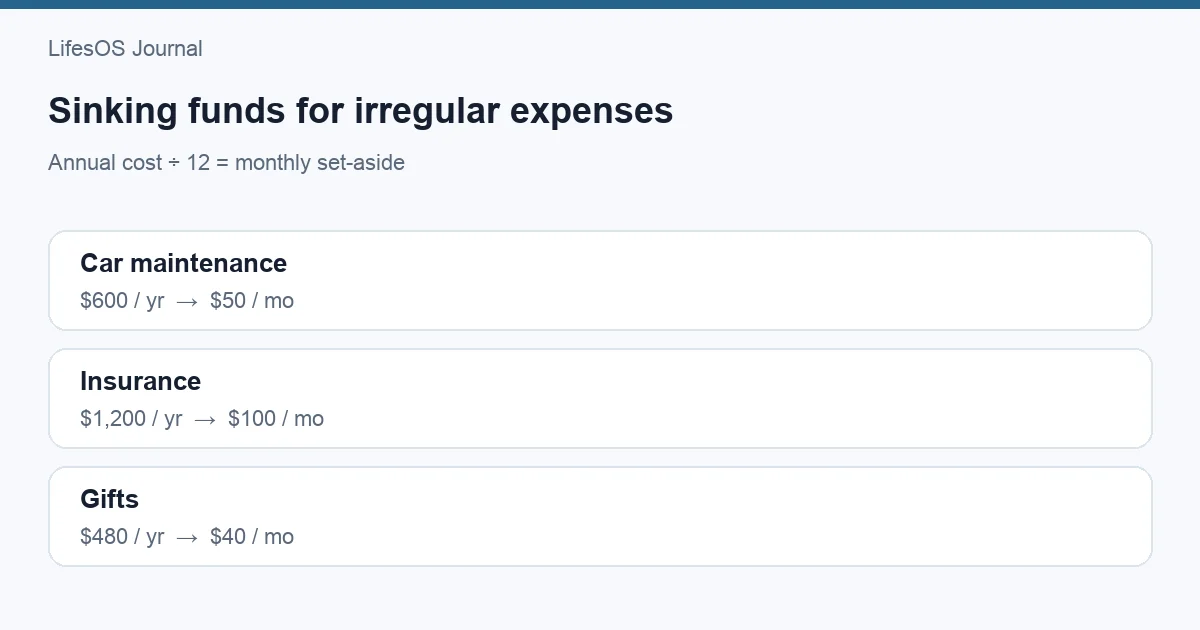
Sinking funds are savings buckets for expenses that are irregular but expected. Instead of treating a $1,200 insurance premium or December holiday spending as a surprise, estimate the amount, divide it by the months remaining, and save that amount each month. The bill stays irregular, but the effect on your budget becomes steady. Start with the few categories most likely to strain cash flow.
What is a sinking fund?
A sinking fund is money accumulated over time for a defined future expense. In a household budget, it sits between routine monthly spending and true emergency savings. You know the expense will probably happen, even if the exact date or amount is uncertain.
Examples include:
- Car maintenance, tires, registration, and repairs
- Annual or semiannual insurance premiums
- Holiday gifts, travel, and hosting
- Professional dues and annual software fees
- Home maintenance and appliance replacement
- School costs, pet care, and planned medical deductibles
The basic calculation is simple:
Monthly set-aside = (Target amount − Current balance) ÷ Months until needed
If you need $900 for an insurance premium in six months and already have $180 saved, set aside ($900 − $180) ÷ 6 = $120 per month.
Sinking fund versus emergency fund
| Question | Sinking fund | Emergency fund |
|---|---|---|
| Is the expense expected? | Yes, at least broadly | No, or timing is genuinely unknown |
| Is there a target? | Usually a category, amount, and date | Usually months of essential expenses |
| Examples | Annual premium, tires, holidays | Job loss, urgent uninsured event |
| What happens after use? | Restart for the next cycle | Replenish after the emergency |
| Planning style | Monthly set-aside | Risk-based reserve |
A transmission failure can blur the line. If you know an older car will need repairs eventually, a car-maintenance sinking fund should carry part of the load. If the repair exceeds that balance and the car is essential, an emergency fund may cover the gap. The categories can work together without being identical.
Step 1: find your irregular expenses
Review the last 12 months of bank and card transactions, your calendar, insurance documents, subscription renewals, vehicle schedule, and home records. Look for large expenses that appear once or a few times a year. If you are new to tracking, start with your monthly budget and add a section called irregular expenses.
Use three questions:
- Will this expense probably happen within the next one to three years?
- Would paying it from one month's income disrupt bills, debt payments, or savings?
- Can I estimate the amount or build a reasonable range?
If all three answers are yes, it is a strong sinking-fund candidate. Do not create 30 funds on day one. Choose the top three to five based on size, timing, and consequence.
Step 2: calculate monthly set-asides
| Fund | Target | Current balance | Months left | Monthly set-aside |
|---|---|---|---|---|
| Car repairs | $1,200 | $300 | 12 | $75 |
| Insurance premium | $960 | $160 | 8 | $100 |
| Holidays | $900 | $180 | 9 | $80 |
| Annual fees | $360 | $60 | 10 | $30 |
| Total | $3,420 | $700 | — | $285 |
The household adds a $285 sinking-fund line to the monthly budget. The eventual bills do not become cheaper, but their timing no longer dictates the month's financial mood.
When the amount is uncertain
Use recent history, quotes, replacement schedules, and a margin. For car repairs, you might review the last two years, consider mileage and age, then choose an annual amount. If costs were $500 and $1,100, a $900 or $1,000 annual target may be more realistic than averaging blindly. Revisit it after each year.
When the date is uncertain
Use a monthly contribution toward a balance cap. A home-maintenance fund might receive $150 each month until it reaches $3,000, pause after reaching the cap, and resume after a withdrawal. A cap prevents every open-ended category from expanding forever.
Step 3: prioritize when the total is too high
Your first calculation may produce monthly set-asides the budget cannot support. That is useful evidence. Rank funds by consequence and deadline:
- Protect necessities. Insurance premiums, required fees, essential transport, and health costs usually come first.
- Fund fixed deadlines. A premium due in four months offers less flexibility than a future appliance replacement.
- Reduce optional targets. Change the holiday plan, delay a device upgrade, or choose a lower-cost trip.
- Extend flexible timelines. A replacement fund may grow over 18 months instead of 12.
- Increase income or use one-off cash. Direct a portion of bonuses, refunds, or sold items to underfunded categories.
| Original plan | Adjustment | Monthly reduction |
|---|---|---|
| $900 holiday target in 9 months | Lower target to $630 | $30 |
| $1,200 car target with $300 saved | Add $300 tax refund | $25 |
| $360 annual fees | Cancel one $120 renewal | $12 |
The revised plan frees $67 per month without pretending the essential insurance bill will disappear.
Step 4: decide where to keep the money
Sinking funds need safety and access on the expense timeline. An insured savings account is often suitable for costs due within a few years. Depending on your bank, use separate savings accounts, labeled buckets inside one account, or one account paired with a tracking ledger.
Separate accounts create visible boundaries but can become cumbersome. One account is simpler, but the bank balance does not show what each dollar is for. If one savings account holds $4,000, your ledger might say: car $1,250, insurance $960, holidays $640, annual fees $350, and home $800. The category balances must add to the account balance.
Step 5: automate and review
Schedule transfers just after payday. If you are paid twice a month and the plan requires $285 monthly, transfer $142.50 from each paycheck. Name the transfer or account so the purpose remains visible.
Review monthly for upcoming deadlines and quarterly for target accuracy. After paying an expense, record the withdrawal against its fund and calculate the next cycle. An annual premium does not stop being annual after you pay it.
Try LifesOS free for 7 days to put monthly set-asides beside the rest of your plan in Finance, then check progress without maintaining a separate mental ledger.
Worked example: four irregular expenses
Maya takes home $4,600 per month. Her routine budget leaves $420 after regular bills, savings, and flexible spending. She identifies four irregular expenses requiring $285 monthly. That leaves $135 of monthly margin.
In month five, her car needs a $620 repair. The car fund has grown from $300 to $675 after five $75 contributions. She pays the repair from that category and leaves $55. She does not call the repair an emergency, use holiday money, or put it on a card. The following month, she resumes the $75 contribution and considers increasing the annual target because the car is aging.
Two months later, the $960 insurance premium is due. Its fund contains the original $160 plus eight $100 contributions, exactly $960. Her regular monthly budget remains unchanged when the payment clears. This is the main benefit: the expense happens, but it does not compete with that month's groceries or rent.
Sinking funds with variable income
If income varies, calculate a minimum monthly contribution for required funds and a priority order for extra income. For example:
- First $150: insurance and required annual fees
- Next $75: essential car maintenance
- Next $50: holiday fund
- Income above the baseline: split between the most underfunded category and emergency savings
You can also fund annual obligations during high-income months, reducing required transfers during low months. The rule should be decided before the income arrives so each strong month does not become an excuse for unplanned spending.
Ways to organize sinking funds
| Method | Best for | Watch out for |
|---|---|---|
| Separate savings accounts | Clear physical separation | Account limits and clutter |
| Bank savings buckets | Automated visual goals | Features vary by institution |
| One account plus ledger | Simple cash management | Requires accurate category tracking |
| Cash envelopes | Near-term cash spending | Security and online payments |
The method matters less than three controls: every fund has a purpose, category balances reconcile to real cash, and withdrawals are recorded. If you like percentage frameworks such as the Six Jars method, treat sinking funds as named obligations inside the appropriate allocation rather than another percentage added on top.
Common sinking-fund mistakes
- Creating too many categories. Begin with the expenses that create the most disruption.
- Saving without a target or cap. Define an amount, date, annual estimate, or maximum balance.
- Mixing funds without a ledger. One account is fine only when category ownership is clear.
- Forgetting inflation and price changes. Refresh estimates from renewals and actual repairs.
- Counting the same cash twice. Money assigned to holidays cannot also cover car repairs unless you explicitly reallocate it.
- Stopping after the bill. Restart contributions for the next cycle.
- Using emergency savings for predictable costs. Give recurring irregular expenses their own plan.
Your 20-minute setup checklist
- Review 12 months of transactions and your next 12 months of known dates.
- List irregular expenses that would strain one month's cash flow.
- Choose three to five starting funds.
- Set a target, current balance, deadline, and monthly contribution for each.
- Add the total contribution to the monthly budget.
- Choose accounts or ledger categories.
- Automate transfers after payday.
- Schedule a quarterly target review.
FAQ
How many sinking funds should I have?
Use as few as you can while keeping important purposes clear. Three to five is a manageable start. Add categories when a distinct expense is large, recurring, and likely to compete with other goals.
How much should I put in sinking funds each month?
For each category, subtract the current balance from the target and divide by the months remaining. Add the category contributions together, then revise priorities if the total does not fit your budget.
Are sinking funds the same as savings goals?
They overlap. A sinking fund is usually a savings goal for a planned expense or replacement. Long-term wealth-building goals, retirement investments, and a risk-based emergency reserve have different jobs.
What if I spend less than the fund balance?
Keep the remainder for the next cycle, lower future contributions, or explicitly reallocate it. Do not let an unlabeled surplus disappear into routine spending by accident.
Can I invest sinking-fund money?
For expenses due within a few years, preserving principal and reliable access are usually more important than market return. Match the account to the timeline and your tolerance for loss; seek qualified advice for your circumstances.
Make the next irregular bill monthly
Choose one bill due in the next year. Write its target, current balance, and due date, then calculate the monthly set-aside. Adding one honest line to your budget is enough to start.
Start your 7-day LifesOS trial and give your irregular expenses clear monthly jobs before they become urgent.
This article provides general educational information, not personalized financial, investment, tax, or legal advice. Consider your circumstances and consult a qualified professional when needed.