Personal Finance
How to Budget With Irregular Income
Budgeting with irregular income works when essential expenses are built around a conservative income floor, extra income follows preset priorities, and a buffer smooths uneven months.
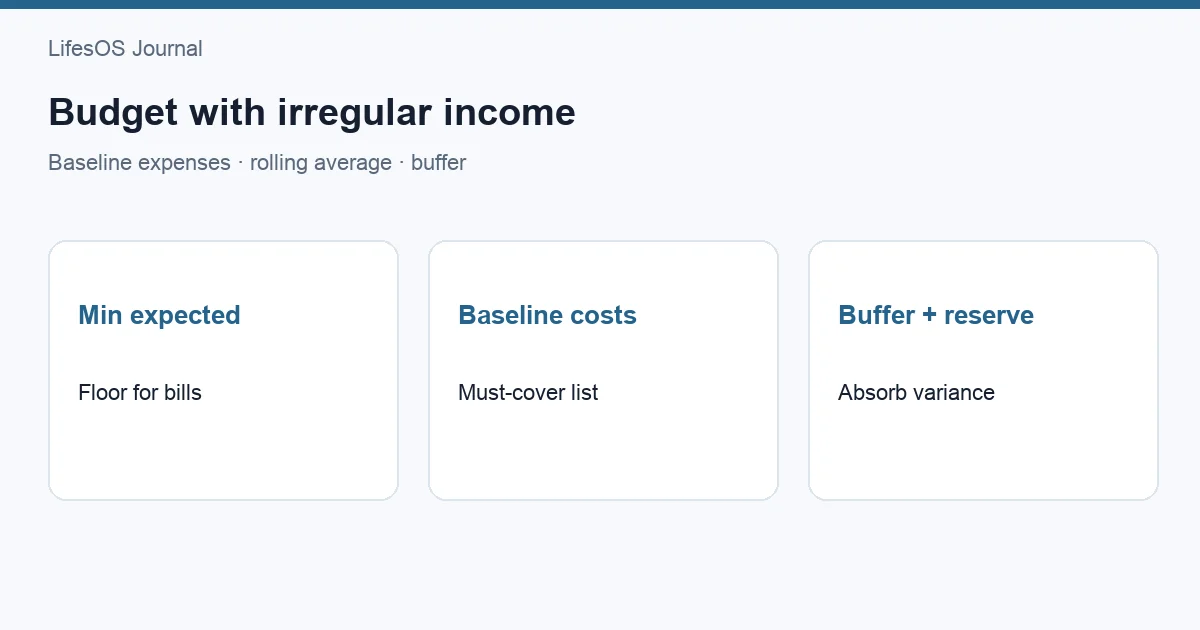
To budget with irregular income, build your core plan around a conservative monthly income floor, rank expenses by priority, and decide in advance what extra income will fund. Use a rolling average to understand the trend, but do not treat an optimistic average as guaranteed cash. Over time, build an income buffer or emergency reserve so a strong month can support a weaker one.
This method works for freelancers, commission workers, seasonal employees, business owners, contractors, and anyone whose pay varies. It does not require predicting every deposit. It requires knowing the minimum your household needs, protecting due dates, and giving above-baseline income a job.
Start with four numbers
- Baseline expenses: the minimum cost of keeping essential obligations current.
- Minimum expected income: a cautious amount you can reasonably expect in a typical low month.
- Rolling average income: recent income averaged over six to twelve months.
- Available buffer: cash deliberately reserved to smooth income timing.
These numbers answer different questions. Baseline expenses show what must be funded. Minimum expected income sets a safe planning limit. The rolling average supports medium-term decisions. The buffer handles the gap between earning money and receiving it.
1. Build an income history
List take-home income received in each of the last 12 months. Use money that reached your accounts after business expenses and required withholding where applicable. Do not include loans, account transfers, or credit-card refunds as income. If you have less history, use what is available and stay more conservative.
| Measure | Example | Use |
|---|---|---|
| Lowest month | $2,900 | Stress-test the plan |
| Six-month average | $4,250 | Recent planning trend |
| Twelve-month average | $4,480 | Seasonality context |
| Conservative floor | $3,300 | Core monthly budget |
A rolling average is the sum of recent monthly income divided by the number of months. Update it monthly so an old exceptional period does not dominate the estimate. Compare the six- and twelve-month averages; a large difference may show seasonality or a meaningful change in work volume.
2. Choose a minimum expected income
Your planning floor is not necessarily the lowest month ever. It should be low enough to be dependable without making the budget unusably austere. Consider signed contracts, recurring clients, base salary, seasonal patterns, and how reliably customers pay. Exclude speculative projects until payment arrives.
For example, someone who earned between $2,900 and $6,200 per month might set a $3,300 floor even though the average is $4,480. The difference between the floor and average provides caution. If actual income falls below $3,300, the person uses a reduced plan and possibly a buffer. If it exceeds $3,300, the surplus follows preset priorities.
3. Calculate baseline expenses
Open your monthly budget and identify the minimum amounts needed for housing, basic utilities, groceries, transportation, insurance, required taxes, minimum debt payments, essential care, and necessary work costs. Remove upgrades and flexible wants for this calculation, but be realistic: food and transport cannot be budgeted at zero.
| Baseline item | Monthly amount |
|---|---|
| Housing | $1,250 |
| Utilities and phone | $260 |
| Groceries | $430 |
| Transport | $240 |
| Insurance and care | $290 |
| Minimum debt payments | $180 |
| Required tax reserve | $350 |
| Total baseline | $3,000 |
If the baseline exceeds minimum expected income, the plan has a structural gap. A buffer can cover occasional shortfalls, but not a permanent one. Review fixed commitments, seek more dependable income, or redesign the timing and level of obligations. Avoid relying on credit as the routine bridge.
4. Put spending into priority tiers
Priority tiers make decisions before the pressure of a low month. They are more practical than cutting every category by the same percentage.
- Tier 1 — must fund: housing, food, core utilities, transport to work, insurance, required taxes, and minimum payments.
- Tier 2 — important: sinking funds, health needs, essential maintenance, modest savings, and tools that protect income.
- Tier 3 — flexible: dining, entertainment, upgrades, optional subscriptions, accelerated goals, and nonurgent purchases.
Fund Tier 1 first. Add Tier 2 when confirmed income supports it. Release Tier 3 only after current obligations, taxes, and near-term cash needs are covered. These tiers are decision order, not moral labels.
5. Create a baseline and surplus plan
Build the baseline budget from the $3,300 floor. Suppose Tier 1 costs $3,000. The remaining $300 can fund the most urgent Tier 2 items. Then write a surplus waterfall for every dollar received above $3,300.
| Surplus priority | Share | Purpose |
|---|---|---|
| Taxes | As required | Avoid spending money owed later |
| Income buffer | 40% | Smooth low or delayed months |
| Sinking funds | 25% | Prepare for irregular expenses |
| Long-term goals | 20% | Retirement, investing, or debt |
| Flexible spending | 15% | Enjoy part of a strong month |
The percentages are illustrative. Your tax obligations, debt, household needs, and business structure may require a different order. The important feature is that the rule exists before a large payment arrives.
6. Build an income buffer
An income buffer holds money from strong months to pay the next month's regular expenses. Start with one baseline month, then consider expanding based on volatility and payment delays. Keep it separate enough that it is not mistaken for spending money, but accessible enough to cover bills.
A buffer differs from a general emergency fund. The buffer handles expected variation in ordinary income. An emergency fund handles unexpected events such as urgent repairs, medical costs, or an extended loss of work. Read how to build an emergency fund and how much emergency fund you may need for broader reserve planning.
If possible, pay this month's expenses from income received in a previous month. That creates a clear boundary: collect income during August, total it at month-end, and use the available amount to fund September. Reaching this position takes time, but it reduces uncertainty around invoice timing.
7. Use sinking funds for irregular expenses
Annual insurance, equipment replacement, holidays, vehicle maintenance, and professional fees are not monthly, but many are predictable. Estimate the annual amount, divide by 12, and save monthly. Keeping these costs outside the baseline makes a good income month look more available than it is.
For example, $1,200 of annual professional costs requires about $100 per month. A $900 car-maintenance estimate requires $75. In low months, you may temporarily reduce lower-priority contributions, but record the gap so future surplus can refill it. See sinking funds for irregular expenses for a full setup.
Three income scenarios
| Actual income | Response |
|---|---|
| $2,800 low month | Fund Tier 1, use $200 buffer, pause flexible goals |
| $3,300 floor month | Follow baseline plan; avoid assuming more income |
| $5,300 strong month | Fund baseline, taxes, buffer, sinking funds, then goals |
Suppose a $5,300 month includes $400 that must be reserved for tax. After the $3,300 baseline and $400 tax reserve, $1,600 remains. Applying the example waterfall would allocate $640 to the buffer, $400 to sinking funds, $320 to long-term goals, and $240 to flexible spending.
In a $2,800 month, do not distribute money by the strong-month percentages. The priority system takes over. Pay essential obligations, use the buffer for the $200 gap, and postpone lower tiers. If low months repeat, lower the floor and revisit fixed costs.
Manage timing as well as totals
A profitable month can still produce a cash shortage when a client pays after rent is due. Maintain a simple calendar of expected deposits and bill due dates. Label expected income as unconfirmed until received. Ask vendors about due-date changes when that would align obligations with dependable payment windows.
For business income, separate business and personal cash where practical. Pay yourself a consistent owner draw or salary based on a conservative amount, leaving business reserves to handle operating variation. Tax and legal treatment depends on your jurisdiction and entity, so obtain qualified guidance for those decisions.
Use LifesOS Finance to track baseline categories, reserves, and monthly cash flow. Download LifesOS to turn variable income into a repeatable planning routine.
Monthly irregular-income checklist
- Record income received, not merely invoiced.
- Update the six- and twelve-month rolling averages.
- Fund required tax reserves before treating income as available.
- Cover Tier 1 baseline expenses.
- Fill the income buffer and essential sinking funds.
- Allocate remaining surplus by the preset rule.
- Review the next 60 days for seasonal dips and large bills.
- Change the income floor only when several months support it.
Common mistakes
- Budgeting from the best month: strong months are not dependable baselines.
- Using average income as cash: averages hide timing and volatility.
- Spending unpaid invoices: expected revenue cannot pay today's bill.
- Forgetting taxes: gross receipts may not be fully available.
- Treating annual costs as emergencies: predictable irregular bills need sinking funds.
- Never enjoying surplus: a modest flexible allocation can make the system sustainable.
FAQ
Should I use my lowest month to budget?
Use it as a stress test, but not automatically as the operating budget. Choose a conservative floor supported by income history and dependable commitments. If the lowest month is likely to recur, the core plan should be able to handle it.
How many months should I use for a rolling average?
Six months reflects recent changes; twelve months captures seasonality. Track both if income varies by season. Neither replaces a conservative floor because an average includes strong months.
How large should an income buffer be?
One month of baseline expenses is a useful first target. Greater volatility, long client payment terms, seasonal work, or multiple dependents may justify more. Keep emergency savings separate conceptually, even if both are held in liquid accounts.
What if income is below baseline expenses?
Use the buffer for a temporary shortfall and fund only the highest priorities. If the gap persists, the budget needs a structural change: lower commitments, increase dependable income, or both. Repeated borrowing is not a stable buffer.
Can I still save with variable income?
Yes. Include a modest savings contribution in the baseline when feasible, then direct part of strong-month surplus toward reserves and long-term goals. Automating percentages after each payment can work better than a fixed amount.
A variable paycheck does not require variable priorities. Try LifesOS to plan from a conservative floor and direct strong months with purpose.
This article is general educational information, not personalized financial, tax, investment, or legal advice. Rules for taxes and business income vary; consult qualified professionals for your circumstances.