Nutrition
How Much Protein Do You Need? A Practical Guide
Protein needs depend on body weight, activity, goals, age, and health context; use evidence-based ranges as a starting point, not a prescription.
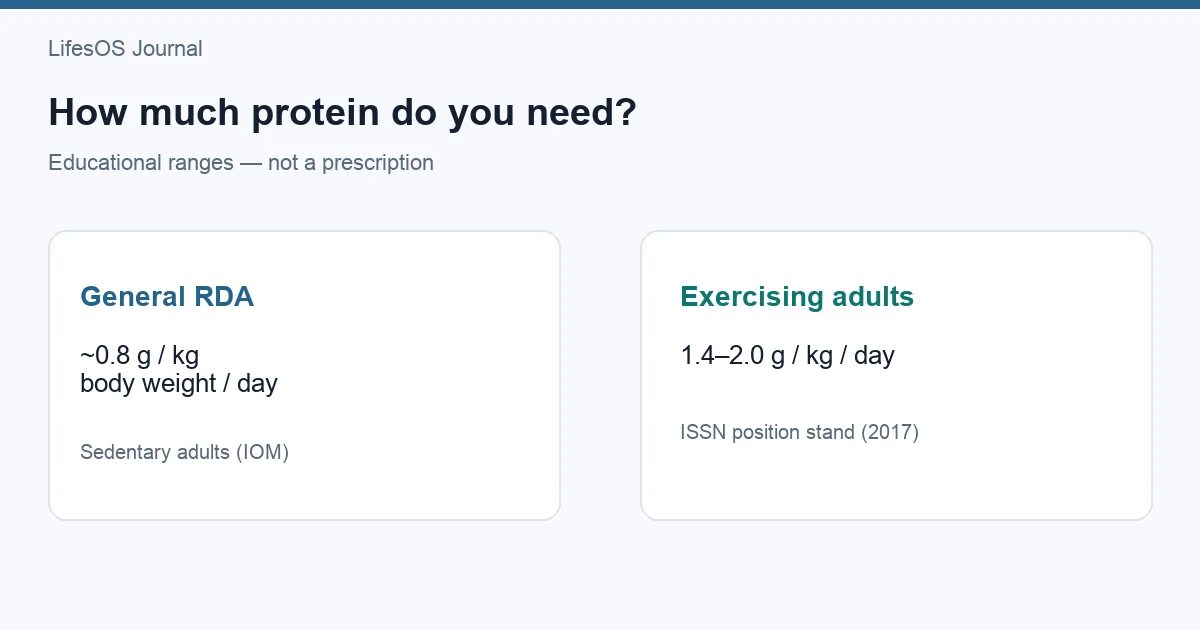
For generally healthy adults, the U.S. RDA is about 0.8 grams of protein per kilogram of body weight per day. People who exercise regularly often use a higher evidence-based range: the International Society of Sports Nutrition suggests 1.4–2.0 g/kg/day for most exercising individuals. Your best target depends on training, goals, age, total energy intake, and health context.
Those numbers are starting points, not a diagnosis or a personalized meal plan. This guide explains the math, what a serving can look like, and how to build a practical routine without turning every meal into an accounting exercise.
This article provides general educational information, not medical or dietary advice. Protein needs can change with kidney disease, pregnancy, injury, eating-disorder history, medications, and other conditions. Consult a qualified clinician or registered dietitian for individual guidance.
The short answer: useful protein ranges
| Context | Common reference range | What it means |
|---|---|---|
| General healthy adults | About 0.8 g/kg/day | U.S. RDA intended to cover the needs of nearly all healthy adults |
| Most exercising individuals | About 1.4–2.0 g/kg/day | ISSN 2017 position stand range supporting training and adaptation |
| Per eating occasion | Roughly 20–40 g | Practical serving range cited by ISSN, often spread across the day |
The 0.8 g/kg RDA is not an athletic optimization target and should not be described as the maximum safe intake. It is a population reference for generally healthy adults. The exercise range reflects different aims, including supporting muscle repair and adaptation.
How to calculate a starting target
Convert body weight in pounds to kilograms by dividing by 2.2. Then multiply kilograms by the relevant grams-per-kilogram value.
Formula: body weight in pounds ÷ 2.2 × target g/kg = grams of protein per day.
| Body weight | 0.8 g/kg | 1.4 g/kg | 1.6 g/kg | 2.0 g/kg |
|---|---|---|---|---|
| 120 lb / 54.5 kg | 44 g | 76 g | 87 g | 109 g |
| 150 lb / 68.2 kg | 55 g | 95 g | 109 g | 136 g |
| 180 lb / 81.8 kg | 65 g | 115 g | 131 g | 164 g |
| 220 lb / 100 kg | 80 g | 140 g | 160 g | 200 g |
These are rounded examples, not individual recommendations. Using current body weight can also produce impractical estimates in some contexts. A dietitian can help choose an appropriate calculation method when body composition, weight change, or a medical condition materially affects the result.
What the 0.8 g/kg RDA actually means
The Recommended Dietary Allowance is set at a level expected to meet the nutrient needs of nearly all healthy people in a life-stage group. The adult protein RDA is 0.8 g/kg/day, based on the Institute of Medicine dietary reference intake framework.
It is useful as a baseline for generally healthy, relatively sedentary adults. It does not mean everyone feels or performs best at exactly that number. Training creates additional turnover and repair demands; aging can affect how muscle responds to a meal; and calorie restriction may change the usefulness of higher protein intake.
Protein for people who exercise
The 2017 International Society of Sports Nutrition position stand states that 1.4–2.0 g/kg/day is sufficient for most exercising individuals to build and maintain muscle mass. Needs within that range vary with training type, intensity, experience, total calories, and goals.
An endurance athlete may use protein to support repair and adaptation even when carbohydrate remains central for training fuel. A person doing resistance training may prioritize protein alongside progressive training and adequate energy. Eating more protein cannot compensate for an ineffective program, poor sleep, or consistently inadequate calories.
People dieting while training sometimes choose the upper part of a reasonable range because protein supports satiety and helps preserve lean mass. That decision still belongs within an overall nutrition plan rather than being treated as a single magic number.
How much protein per meal?
Daily intake matters, but distribution can make the target easier to reach. The ISSN paper describes a general recommendation of about 0.25 g/kg of high-quality protein per dose, or an absolute dose around 20–40 g, ideally distributed every three to four hours across the day.
This does not mean the body “wastes” everything above 40 g. Digestion and absorption continue, and protein has uses beyond muscle protein synthesis. The 20–40 g range is a practical meal-sized reference, not a hard absorption ceiling.
| Daily target | Possible distribution |
|---|---|
| 80 g | 25 g breakfast + 25 g lunch + 30 g dinner |
| 120 g | 30 g breakfast + 35 g lunch + 15 g snack + 40 g dinner |
| 160 g | 40 g at four eating occasions |
Choose a pattern that fits appetite, schedule, culture, and training. Three meals can work; so can meals plus a snack. A target that requires constant eating or creates digestive discomfort needs adjustment.
What 20–40 grams can look like
Nutrition values vary by brand, cut, preparation, and serving size, so check labels when precision matters. Approximate examples include:
- 3–4 ounces cooked chicken breast: roughly 26–35 g
- One can of tuna, depending on drained weight: roughly 25–35 g
- 1 cup Greek yogurt: often 18–25 g
- 1 cup cottage cheese: often 24–28 g
- 3 large eggs plus 1 cup milk: roughly 26 g
- 1 cup cooked lentils plus a grain: roughly 18–25 g, depending on portions
- Firm tofu, 6 ounces: often 20–25 g
- One scoop protein powder: commonly 20–30 g
Plant-based meals can meet protein needs. Variety helps provide essential amino acids across the day. Soy foods, beans, lentils, peas, seitan, dairy alternatives with added protein, nuts, seeds, and grains can all contribute. Because some plant foods are less protein-dense per calorie or have different digestibility, active people eating fully plant-based diets may benefit from deliberate portions and professional guidance.
Make the pattern visible: Log a few typical days in LifesOS Nutrition and compare your average with an appropriate range. The goal is to learn where protein naturally appears—not to chase perfect numbers at every meal.
A simple protein-first meal method
- Choose the protein anchor. Decide on fish, poultry, eggs, dairy, tofu, tempeh, beans, lentils, meat, or another preferred source.
- Add carbohydrate based on needs. Rice, potatoes, oats, bread, fruit, and other carbohydrate foods can support training and daily energy.
- Add vegetables or fruit. Protein does not replace fiber, micronutrients, or dietary variety.
- Add fat and flavor. Oils, avocado, nuts, seeds, sauces, and dressings help with enjoyment and energy needs.
- Adjust the portion after reviewing the day. One meal does not need to carry the whole target.
For help understanding how protein fits into total energy intake, see Calories vs. Macros. If you want to estimate your usual pattern, How to Track Macros offers a lower-friction approach.
Does protein timing matter?
Total daily protein and a sustainable eating pattern deserve priority. Timing becomes a refinement after those basics are consistent. Consuming protein around training can be convenient, and spreading servings across the day may support repeated opportunities for muscle protein synthesis.
You do not need to panic about a tiny post-workout window. The ISSN position stand notes that the anabolic effect of exercise is long-lasting, though it likely decreases with time. If you trained after a meal, eating your next normal protein-containing meal is often a practical approach.
Do you need protein powder?
No. Protein powder is a convenient food product, not a requirement. It can help when appetite is low, schedules are busy, or a high target is difficult to reach with preferred foods. Whole foods also provide vitamins, minerals, fats, carbohydrates, and texture that powders may not.
If you use a supplement, check the serving size, ingredients, allergens, and third-party testing relevant to your needs. Competitive athletes should be especially careful about products that could contain prohibited or undeclared substances.
When a generic calculator is not enough
Seek individualized guidance if you have diagnosed kidney or liver disease, are pregnant or breastfeeding, are recovering from surgery or serious injury, are an adolescent athlete, have significant unintentional weight change, or have a current or past eating disorder. Older adults may also benefit from discussing protein amount, meal distribution, appetite, and resistance exercise with a professional.
Symptoms and lab results cannot be interpreted from a protein target alone. Do not use this article to diagnose a deficiency or medical condition.
Common protein mistakes
Jumping straight to the highest number
More is not automatically better. Choose a range that matches your context, then consider total calories, food preference, cost, digestion, and the rest of your diet.
Saving nearly all protein for dinner
A protein-containing breakfast or lunch can make the daily target easier and create a more even distribution.
Ignoring fiber and overall diet quality
A high-protein pattern can still be nutritionally narrow. Include plants, varied food sources, and enough fluid based on your needs.
Assuming the label serving is your serving
Packages may list a serving that differs from what you pour or cook. Weighing or measuring briefly can help calibrate your visual estimate, but lifelong precision is not required for everyone.
Expecting protein to replace training
Muscle gain depends on an appropriate training stimulus, adequate food, recovery, and time. Review how much exercise per week for public-health activity guidance.
A practical protein checklist
- Choose a reference range appropriate to your activity and health context.
- Calculate a rough daily range rather than one perfect number.
- Include a meaningful protein source at regular meals.
- Use roughly 20–40 g per eating occasion as a practical reference when applicable.
- Keep carbohydrates, fats, fiber, and micronutrients in the picture.
- Review a weekly average instead of judging one unusual day.
- Get professional advice when medical or life-stage factors apply.
FAQ
How much protein do I need to build muscle?
The ISSN suggests 1.4–2.0 g/kg/day for most exercising people. Your useful point within that range depends on training, calories, experience, goals, and individual context.
Is 0.8 g/kg enough?
It is the adult RDA designed to cover the needs of nearly all healthy adults. People training regularly or pursuing specific body-composition goals often use higher evidence-based ranges.
Can I eat all my protein in one meal?
You will digest and absorb protein from a large meal, but distributing useful servings across the day is practical and may better support repeated muscle protein synthesis.
Can you get enough protein without meat?
Yes. A varied pattern using soy foods, legumes, seitan, grains, nuts, seeds, and optional dairy or eggs can meet needs. Portion planning may require extra attention at higher targets.
Does more protein damage healthy kidneys?
This article cannot assess individual safety or kidney function. People with kidney disease or relevant risk factors need advice from their clinician; do not infer medical clearance from general sports-nutrition ranges.
Sources
- Institute of Medicine: Dietary Reference Intakes for Energy and Macronutrients
- International Society of Sports Nutrition position stand: protein and exercise (2017)
- NIH Office of Dietary Supplements: Exercise and Athletic Performance
Use the evidence to choose a sensible starting range, then build meals you can enjoy and repeat. Start a 7-day LifesOS trial to track nutrition patterns alongside schedule and activity—without treating the result as medical advice.