Nutrition
Meal Tracking vs Calorie Counting: What's the Difference?
Meal tracking records what and when you eat; calorie counting estimates food energy. Macro tracking adds nutrient detail, while food journaling adds context.
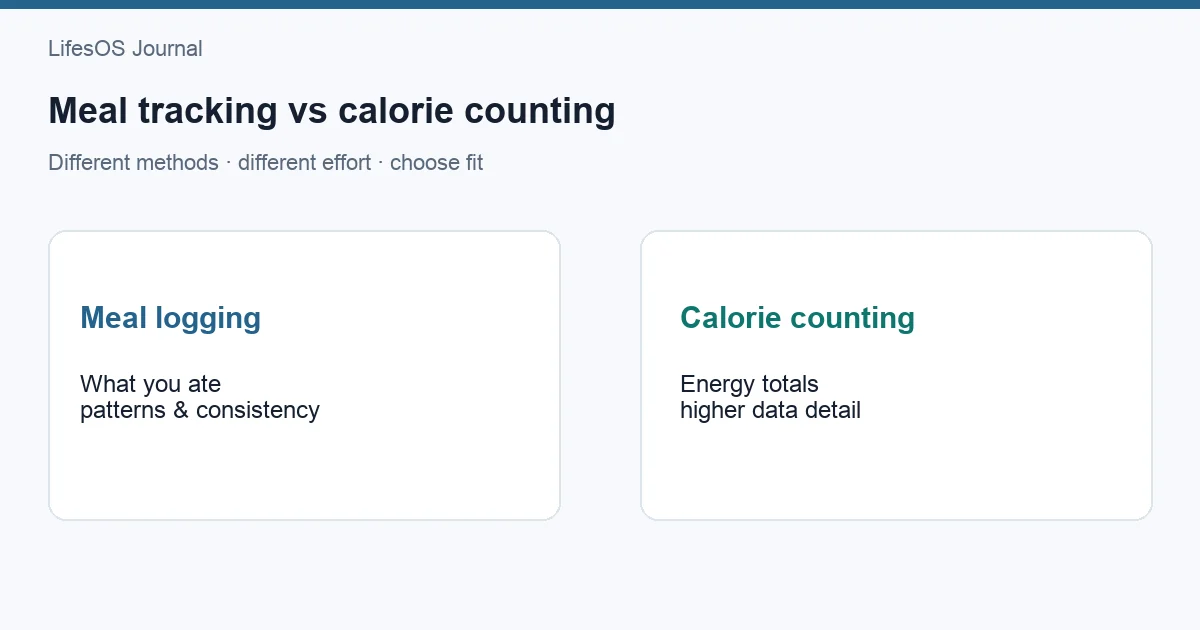
Meal tracking is the broad practice of recording meals, while calorie counting is one specific method that estimates food energy. Macro tracking records protein, carbohydrate, and fat; food journaling records context such as hunger, mood, symptoms, setting, or satisfaction. You do not need calorie data to benefit from noticing meal patterns, and the lightest method that answers your question is usually the best place to start.
The distinction matters because “tracking food” can mean taking a quick photo, writing a meal name, weighing every ingredient, or noting how you felt afterward. These methods require different effort and produce different information. They should not be treated as one escalating ladder that everyone must climb.
This article is for general education and is not medical or nutrition advice. People with medical conditions, allergies, pregnancy-related needs, digestive symptoms, or a current or past eating disorder should seek guidance from an appropriately qualified clinician or registered dietitian before using detailed food tracking.
Four food-tracking methods compared
| Method | Effort | Data detail | Best for | Limitations |
|---|---|---|---|---|
| Meal logging | Low | Foods, meals, timing, sometimes photos | Seeing routines, meal frequency, and broad variety | Does not quantify energy or nutrients; detail can be inconsistent |
| Calorie tracking | Medium to high | Estimated food energy | Understanding approximate energy intake when that information serves a clear goal | Estimates can be inaccurate; can add burden or become overly restrictive |
| Macro tracking | High | Calories plus protein, carbohydrate, and fat | Sports nutrition, protein awareness, or a specific professionally informed target | Requires portions and database quality; can obscure food quality and enjoyment |
| Food journaling | Low to medium | Meals plus hunger, mood, symptoms, context, or satisfaction | Finding situational patterns and supporting discussion with a professional | Subjective, harder to summarize, and not diagnostic |
No row is universally superior. Choose based on the decision you need to make, the accuracy actually available, and the cost of collecting the data.
What is meal logging?
Meal logging records what you ate and often when. An entry can be as simple as “oatmeal, yogurt, berries” or a photo of lunch. Some people include location, portions described in ordinary language, or whether the meal was planned.
This lighter method can answer practical questions:
- Do I regularly skip breakfast and become very hungry later?
- How often do I prepare lunch versus buy it?
- Are vegetables, protein sources, or whole grains appearing across the week?
- Which days depend on last-minute food decisions?
- Do long meetings repeatedly displace meals?
Meal logging avoids false precision and takes less time than nutrient tracking. Its weakness is that entries vary. “Pasta” could describe many ingredients and portions, so the record cannot reliably answer a calorie or macro question.
What is calorie counting?
Calorie counting estimates the energy provided by food and drink. It usually requires identifying items, estimating or measuring portions, and using labels or a food database. The daily total is an estimate, not an exact measurement.
Error can come from portion estimates, restaurant preparation, recipes, database entries, label tolerances, and the amount actually eaten. Energy needs are also estimates and vary between people and over time.
Calorie information can be useful in some contexts, including work with a qualified professional or learning the approximate energy density of frequently eaten foods. It is not required for everyone. If your question is simply whether weekday lunches are regular, calorie counting adds effort without adding relevant information.
What is macro tracking?
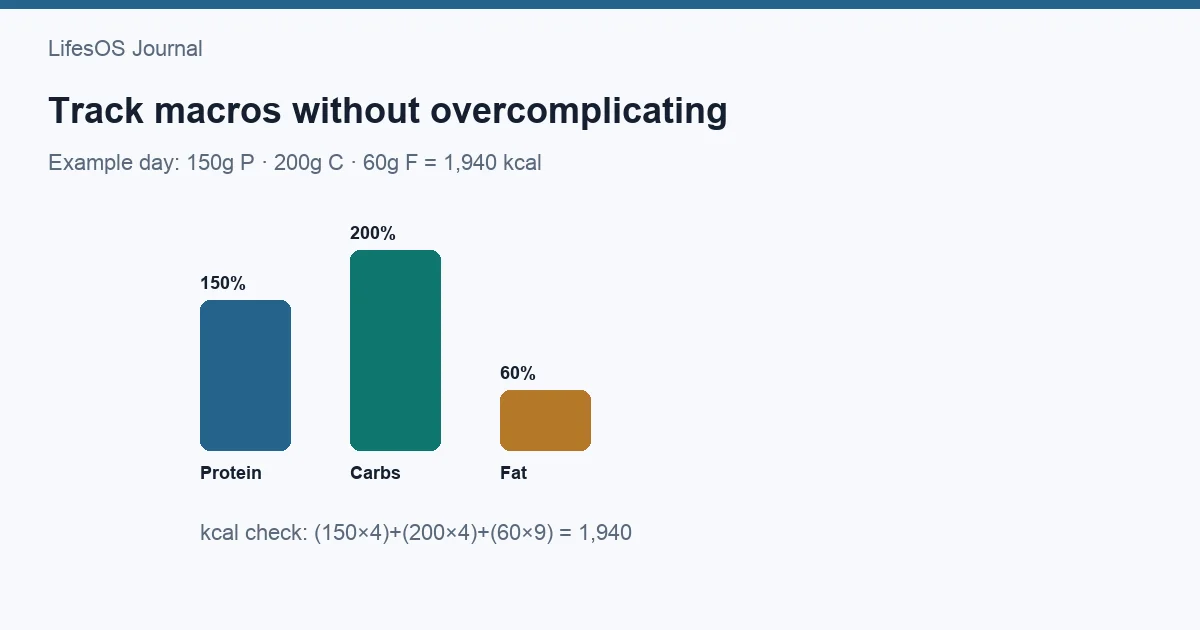
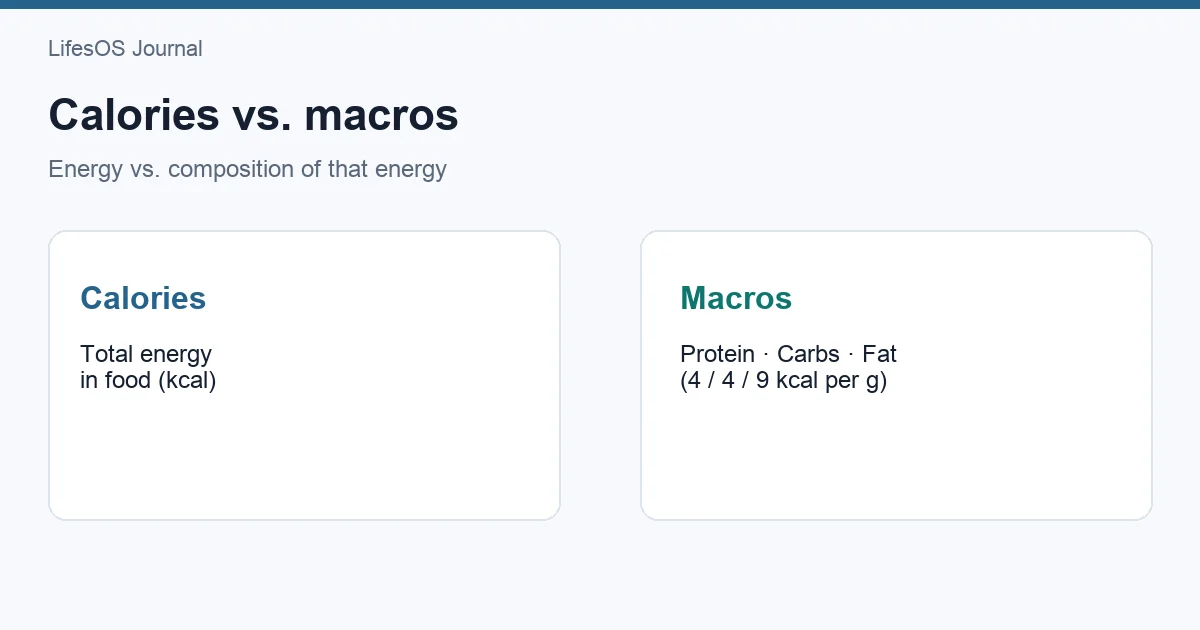
Macro tracking records protein, carbohydrate, and fat, usually alongside calories. It asks a different question from calorie counting alone: not only how much estimated energy was consumed, but how that energy was distributed among the three macronutrients.
This article compares methods. For the conceptual difference between energy and nutrient composition, read calories vs macros. If you have a reason to monitor macros, how to track macros explains portions, labels, databases, and common errors.
Macro tracking may be relevant for athletes, people working toward a professionally recommended intake, or someone checking whether meals contain enough protein. But the numbers do not fully describe fiber, micronutrients, food variety, cultural meaning, convenience, cost, or satisfaction.
What is food journaling?
Food journaling combines meal records with context. An entry may include hunger before eating, fullness afterward, mood, energy, symptoms, environment, company, or the reason a choice was convenient.
For example: “Lunch at 3:00 after back-to-back meetings; very hungry; ate quickly; satisfied but tired afterward.” That note does not quantify nutrition, but it reveals a scheduling problem that a calorie total may miss.
A journal can support observation or a conversation with a qualified professional. It cannot diagnose allergies, intolerances, digestive disease, or mental-health conditions. Avoid repeatedly removing foods based only on a few associations without appropriate clinical guidance.
Match the method to the question
| Question | Lightest useful method | What to record |
|---|---|---|
| Why do weekday dinners become last-minute? | Meal log | Meal, time, plan status, schedule constraint |
| Am I including protein regularly? | Meal log first; macro tracking if needed | Protein source at each meal, then estimated grams if relevant |
| How much energy does my current pattern roughly provide? | Calorie tracking | Foods, portions, and estimated calories for a limited period |
| Do certain situations affect eating pace or satisfaction? | Food journal | Meal, setting, hunger, pace, satisfaction |
| Am I meeting a sport-specific macro target? | Macro tracking | Portions and protein, carbohydrate, and fat estimates |
If a simple record answers the question, stop there. More detailed data is not automatically more useful.
Lighter approaches that still create insight
People often assume food tracking requires scales and daily totals. Several lower-effort options can reveal useful patterns.
Photo log
Take a photo before meals for one week. Review timing, variety, preparation, and repeated gaps. Photos do not provide reliable nutrient totals, but they reduce typing.
Meal-name log
Record only the meal and time: “12:30—chicken wrap, apple.” This can reveal skipped meals, long gaps, or dependence on convenience food.
Single-variable tracking
Track only the factor linked to your current question, such as whether breakfast included a protein source, how many home-prepared lunches occurred, or whether water was available during long work blocks.
Three-day sample
Use a short sample that includes two typical weekdays and one weekend day. A sample is not a complete picture, but it can test whether additional tracking would be worth the burden.
Planning rather than recording
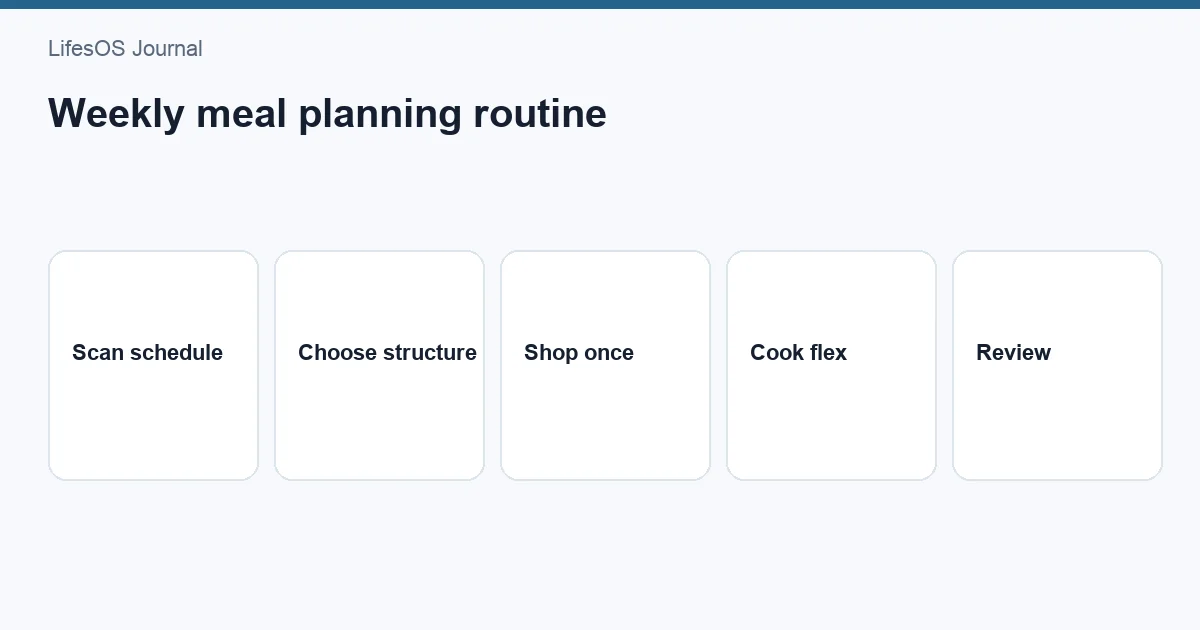
Some problems improve more through preparation than measurement. Planning three dinners and buying ingredients may be more useful than documenting another week of last-minute meals.
How accurate are calorie and macro estimates?
Accuracy depends on the question. A packaged item with a measured portion may be easier to estimate than a restaurant curry or shared casserole. Homemade recipes require ingredient amounts and the portion of the finished dish. Databases may contain several entries for the same food.
- Prefer verified label or database entries when available.
- Save repeat recipes instead of rebuilding them.
- Use the same reasonable method consistently.
- Label restaurant and photo-based values as estimates.
- Avoid interpreting small daily differences as meaningful precision.
If the uncertainty is larger than the decision you are trying to make, detailed counting may not be the right tool.
When tracking becomes unhelpful
Tracking has a cost: time, attention, and possible effects on your relationship with food. Stop or simplify if it creates anxiety, guilt, compulsive checking, avoidance of social meals, or pressure to ignore hunger and fullness. Seek professional support if those concerns are significant.
Also stop when the data no longer changes decisions. A permanent log is not required. Tracking can be a short learning experiment with a start date, question, and review date.
Run a two-week tracking experiment
- Write one question. Example: “Which workdays make lunch difficult?”
- Choose the minimum data. Record meal time, meal name, and relevant schedule constraint.
- Set an end date. Seven to fourteen days is often enough to test the method.
- Review patterns, not isolated meals. Look for recurrence across similar days.
- Choose one action. Pack lunch Tuesday, protect a break, or keep an accessible backup meal.
- Stop, continue, or simplify. Keep collecting only if new data could improve the next decision.
Use LifesOS Nutrition to record meals at the level of detail that serves your question. The purpose is not to create the largest dataset. It is to make one useful pattern visible.
Three examples
A meeting-heavy professional
The question is why evening hunger feels unpredictable. A meal-name log shows lunch occurring after 3:00 on meeting-heavy days. The first intervention is scheduling a lunch break or accessible snack—not calculating every calorie.
A recreational strength trainee
The question is whether meals regularly include protein. The person starts by marking protein sources, then uses a short period of macro tracking if the answer remains unclear. General context on needs is available in how much protein you need.
A person noticing digestive symptoms
A food-and-symptom journal may help organize observations for a clinician. It should not be used to self-diagnose or begin broad elimination diets without qualified guidance.
Common tracking mistakes
- Collecting everything without a question. Define the decision first.
- Treating estimates as exact. Labels, portions, and needs all contain uncertainty.
- Equating numbers with food quality. Calories and macros are partial descriptions.
- Ignoring context. Schedule, access, culture, budget, and satisfaction shape meals.
- Changing behavior during observation. Note that the first week may not represent your usual routine.
- Tracking indefinitely. Set a review date and remove fields that do not help.
- Using tracking as judgment. Records are evidence for decisions, not grades for eating.
FAQ
Is meal tracking the same as calorie counting?
No. Meal tracking can record foods, meal names, photos, or timing without calories. Calorie counting is a more detailed form that estimates food energy.
Do I need to count calories to eat well?
No. Many people can support balanced eating through meal planning, food variety, regular meals, hunger and fullness awareness, or professional guidance without counting calories.
Is macro tracking more accurate than calorie tracking?
It provides more categories, not guaranteed accuracy. Both depend on food entries and portion estimates. Macro totals also imply calories, but rounding and database differences can create discrepancies.
How long should I track meals?
Track long enough to answer a defined question, then review. A one- or two-week experiment may be enough for routine patterns; clinical needs should follow professional guidance.
What is the easiest method?
A meal-name or photo log is usually lighter than calorie or macro tracking. Record only what is needed for your question.
Choose the least demanding useful method
Write down one nutrition question and choose one corresponding field to track for seven days. If that evidence supports a clear action, you have enough. If not, add detail deliberately rather than assuming more numbers are always better.
Try LifesOS free for 7 days and test a meal record that fits your purpose, from a simple log to more detailed nutrition context.