Fitness & Activity
How Much Exercise Do You Really Need Each Week?
Adults should generally aim for 150–300 minutes of moderate aerobic activity or 75–150 vigorous minutes weekly, plus strength work on two days.
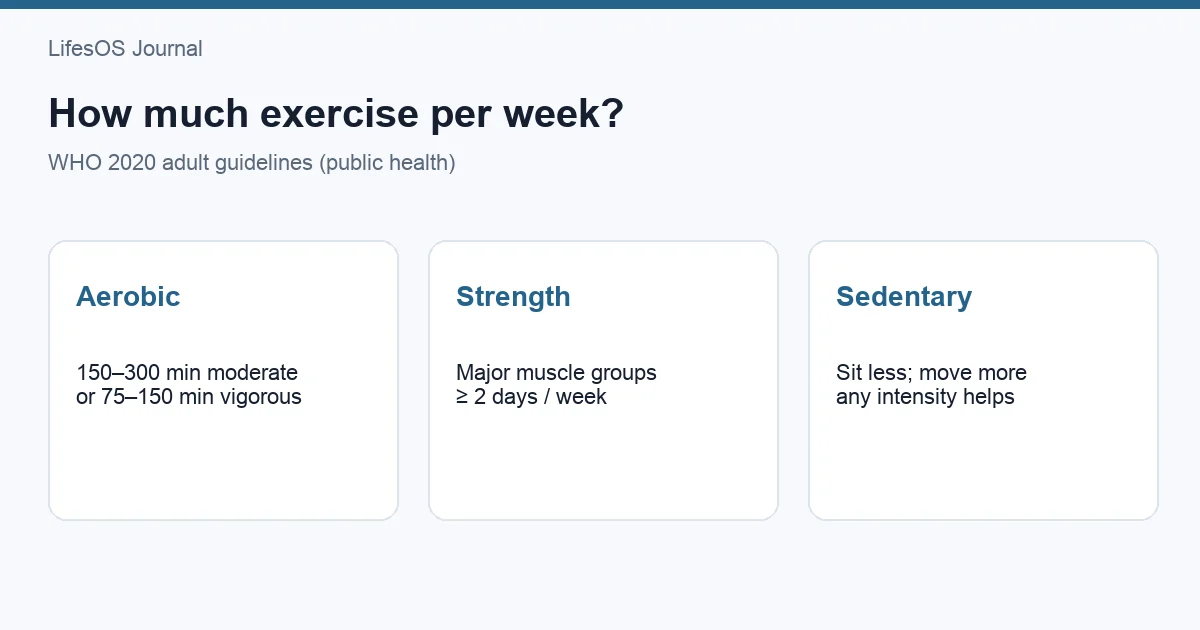
The World Health Organization recommends that adults get 150–300 minutes of moderate-intensity aerobic activity per week, or 75–150 minutes of vigorous activity, or an equivalent combination. Adults should also do muscle-strengthening activities involving major muscle groups on two or more days each week. More activity can offer additional benefits, but some movement is better than none.
That recommendation can be divided across the week in many ways. You do not need seven perfect workouts, expensive equipment, or one uninterrupted block. A brisk walk, bike commute, active game, gym session, or home strength routine can all contribute when the effort and duration fit.
This article is general education, not medical advice or a diagnosis. If you have symptoms, a medical condition, are pregnant or postpartum, are recovering from injury, or have been advised to limit activity, ask a qualified health professional how the guidelines apply to you.
The WHO 2020 adult exercise guidelines
The WHO Guidelines on Physical Activity and Sedentary Behaviour (2020) recommend the following for adults ages 18–64:
- At least 150–300 minutes of moderate-intensity aerobic activity each week; or
- At least 75–150 minutes of vigorous-intensity aerobic activity; or
- An equivalent combination of moderate and vigorous activity.
- Muscle-strengthening activity on two or more days per week, involving all major muscle groups.
- Limit sedentary time and replace it with physical activity of any intensity when possible.
The guidelines also state that adults may increase moderate activity beyond 300 minutes, or vigorous activity beyond 150 minutes, for additional health benefits, provided the amount is appropriate for the person.
What counts as moderate or vigorous exercise?
Intensity is relative to your fitness. The same hill may be moderate for one person and vigorous for another. A simple “talk test” can help:
- Moderate intensity: breathing and heart rate increase, but you can still speak in sentences. Examples may include brisk walking, recreational cycling, water aerobics, or active yard work.
- Vigorous intensity: breathing is much harder and speaking more than a few words requires a pause. Examples may include running, fast cycling, lap swimming, or high-intensity sport.
Fitness trackers and heart-rate zones can add information, but they are not required. Medication, temperature, stress, and device error can affect readings. Perceived effort and professional advice may be more appropriate in some contexts.
How moderate and vigorous minutes combine
As a practical guideline, one minute of vigorous activity is often treated as roughly equivalent to two minutes of moderate activity when combining totals. This makes mixed weeks easy to estimate.
| Weekly activity | Moderate-equivalent minutes |
|---|---|
| 150 minutes moderate | 150 |
| 75 minutes vigorous | About 150 |
| 100 minutes moderate + 25 minutes vigorous | About 150 |
| 180 minutes moderate + 30 minutes vigorous | About 240 |
This is a planning shortcut, not a physiological equation for every body or activity. Use it to understand the guideline, not to force exact equivalence between very different sessions.
Where strength training fits
The aerobic target and the strength recommendation are separate. Two weekly strength sessions do not automatically replace aerobic activity, though circuit-style training may include both elements.
A balanced strength session can include movement patterns for major muscle groups:
- Squat or sit-to-stand
- Hip hinge
- Push
- Pull
- Carry or trunk stability
- Calf and other accessory work when useful
Strength work can use machines, free weights, resistance bands, body weight, or demanding manual tasks. The activity should be challenging enough to train the muscles while using a range of motion and technique appropriate to you. Beginners benefit from gradual progression and qualified instruction when available.
Four ways to build a week
Option 1: walking-centered
| Day | Plan |
|---|---|
| Monday | 30-minute brisk walk |
| Tuesday | 30-minute full-body strength session |
| Wednesday | 30-minute brisk walk |
| Thursday | 30-minute brisk walk |
| Friday | 30-minute full-body strength session |
| Saturday | 60-minute moderate hike or bike ride |
| Sunday | Rest or easy movement |
This provides 150 moderate aerobic minutes plus two strength days.
Option 2: shorter daily sessions
Complete 25 minutes of moderate aerobic activity on six days, with two of those days also including a 20–30 minute strength routine. This suits people who prefer repetition and have limited blocks of time.
Option 3: mixed intensity
Do a 30-minute vigorous run on Tuesday, 45 minutes of moderate cycling on Thursday, and 45 minutes of moderate walking on Saturday. Add strength sessions Monday and Friday. The aerobic total is approximately 150 moderate-equivalent minutes.
Option 4: minimum-to-guideline progression
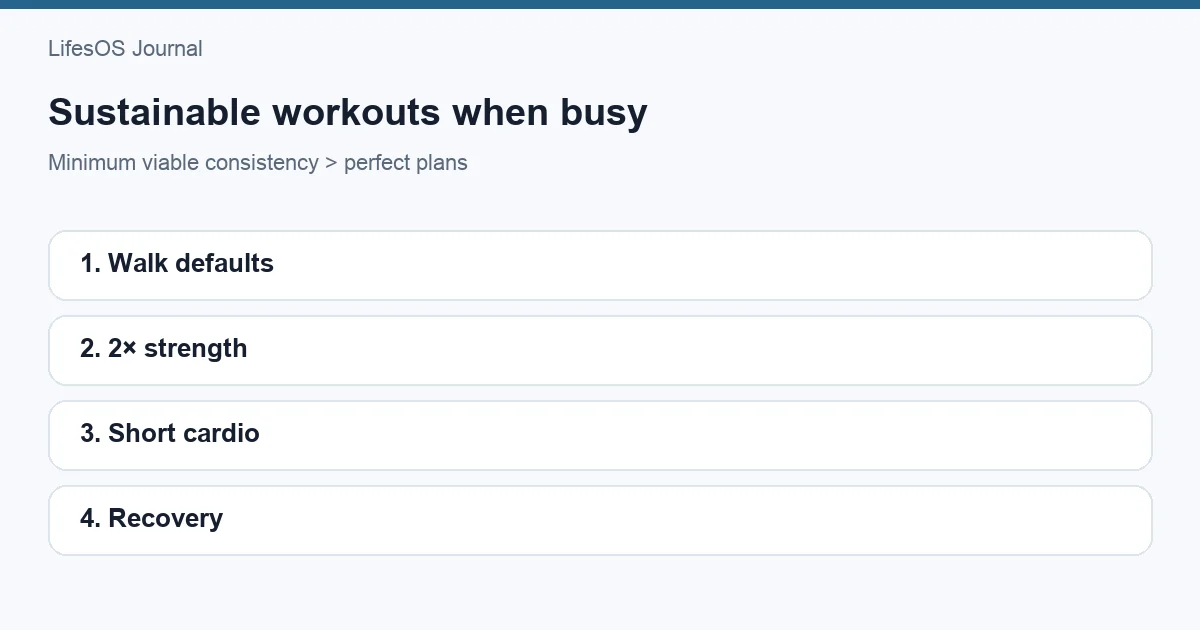
Begin with three 15-minute walks and one brief strength session. Add five minutes to one or two walks each week, then add a second strength day. Reaching the guideline gradually is more sustainable than leaping from inactivity to a demanding schedule.
Make your actual week visible: Add planned sessions to LifesOS Activity and leave space for work, sleep, and recovery. A modest plan completed is more informative than an ideal plan that never fits.
How to start if you currently do very little
The WHO emphasizes that doing some physical activity is better than none. The guideline is a destination and public-health benchmark, not a minimum ticket required before movement “counts.”
- Choose an accessible activity. Walking is common, but chair-based exercise, cycling, swimming, dancing, or another option may fit better.
- Pick a repeatable duration. Ten minutes may be enough for the first session.
- Set a weekly floor. For example, three sessions you are confident you can complete.
- Increase one variable at a time. Add duration before adding frequent hard intensity.
- Review how you recover. Consider sleep, soreness, fatigue, mood, and willingness to repeat the plan.
Sharp pain, chest pain, fainting, or unusual severe shortness of breath should not be treated as normal training discomfort. Stop and seek appropriate medical guidance.
Do short bouts count?
Yes. The 2020 WHO guidance removed the prior requirement that aerobic activity occur in bouts of at least 10 minutes. Short periods can contribute to the total. Taking stairs, walking during a break, or cycling part of a commute can add meaningful activity.
Longer sessions may still be useful for endurance, skill practice, enjoyment, or convenience. The point is that a busy day is not automatically a zero.
Exercise does not erase all sedentary time
A workout and an otherwise seated day are not mutually exclusive. The WHO recommends limiting sedentary time and replacing it with activity of any intensity. Stand, walk, stretch, or do light household tasks during natural breaks when feasible.
Do not turn this into a demand to move constantly. The useful aim is to interrupt long periods of sitting and create more movement across the day while still allowing necessary rest.
Recovery belongs in the weekly plan
Exercise creates a stimulus; recovery supports adaptation. Sleep, adequate nutrition, manageable progression, and easier days all matter. More exercise is not always better when it displaces sleep, worsens persistent pain, or makes the routine impossible to sustain.
Protein is one part of recovery and overall nutrition. Read How Much Protein Do You Need? for general adult and exercise ranges. For the relationship between food energy and macronutrients, see Calories vs. Macros.
How to progress without overhauling everything
Progress can mean more minutes, slightly higher intensity, additional resistance, improved technique, or greater consistency. Change one major variable at a time and give your body time to respond.
| Current pattern | Possible next step |
|---|---|
| Two 15-minute walks | Add a third walk |
| Three 20-minute walks | Extend one to 30 minutes |
| 150 moderate minutes | Add one short vigorous interval session if appropriate |
| One strength day | Add a second nonconsecutive day |
| Two strength days | Gradually add repetitions or resistance |
There is no obligation to make every session harder. Maintenance is a valid phase, especially during stressful work, travel, caregiving, or disrupted sleep.
Additional guidance for older adults
WHO guidance for adults 65 and older includes the same aerobic and muscle-strengthening targets, plus varied multicomponent activity emphasizing functional balance and strength on three or more days per week to enhance functional capacity and help prevent falls.
Individual ability varies widely. A clinician, physical therapist, or qualified exercise professional can help adapt movements, especially after a fall, surgery, or major change in mobility.
Common weekly exercise mistakes
Doing too much too soon
A sudden jump in duration and intensity can create excessive soreness or injury risk. Build progressively from your current baseline.
Counting only formal workouts
Active transport, recreational activity, household movement, and short bouts can contribute. Formal training is useful, but it is not the only valid movement.
Skipping strength work
Aerobic minutes receive more attention, yet the WHO separately recommends strengthening major muscle groups at least twice weekly.
Making every session hard
Vigorous activity is time-efficient but demanding. A mix of easier and harder work is often more repeatable than constant high intensity.
Using exercise as punishment for food
Exercise supports health, capacity, skill, and enjoyment. Treating movement as repayment can damage consistency and your relationship with both food and activity.
Weekly exercise checklist
- Aim toward 150–300 moderate minutes, 75–150 vigorous minutes, or a combination.
- Include strength work for major muscle groups on at least two days.
- Count short bouts and active transportation when intensity is relevant.
- Break up long sedentary periods where practical.
- Increase volume or intensity gradually.
- Protect sleep and recovery.
- Adapt the plan to health status and professional guidance.
FAQ
Is 30 minutes of exercise five days a week enough?
Five 30-minute moderate sessions total 150 minutes, meeting the lower end of the WHO aerobic guideline. Add muscle-strengthening activity on two or more days.
Can walking count as moderate exercise?
Yes, if the pace raises breathing and heart rate to a moderate level for you. A brisk walk commonly qualifies; a gentle stroll may count as light activity.
Do I need rest days?
Recovery needs depend on intensity, training type, experience, and health. You can move daily while alternating hard sessions with easier activity, but persistent fatigue or pain deserves attention.
Can household chores count?
Some chores can count when they reach moderate or vigorous intensity. Light movement still helps reduce sedentary time even when it does not reach that threshold.
What if I cannot reach 150 minutes?
Do what is feasible. Some activity is better than none, and gradual increases can provide benefits. Seek tailored advice if health or mobility limits your options.
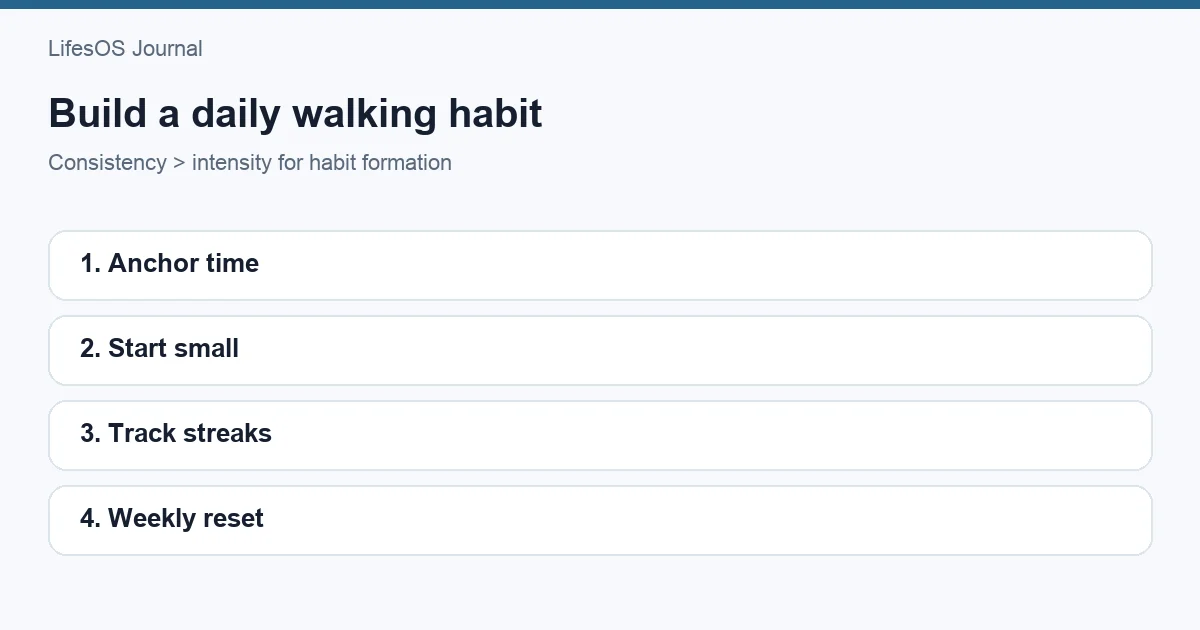
Related: Start consistency with a daily walking habit.
Sources
- World Health Organization: Guidelines on Physical Activity and Sedentary Behaviour (2020)
- U.S. Centers for Disease Control and Prevention: Physical Activity Basics
- U.S. Physical Activity Guidelines for Americans
Choose a starting week you can recover from, then build toward the guideline one repeatable session at a time. Start a 7-day LifesOS trial to plan and track activity alongside the rest of your schedule.