Fitness & Activity
How to Build a Sustainable Workout Routine When You're Busy
A sustainable busy-week routine starts with a small weekly floor, two practical strength sessions, regular walking or cardio, and room to recover and adapt.
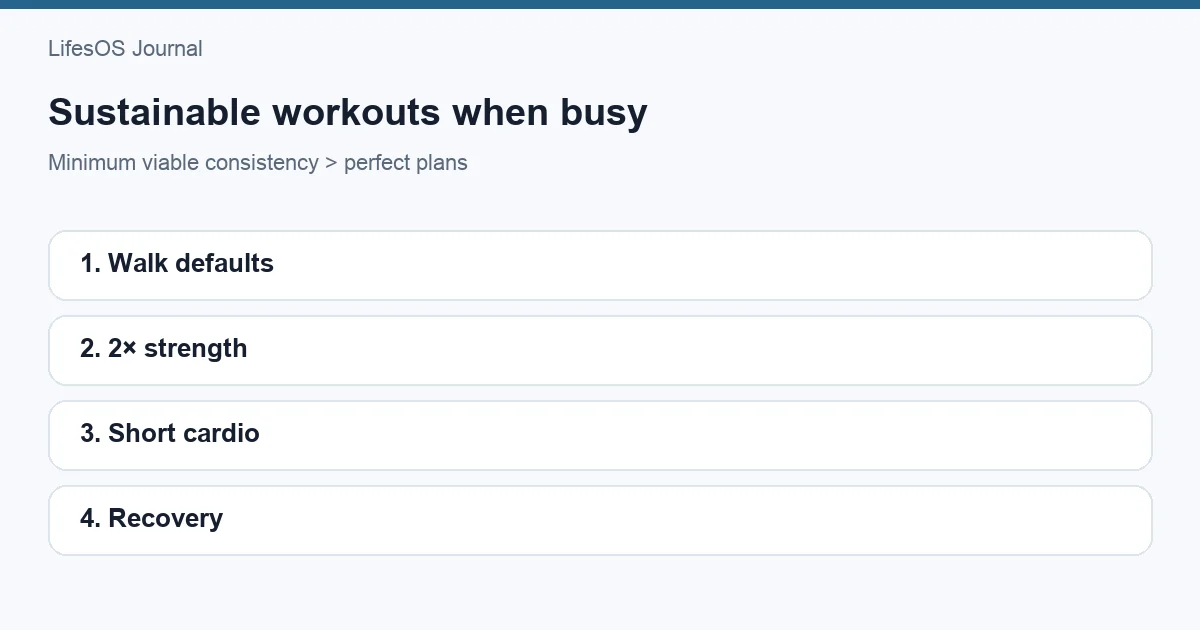
The best workout routine when you're busy is the smallest plan you can repeat, recover from, and expand when capacity allows. Start with a weekly floor—perhaps two short full-body strength sessions and several brisk walks—then schedule those sessions around real commitments. Build toward public-health guidelines gradually, but do not treat a disrupted week as failure.
A sustainable routine is not the most ambitious week you can complete once. It is a structure that survives deadlines, travel, caregiving, poor weather, and ordinary fluctuations in energy. That requires a minimum version, a normal version, and clear rules for adjustment.
This article provides general education, not medical advice, diagnosis, or an individualized exercise prescription. If you have pain, symptoms, a medical condition, are pregnant or postpartum, are returning after injury, or have been advised to limit activity, consult an appropriately qualified health professional.
Know the weekly target without turning it into a pass-fail test
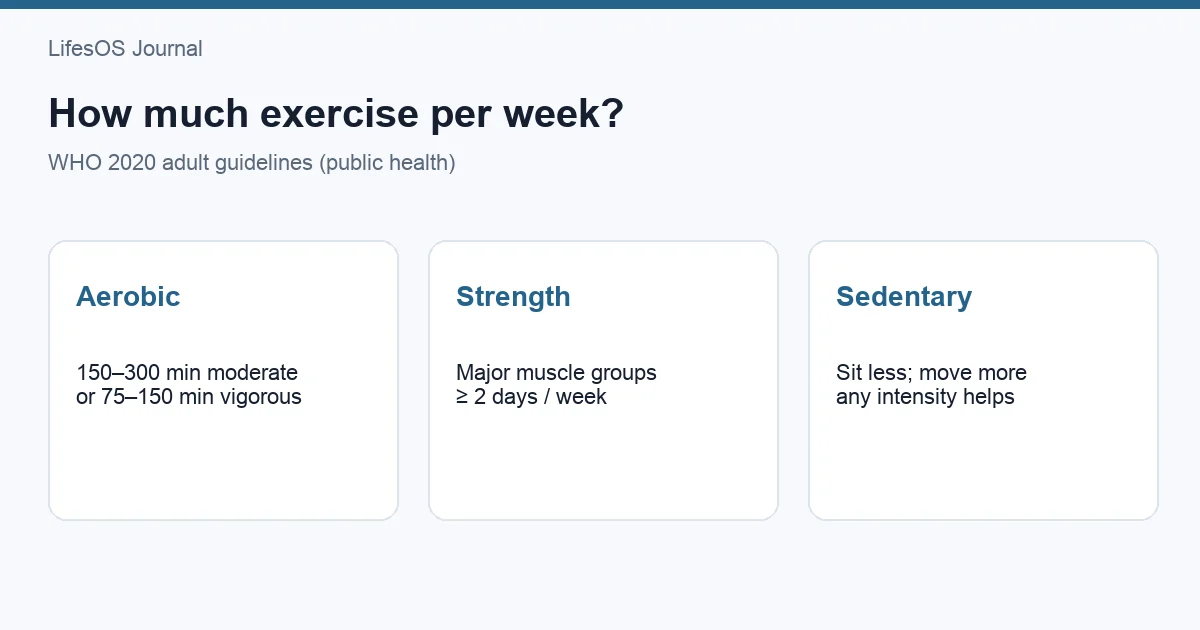
The World Health Organization's 2020 guidelines recommend that adults generally complete 150–300 minutes of moderate-intensity aerobic activity per week, or 75–150 minutes of vigorous activity, or an equivalent combination. Adults should also do muscle-strengthening activities involving major muscle groups on two or more days per week.
These are population-level targets, not a demand to begin at full volume. The WHO also emphasizes that some physical activity is better than none. If you are currently inactive, a few repeatable sessions are a valid beginning. For more detail on intensity and combining minutes, read how much exercise you need per week.
| Level | Purpose | Example week |
|---|---|---|
| Minimum | Keep the routine alive during a difficult week | Two 15-minute strength sessions plus three 10-minute walks |
| Normal | Your realistic repeatable baseline | Two 30-minute strength sessions plus 120–150 minutes of brisk walking or cardio |
| Expanded | Use extra capacity without redefining success | Add a longer walk, sport session, or third strength session |
The exact numbers should reflect your current ability and guidance. The important design choice is separating your floor from your ceiling.
Define your minimum viable workout
A minimum viable workout is a safe, useful session short enough to complete when the original plan no longer fits. It is not punishment, a frantic maximal effort, or a claim that ten minutes replaces every longer session. It preserves the cue and keeps some movement in the week.
A simple 10-to-15-minute full-body session might include a warm-up followed by a few movements you already know how to perform comfortably: a squat or sit-to-stand, a push variation, a pull with a band or machine, a hip-hinge pattern, and a carry or trunk exercise. Use a manageable effort and stop if technique deteriorates or symptoms appear.
For cardio, the minimum might be a 10-minute brisk walk, easy cycle, or other accessible activity. Moderate intensity generally means breathing faster while remaining able to speak in sentences. Vigorous effort is not required for a session to count.
Design the week from constraints, not wishes
Open your calendar before choosing sessions. Mark fixed work, commuting, caregiving, sleep, meals, and other commitments. Then identify two or three windows that are both available and reasonably reliable.
- Place strength first. Two nonconsecutive opportunities often work well because strength is easy to postpone and harder to accumulate through incidental movement.
- Add aerobic activity. Use walks, cycling, swimming, classes, sport, or equipment you can access consistently.
- Use short bouts. The WHO guidelines do not require aerobic activity to occur in blocks of at least ten minutes.
- Protect recovery. Avoid planning hard sessions into every available slot.
- Create one fallback. Name the alternate day or minimum session before disruption occurs.
Use time blocking to reserve sessions, but distinguish a movable workout block from an immovable appointment. A calendar is a plan, not proof of completion.
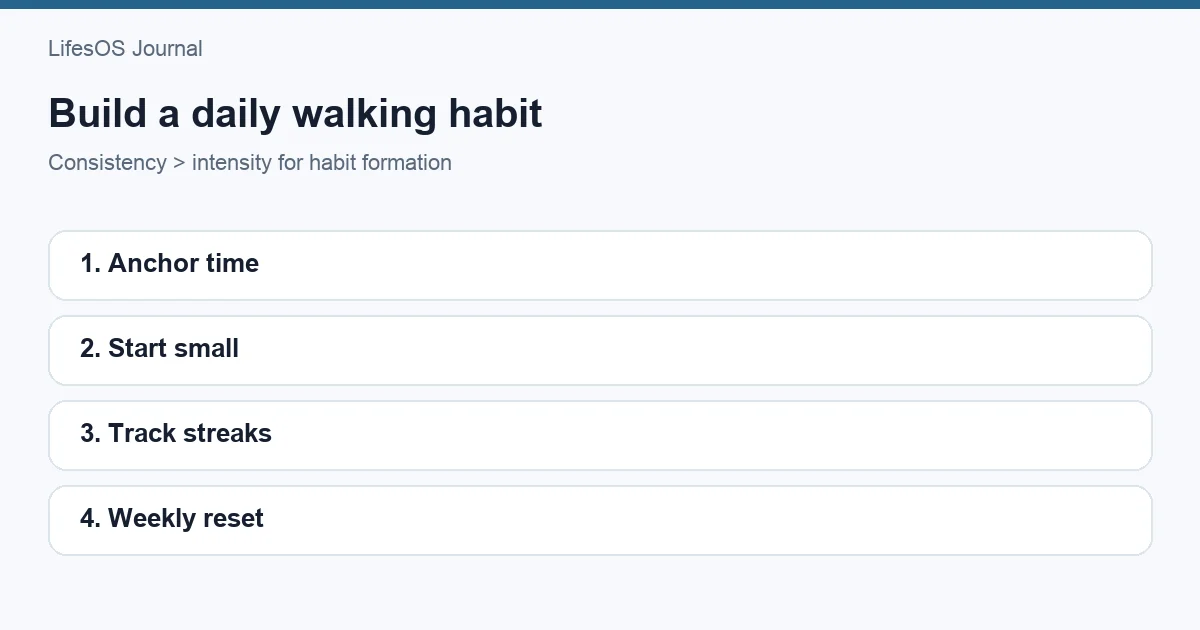
Use walking as infrastructure
Walking is accessible for many people, requires little setup, and can connect exercise with transport, breaks, errands, or social time. A busy routine can use both planned brisk walks and lighter movement that interrupts sitting.
- Walk for 10–15 minutes after one meal.
- Use part of a commute when conditions are safe.
- Hold a walking conversation instead of a seated call.
- Take a longer weekend walk at a comfortable pace.
- Keep shoes or weather gear where the cue occurs.
Not everyone can or should use walking as the main option. Cycling, swimming, chair-based movement, or other adapted activities may fit better. Accessibility matters more than following a generic example.
Make strength training efficient
Two full-body sessions can cover major movement patterns without splitting the body across many gym days. A practical session often includes a knee-dominant movement, hip-dominant movement, push, pull, and trunk or carry exercise.
| Constraint | Practical response |
|---|---|
| Only 20 minutes | Use four familiar movements and limit setup |
| Gym commute is unreliable | Keep a home alternative using body weight or bands |
| Equipment is busy | Prepare equivalent machine, dumbbell, or body-weight options |
| Energy is lower than expected | Reduce sets, resistance, or complexity while keeping technique sound |
| Missed one session | Use the fallback window; do not double the next workout automatically |
Progress gradually by adding a small amount of resistance, repetitions, sets, or technical control. More is not automatically better. If you are new to strength work, qualified instruction can help you choose appropriate movements and technique.
Choose cardio that fits your life
Cardio does not need to mean running or high-intensity intervals. Brisk walking, cycling, dancing, swimming, hiking, rowing, active recreation, and some forms of sport can contribute.
Moderate activity is often easier to recover from and combine with busy weeks. Vigorous activity can be time-efficient, but it also creates greater demands and may be inappropriate for some people without progression or medical guidance. Do not make every session hard simply because time is limited.
Three ways to accumulate aerobic minutes
- Three anchors: three 30-to-50-minute sessions.
- Daily pieces: 15–25 minutes on most days.
- Mixed: short weekday walks plus one longer weekend activity.
The best format is the one that repeatedly reaches the calendar and leaves you able to continue.
A sample busy-week routine
| Day | Normal plan | Fallback |
|---|---|---|
| Monday | 20-minute brisk walk | Two 5-minute walks |
| Tuesday | 30-minute full-body strength | 12-minute home session |
| Wednesday | 20-minute brisk walk | Easy movement break |
| Thursday | 30-minute cycling or other moderate cardio | 15-minute walk |
| Friday | 30-minute full-body strength | Move to Saturday morning |
| Saturday | 45–60-minute walk, hike, sport, or cycle | 20-minute accessible activity |
| Sunday | Rest or easy movement | Rest |
This is an example, not a prescription. Adjust intensity, duration, movements, and rest to your baseline. Track the sessions you actually complete in LifesOS Activity, then use that evidence to revise next week.
Build consistency with fewer decisions
Consistency usually improves when the environment and rules are clear.
- Use stable cues: after work on Tuesday, before breakfast Saturday, or after school drop-off.
- Prepare equipment: place clothes, shoes, bands, or a water bottle where you begin.
- Keep the first action tiny: change clothes, start the warm-up, or walk to the corner.
- Record completion simply: duration, activity, and perhaps perceived effort are often enough.
- Use if-then rules: “If Thursday runs late, I will do the minimum walk Friday at lunch.”
- Avoid streak perfection: measure return speed after disruption, not only consecutive days.
A plan that needs ideal motivation is not yet sustainable. Reduce startup friction until ordinary follow-through is plausible.
Recovery is part of the routine
Training competes with the same capacity used by work, caregiving, and sleep. Persistent fatigue, declining performance, irritability, disrupted sleep, or pain can signal that the plan needs adjustment or professional review.
Protect adequate food, hydration, and sleep. Protein supports many body functions and can matter for exercise recovery, but needs vary; see how much protein you need for educational ranges and limitations.
Easy days and rest are not missed opportunities. They help make the next session repeatable. During intense work periods, maintaining a smaller routine may be a better decision than adding volume.
Review the routine every two to four weeks
Do not judge only by motivation or appearance. Review evidence that can improve the plan:
| Question | Possible adjustment |
|---|---|
| Which sessions were repeatedly missed? | Change their time, location, or minimum version |
| Which sessions felt easiest to start? | Reuse their cue and environment |
| Did the plan disrupt sleep or recovery? | Reduce volume or move demanding sessions |
| Was the minimum used every week? | Your normal plan may be too large |
| Was there comfortable spare capacity? | Add a small amount to one session |
Change one major variable at a time. That makes it easier to understand what improved sustainability.
Common mistakes when time is limited
- Starting with the ideal week. Begin near your current capacity.
- Making every session intense. Time efficiency does not remove recovery needs.
- Ignoring transition time. Include travel, changing, setup, and showering.
- Doubling after a missed session. Return to the schedule unless a qualified plan says otherwise.
- Using exercise as punishment. Movement is not repayment for food or a moral test.
- Changing the plan every week. Repeat long enough to learn where friction occurs.
- Training through warning symptoms. Stop and seek appropriate medical guidance for chest pain, fainting, unusual severe shortness of breath, or concerning pain.
FAQ
What is the minimum workout worth doing?
Any safe amount that is appropriate for you can be useful. A 10-to-15-minute walk or brief familiar strength routine can preserve the habit, but it does not need to be intense or replace every longer session.
Can short workouts help me meet weekly guidelines?
Yes. Aerobic activity can accumulate in short bouts. Add the minutes across the week and include muscle-strengthening activity on at least two days as you work toward WHO recommendations.
Should I exercise every day?
Not necessarily. Daily light movement may suit many people, while demanding sessions require recovery. Frequency should reflect intensity, experience, health, and your ability to recover.
What if I miss an entire week?
Restart below or at your previous normal level rather than trying to compensate. Identify the disruption, choose the next available cue, and use the minimum version if capacity remains limited.
Is walking enough?
Brisk walking can contribute substantially to aerobic targets. The WHO also recommends muscle-strengthening activities on two or more days, so add appropriate strength work when feasible.
Start with next week, not forever
Choose two realistic strength windows, three opportunities for walking or another aerobic activity, and one fallback rule. Put them beside your actual commitments, not on an imaginary empty calendar. After two weeks, adjust using completion and recovery—not guilt.
Start a 7-day LifesOS trial to plan activity alongside the schedule it must fit. A routine becomes sustainable when it works with your life often enough to continue.