
Personal Growth
How to Set Goals You’ll Actually Stick To
Goals become more durable when you define a meaningful outcome, build a repeatable system, set milestones, and review progress each week.
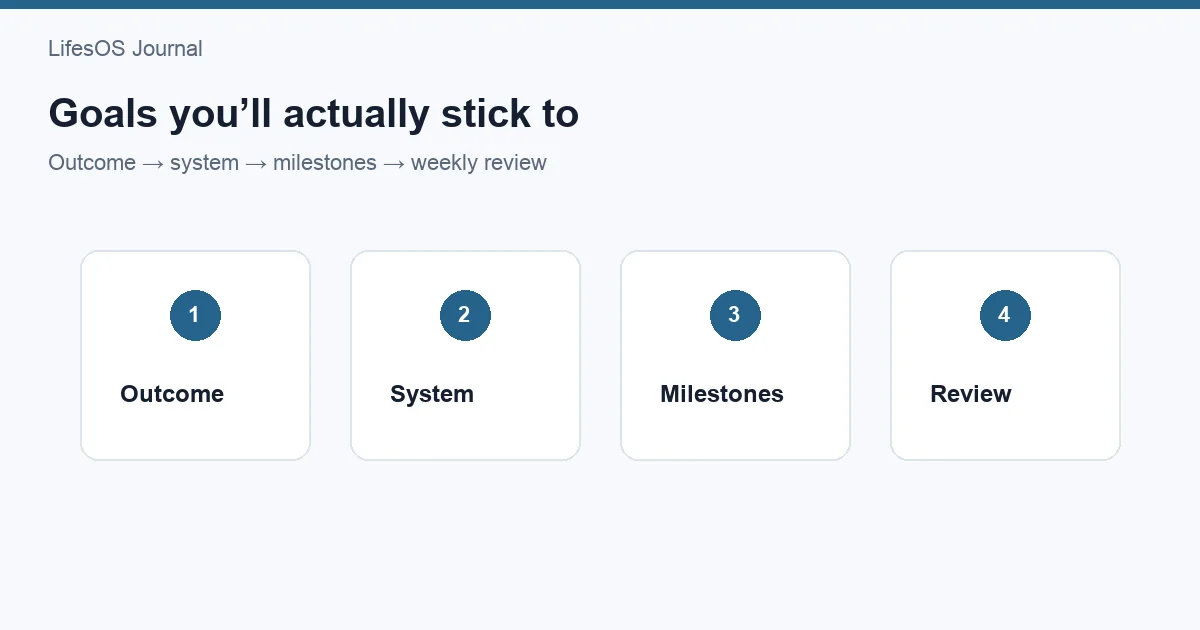
To set goals you will actually stick to, define a clear outcome, identify the repeatable actions that influence it, and review those actions every week. A goal gives you direction; a system gives you something to do on an ordinary Tuesday. The strongest plans include milestones, realistic capacity, and a fallback version for difficult weeks.
Most abandoned goals are not evidence of weak motivation. They are often too vague, too detached from daily life, or built around an ideal schedule that never existed. Better goal setting turns an aspiration into a series of choices you can repeat and revise.
Start with the difference between an outcome and a system
An outcome describes a result: save $3,000, run a 10K, complete a certificate, or publish a portfolio. A system describes the recurring process: transfer money on payday, train three times per week, study four evenings, or write for 45 minutes each morning.
| Goal area | Outcome | System |
|---|---|---|
| Money | Build a $3,000 emergency fund | Automatic $250 transfer each payday |
| Fitness | Complete a 10K in October | Three progressive runs each week |
| Career | Earn a certification by June | Study Tuesday, Thursday, and Saturday |
| Creative work | Publish 12 essays this year | Draft twice weekly and edit on Fridays |
You need both. An outcome without a system becomes wishful thinking. A system without an outcome can become busywork. The outcome helps you choose a direction, while the system keeps progress alive when enthusiasm changes.
Choose a goal that earns space in your life
Before improving the wording, ask why this goal deserves time, money, and attention. Some goals are inherited from social pressure, an old identity, or a brief burst of comparison. A goal is more likely to last when it connects to a value or a problem you genuinely want to solve.
Use these questions:
- What would become meaningfully better if I achieved this?
- What will this require me to say no to?
- Would I still want it if nobody else saw the result?
- Is now the right season, given my responsibilities?
- What evidence would show that the goal is complete?
Limit active goals. Three major life changes at once can quietly create 15 new weekly commitments. One primary goal and one maintenance goal are often enough for a demanding season.
Use SMART as a clarity check, not a personality test
The familiar SMART framework asks whether a goal is specific, measurable, achievable, relevant, and time-bound. It is useful for removing ambiguity, but a perfectly written sentence does not create follow-through.
“Get healthier” is difficult to act on. “Walk briskly for 30 minutes on Monday, Wednesday, and Saturday for the next eight weeks” is easier to schedule and review. Still, the second statement needs a route, a start time, weather alternatives, and enough room in the week.
Use SMART lightly: clarify the target, then spend more effort designing the system around it.
Break the outcome into evidence-based milestones
A distant deadline provides little feedback. Milestones create intermediate proof that your approach is working. They should represent meaningful states, not arbitrary percentages.
For a goal to launch a portfolio site in 12 weeks, milestones might be:
- Week 2: choose the audience, scope, and three projects.
- Week 4: complete first drafts of all case studies.
- Week 7: build the site structure and core pages.
- Week 9: collect feedback from three relevant people.
- Week 11: revise, proofread, and test on mobile.
- Week 12: publish and share with selected contacts.
Each milestone should have a clear definition of done. “Work on site” is not a milestone. “Three case-study drafts ready for review” is.
Translate milestones into weekly habits
Ask, “What action, repeated at a realistic frequency, makes the next milestone more likely?” The answer becomes your system. Put it into actual weekly capacity using the method in How to Plan Your Week.
A useful habit has five parts:
- Action: the behavior you will perform.
- Trigger: the event or time that starts it.
- Location: where it happens.
- Minimum: the smallest version that keeps continuity.
- Finish line: how you know the session is complete.
For example: “After breakfast on Tuesday and Thursday, I will study at my desk for 45 minutes. On overloaded weeks, I will review notes for 10 minutes. I stop after completing the assigned lesson and five practice questions.”
Design a minimum version before you need it
Consistency does not mean identical output every week. Illness, deadlines, travel, and caregiving change available capacity. A minimum version preserves the relationship with the goal without pretending circumstances are normal.
| Standard version | Minimum version |
|---|---|
| 45-minute strength session | 10 minutes of planned movements |
| Write 1,000 words | Open the draft and write 150 words |
| Cook four dinners | Prepare one protein and chopped vegetables |
| Study three chapters | Review flashcards for 15 minutes |
The minimum is not a loophole for avoiding effort. It is a deliberate continuity tool. If you use it for several weeks, revise the standard plan rather than relying on constant rescue mode.
Put the system somewhere visible: Add the next milestone and its recurring actions to LifesOS Journey, then schedule only the next week. You can adjust after seeing what your real capacity supports.
Make the desired action easier to start
Motivation fluctuates, so reduce friction around the behavior. Place walking shoes near the door, automate the savings transfer, leave the document open with a next-action note, or prepare study materials before the scheduled session.
Also increase friction around the most common distraction. Put the phone in another room, sign out of entertainment apps, or block a recurring meeting-free period. Environment design is not dramatic, but it changes how much willpower each repetition requires.
Track leading actions, not only lagging results
Lagging measures show outcomes: account balance, body weight, test score, race time, or published work. Leading measures show behaviors that influence those outcomes: transfers completed, training sessions, practice questions, or writing blocks.
Outcomes can move slowly or noisily. If you only watch the scale, balance, or score, you may abandon a useful system before it has time to work. Track a small number of leading actions alongside the result.
A simple weekly scorecard might include:
- Planned sessions: 3
- Completed standard sessions: 2
- Completed minimum sessions: 1
- Current milestone status: on track
- One adjustment for next week: move Thursday session to morning
Use a weekly review to keep the goal alive
A weekly review closes the gap between intention and reality. It should take 10–20 minutes, not become a trial about your discipline. A Sunday reset is one possible time, but any repeatable slot works.
- Review the outcome and current milestone.
- Count completed actions without rewriting history.
- Name the main source of friction.
- Decide whether to keep, shrink, move, or replace the system.
- Schedule the next week’s actions.
The review is where flexibility belongs. Do not renegotiate the entire goal every morning based on mood. Test a reasonable system for long enough to gather evidence, then adjust it at a planned checkpoint.
Example: turning “write a book” into a workable goal
Suppose the desired outcome is a complete 50,000-word first draft in six months. The first milestone is a chapter outline and 5,000 words by the end of month one. The weekly system is three 60-minute writing blocks, with a minimum version of 15 minutes and a next-action note after every session.
The writer tracks sessions completed and approximate words drafted. At the weekly review, they notice Friday evenings fail repeatedly. Rather than labeling themselves inconsistent, they move that block to Saturday morning. After four weeks, the evidence shows an average of 2,200 words per week, enough to revise the timeline or add one modest session.
This approach treats the plan as a working model. It preserves ambition while letting actual data shape expectations.
Common goal-setting mistakes
Starting too many goals
Every goal consumes calendar space and recovery capacity. Keep an “ideas for later” list so postponing a goal does not feel like losing it.
Depending on motivation
Excitement helps you begin, but triggers, scheduled time, and reduced friction help you continue. Design for average days.
Choosing an all-or-nothing measure
A missed session should not erase a week. Track partial progress honestly and return at the next planned opportunity.
Making milestones too large
If feedback arrives only after three months, you cannot learn quickly. Create milestones that produce useful evidence every two to four weeks.
Never retiring a goal
Changing priorities is not automatically quitting. If a goal no longer fits your values or circumstances, close it deliberately and record why.
Give goals a home in your personal system
Goals compete with finances, schedules, health routines, and responsibilities. A personal operating system helps connect these domains. A travel goal affects savings; a race goal affects weekly scheduling and recovery; a career goal may require a temporary budget or reduced social commitments.
Looking across those constraints makes a goal more realistic. It also helps you notice trade-offs before they become surprises.
Goal-setting checklist
- Write one clear outcome and why it matters.
- Check that the goal fits the current season.
- Define completion and a reasonable date.
- Create meaningful intermediate milestones.
- Choose one to three recurring actions.
- Put those actions into the calendar.
- Define a minimum version for hard weeks.
- Track leading actions and the outcome.
- Review and adjust once per week.
FAQ
How many goals should I work on at once?
There is no universal number, but one primary change plus one maintenance goal is often more sustainable than several demanding goals. Count the weekly actions, not just the goal titles.
What if I miss a week?
Resume with the smallest useful action and review what caused the miss. Do not compensate with an extreme catch-up plan that creates another failure.
Should goals always have deadlines?
Projects benefit from dates. Ongoing values such as being an attentive parent or maintaining health may work better as standards and recurring practices, with periodic reviews.
How do I know when to change the system?
Change it when repeated evidence shows a mismatch in timing, difficulty, frequency, or resources. One bad day is not enough; a recurring pattern is.
Is it okay to abandon a goal?
Yes. A deliberate decision based on changed values, constraints, or information is different from forgetting the goal. Record the reason and redirect the freed capacity.
Sources and further reading
- Locke and Latham: New directions in goal-setting theory
- Lally and colleagues: How habits form in the real world
- National Cancer Institute: Implementation intentions
Choose one outcome, build one workable weekly system, and let review—not guilt—guide the adjustments. Start a 7-day LifesOS trial to connect your goals, milestones, and weekly actions in one place.